MediaCrawler: Deep Dive into an Open-Source Crawler Framework Covering Seven Major Platforms

An in-depth look at MediaCrawler, an open-source Playwright-based crawler framework covering seven major Chinese platforms.
MediaCrawler is a Python-based open-source crawler framework with 57K+ GitHub Stars that uses Playwright browser automation to collect data from seven major Chinese platforms including Xiaohongshu, Douyin, Bilibili, and Zhihu. By simulating real browser behavior instead of reverse engineering APIs, it avoids the complexity of cracking encrypted signatures while maintaining stability against platform updates. The article explores its technical architecture, use cases in research and AI training, compliance considerations, and performance trade-offs.
Project Overview: A Crawler Framework Covering Seven Major Platforms
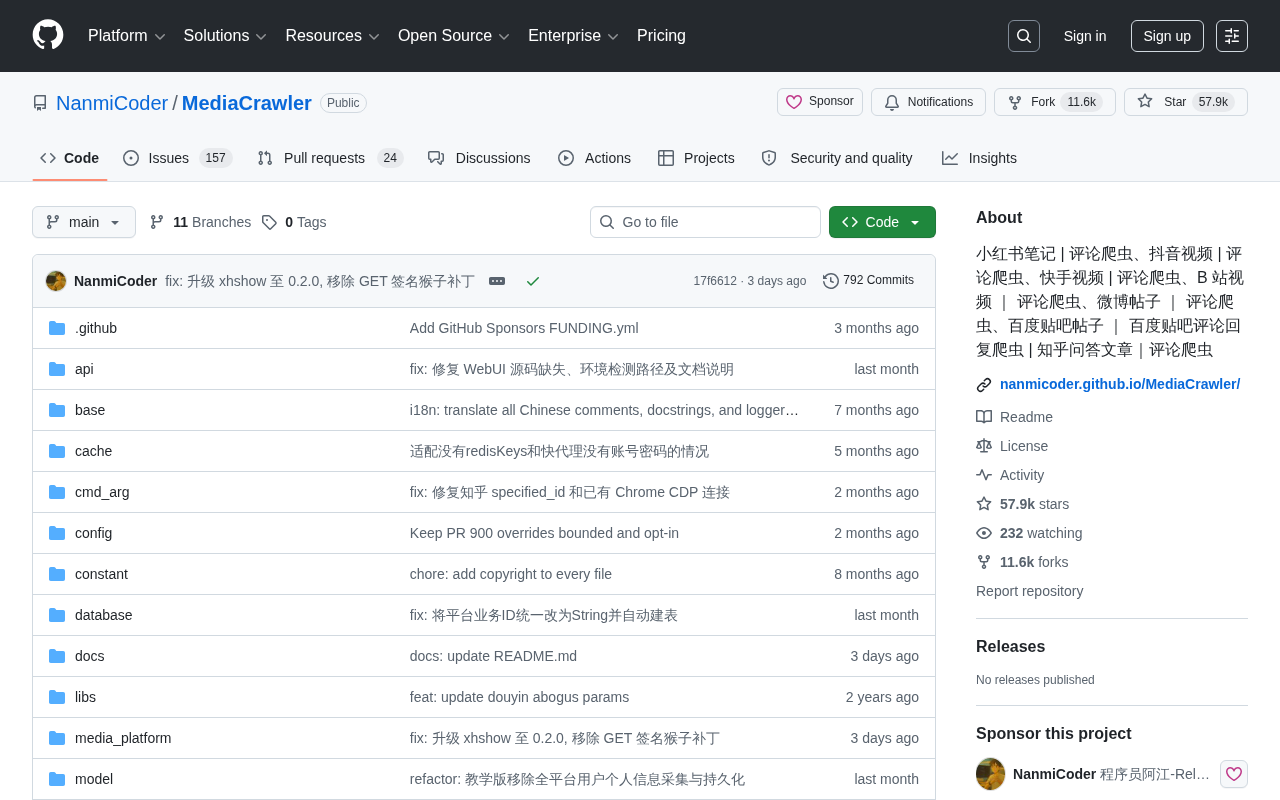
In the era of data-driven decision making, social media content has become a vital source for sentiment analysis, market research, and content creation. The GitHub open-source project NanmiCoder/MediaCrawler was built precisely to address this need. Written in Python, the project has accumulated over 57,000 Stars, making it one of the most popular open-source crawler projects in China.
MediaCrawler's core positioning is crystal clear: it integrates data collection capabilities across major Chinese content platforms, covering Xiaohongshu (RED), Douyin (TikTok China), Kuaishou, Bilibili, Weibo, Baidu Tieba, and Zhihu — seven platforms in total. It can scrape notes, videos, posts, Q&A articles, and their corresponding comments and replies. This "all-in-one" multi-platform coverage sets it apart from similar open-source crawler tools.
Technical Highlights: A Browser Automation-Based Collection Approach
No Need for JavaScript Reverse Engineering
MediaCrawler's most commendable technical choice is that it doesn't rely on traditional API reverse engineering. Instead, it leverages Playwright browser automation technology to drive a real browser environment for login and data retrieval.
Playwright is a browser automation framework developed and open-sourced by Microsoft, supporting three major browser engines: Chromium, Firefox, and WebKit. Its core team originated from Google's Puppeteer project, building upon it with a more modern API design, faster execution speed, and more reliable waiting mechanisms. Compared to traditional Selenium, Playwright natively supports automatic element wait, network request interception, mobile device emulation, and headless mode — running without displaying a browser window, executing operations purely in the background. In the crawler domain, Playwright's greatest value lies in its ability to fully render JavaScript dynamic content. Even when target websites heavily use frontend frameworks like React or Vue to dynamically load data, it can still capture the final rendered page content.
The biggest advantage of this approach is that developers don't need to spend enormous effort cracking each platform's constantly changing encryption parameters and signature algorithms.
For platforms like Xiaohongshu and Douyin, which have extremely strict anti-crawling mechanisms, parameter encryption (such as x-s, a_bogus signatures) is often the biggest obstacle facing developers. API reverse engineering refers to analyzing a platform's HTTP/HTTPS API requests through packet capture, then simulating these requests with code to directly obtain data. However, to combat crawlers, mainstream Chinese platforms commonly introduce complex encrypted signature parameters into their requests — for example, Xiaohongshu's x-s and x-t signature parameters are generated through multiple layers of JavaScript obfuscated code, while Douyin's a_bogus parameter involves encrypted calculations of device fingerprints and timestamps. These signature algorithms are typically processed with code obfuscation, control flow flattening, and other protection techniques, making reverse analysis extremely time-consuming. More critically, platforms periodically update these encryption logics, meaning reverse engineering results often have a limited shelf life.
By simulating real user operations in the browser, MediaCrawler cleverly sidesteps this challenge and maintains good stability even after platform risk control strategy updates.
Login State Reuse and Cookie Management
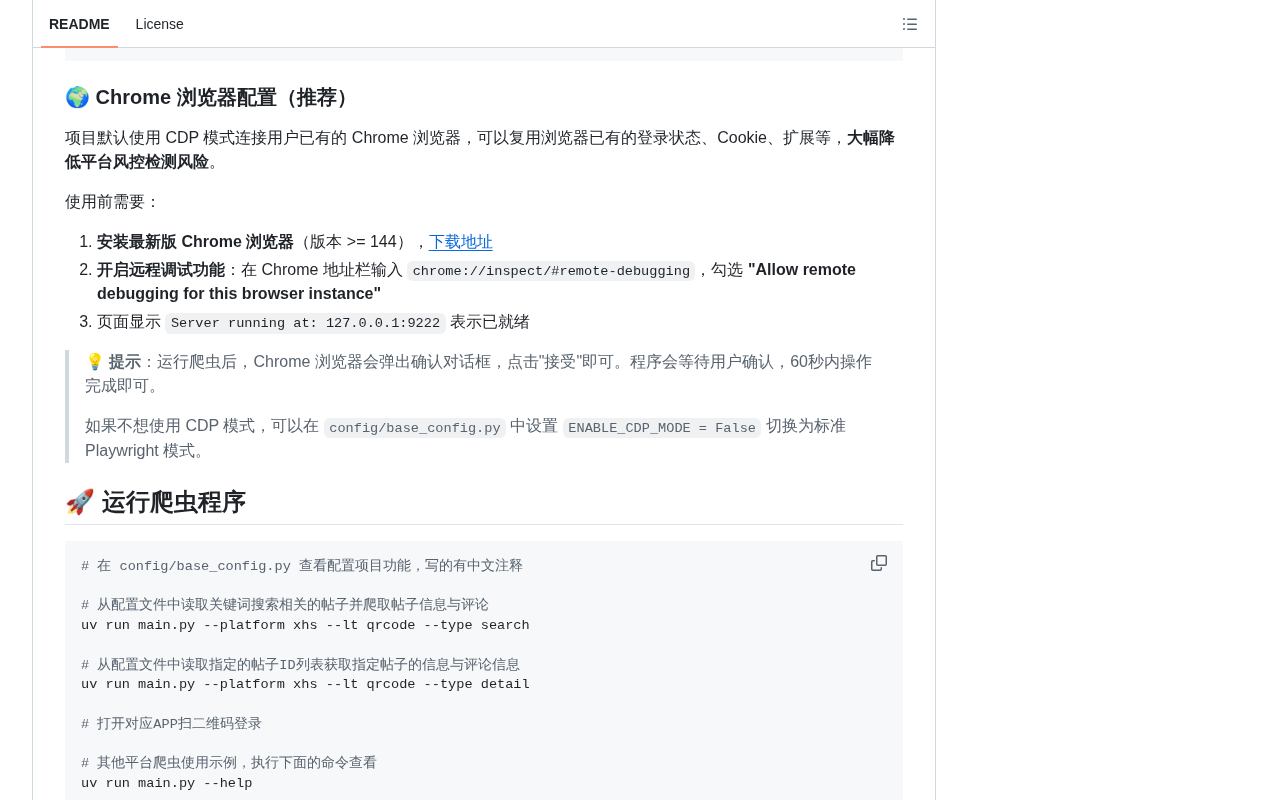
The project supports maintaining login state through multiple methods including QR code scanning login and Cookie import, allowing collection tasks to reuse authenticated session information.
Cookies are the core mechanism for web applications to maintain user session state. When a user logs into a platform through a browser, the server returns a set of Cookies containing session identifiers (Session IDs) or authentication tokens. The browser automatically carries these Cookies in subsequent requests to prove the user's identity. The principle behind login state reuse in MediaCrawler is extracting these Cookies and persisting them in storage, then injecting them into subsequent collection requests to skip repeated login processes. Specifically, the QR code login implementation uses Playwright to open the platform's login page, waits for the user to complete QR code verification, then automatically extracts and saves Cookies from the browser context. This approach is more secure than username/password login and avoids the additional complexity of CAPTCHA recognition. It's worth noting that Cookies typically have expiration time limits, so long-running collection tasks need mechanisms for automatic renewal or re-login.
This design both improves data scraping success rates and makes batch collection more feasible.
Use Cases: Who's Using MediaCrawler
Academic Research and Sentiment Monitoring
For researchers in social sciences and communication studies, comment data from social platforms is an invaluable sample for analyzing public sentiment and tracking topic propagation paths. MediaCrawler can batch-collect comments and replies under specified keywords or content, providing a data foundation for quantitative research.
Content Creation and Competitive Analysis
For content creators and operations teams, understanding competitors' viral content characteristics and comment section feedback on Xiaohongshu and Douyin is an important reference for optimizing their own content strategies. By collecting and analyzing this data, they can more precisely grasp user preferences and trending topics.
Data Science and Model Training
With the proliferation of large language models, demand for high-quality Chinese corpora has surged. Since ChatGPT ignited the LLM boom in 2022, the scarcity of high-quality training corpora has become a key bottleneck constraining Chinese LLM development. Compared to English corpora, publicly available high-quality Chinese text data is relatively scarce — Chinese content in public datasets like Common Crawl accounts for a low proportion and varies significantly in quality. User-generated content (UGC) on social media, with its conversational tone, diversity, and strong timeliness, has become an important source for supplementing Chinese training corpora. Particularly in vertical domains (such as beauty, electronics, food, etc.), professional discussions on Xiaohongshu and Zhihu often contain rich domain knowledge and authentic user expression patterns.
Multi-platform authentic user content and comments can serve as one source for domain-specific datasets, providing material for model fine-tuning and training. However, using this data for model training is also controversial: companies like OpenAI and Meta have faced multiple copyright lawsuits for using internet content without authorization to train models, and China's legal and regulatory framework is also increasingly tightening requirements on the legality of training data sources.
Usage Guidelines: Compliance and Ethical Boundaries
It must be particularly emphasized that any crawler tool must be used on the premise of legality and compliance. The "for learning and communication purposes only" statement in MediaCrawler's project documentation is not a mere disclaimer — it's a baseline that users must take seriously.
Key Considerations for Data Collection
- Comply with platform robots protocols and terms of service: robots.txt is a gentleman's agreement between websites and crawlers, placed by website administrators in the domain root directory to declare which paths allow or prohibit crawler access. Although the robots protocol is not technically enforceable, in multiple judicial precedents, crawler behavior violating robots protocols has been considered by courts as an important factor in infringement cases. Circumventing technical restrictions to scrape data in bulk may violate platform terms of service.
- Protect personal privacy: Collected comments and user information involve personal data, and processing and storage must comply with the Personal Information Protection Law and other relevant laws and regulations. Under China's legal system, the Personal Information Protection Law (PIPL), effective since 2021, imposes strict regulations on the collection, storage, and use of personal information. Collecting and processing personal data without the subject's consent may face serious legal consequences.
- Control collection frequency: High-frequency requests place pressure on target servers and easily trigger risk control bans. Reasonable collection intervals should be set.
- Exercise caution with commercial use: When using collected data for commercial monetization, legal risks increase significantly. Compliance must be assessed beforehand. Legal risks primarily include unfair competition liability under the Anti-Unfair Competition Law, as well as criminal liability under Article 285 of the Criminal Law regarding illegally obtaining computer information system data. Additionally, the Interim Measures for the Management of Generative AI Services issued by the Cyberspace Administration of China in 2023 also explicitly requires legitimate sources for training data.
MediaCrawler's Open-Source Value and Limitations
What Deserves Recognition
MediaCrawler's nearly 60,000 Stars clearly demonstrate that it meets the practical needs of a large number of developers. Its modular design keeps collection logic for different platforms relatively decoupled, allowing users to selectively use what they need. An active open-source community also means that when a platform's risk control strategy is updated, the project can often be fixed and adapted relatively quickly.
Objective Limitations
On the other hand, while the browser automation approach offers good stability, its collection efficiency is relatively lower compared to direct API calls, and CPU and memory resource consumption is higher, making it less suitable for ultra-large-scale distributed collection scenarios.
The fundamental reason for this efficiency gap lies in the vast difference in resource overhead. Launching a Chromium browser instance typically requires 150-300MB of memory, while a simple HTTP request client might only need a few MB. The browser needs to fully load and render the page (including CSS, JavaScript, images, and other resources), whereas API calls only transmit necessary JSON data. In terms of collection speed, a single browser page load may take 2-5 seconds, while an API request typically completes within 100-500 milliseconds. In distributed collection scenarios, if hundreds of collection tasks need to run simultaneously, the browser approach's CPU and memory demands on servers multiply. However, the browser approach also has unique advantages: it naturally supports JavaScript rendering, automatically handles redirects and dynamic loading, and its request characteristics are highly consistent with real users, resulting in a lower probability of detection by risk control systems.
Additionally, as each platform's anti-crawling strategies continuously evolve, no crawler tool can guarantee long-term availability. Users need to be prepared for ongoing maintenance and adaptation.
Conclusion
MediaCrawler is a mature and popular open-source solution in the Chinese multi-platform content collection space. Its technical approach of replacing API reverse engineering with browser automation effectively lowers the barrier to social media data acquisition and gives it a unique position among similar Python crawler projects.
However, the neutrality of technology itself does not equate to unconstrained usage. While enjoying the convenience of the tool, developers should clearly recognize the legal and ethical responsibilities behind data collection. Using it reasonably, compliantly, and with restraint is the right way to realize the true value of such open-source crawler tools.
Related articles
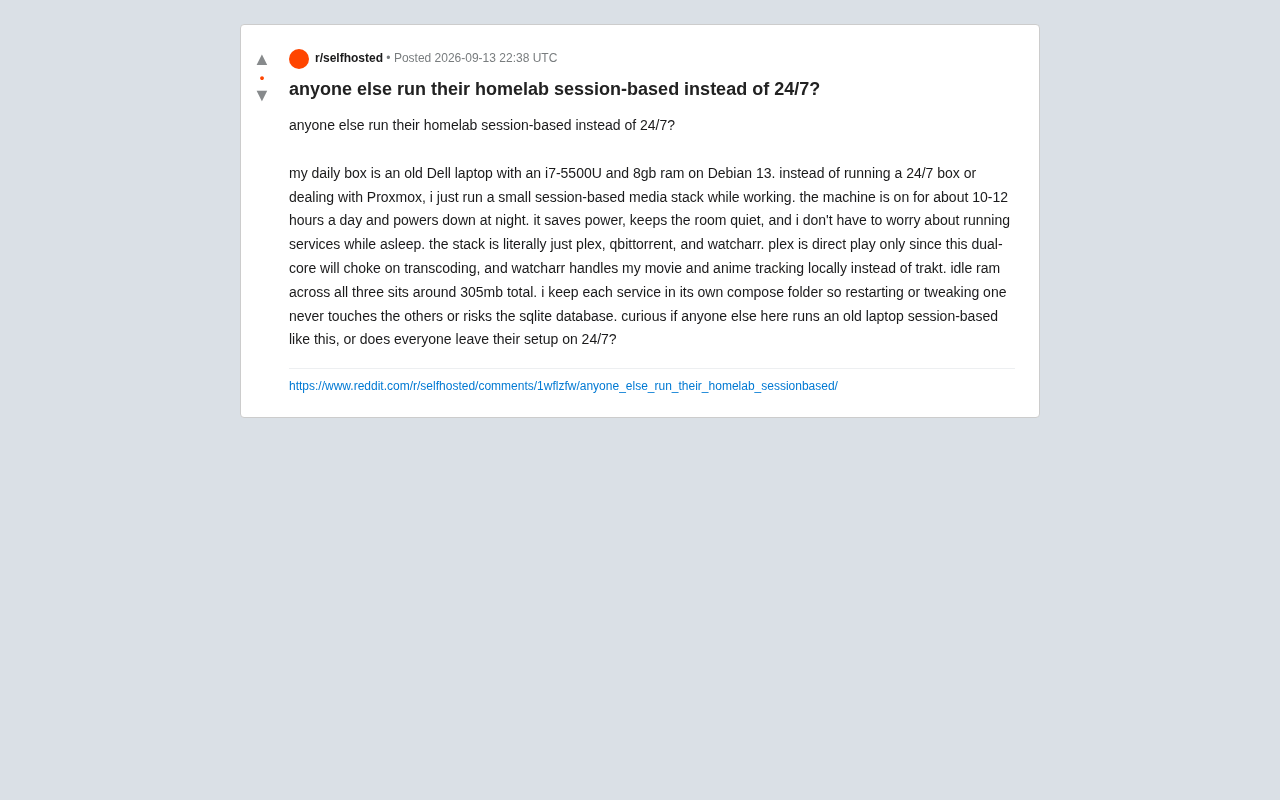
Session-Based Home Server: Running a Low-Power Homelab on an Old Laptop
A Reddit user runs Plex, qBittorrent, and Watcharr on a 10-year-old laptop for just 10–12 hrs/day, using only 305MB RAM idle. Exploring session-based vs. 24/7 Homelab trade-offs.

OpenAI Launches ChatGPT for Financial Services: Built-in Financial Data + GPT-6 Reasoning
OpenAI launches ChatGPT for Financial Services, combining built-in financial data with GPT-6 Astra reasoning to support research, financial modeling, and client materials for financial institutions.

When AI Controls Your Credit Card: The Hidden Risks of Autonomous Payments
When AI agents gain credit card access, hidden dangers emerge: vague authorization, prompt injection attacks, and unclear liability. Learn the real risks and how to stay protected.