Memory Peak Optimization in Long-Context MoE Training
Analysis of memory peaks in long-context MoE training and peak-flattening approaches like dynamic recomputation and heterogeneous scheduling.
This article examines the memory peak problem in long-context Mixture-of-Experts training. The combination of MoE's sparse activation with long-sequence attention causes intermediate activations and expert parameters to momentarily balloon, leading to dramatic GPU memory fluctuations that limit trainable sequence length and cause fragmentation. Traditional gradient checkpointing and ZeRO sharding only reduce average memory, not peaks. The article outlines two peak-flattening paths: fine-grained dynamic recomputation of expert forward computation with attention chunking to decouple peaks from sequence length; and offloading expert parameters or KV caches to CPU/NVMe with routing-prediction-based prefetching to hide transfer latency. It concludes that additional overhead, throughput impact, and framework complexity remain open challenges, with memory optimization shifting from "reducing the mean" to "managing fluctuations."
Introduction
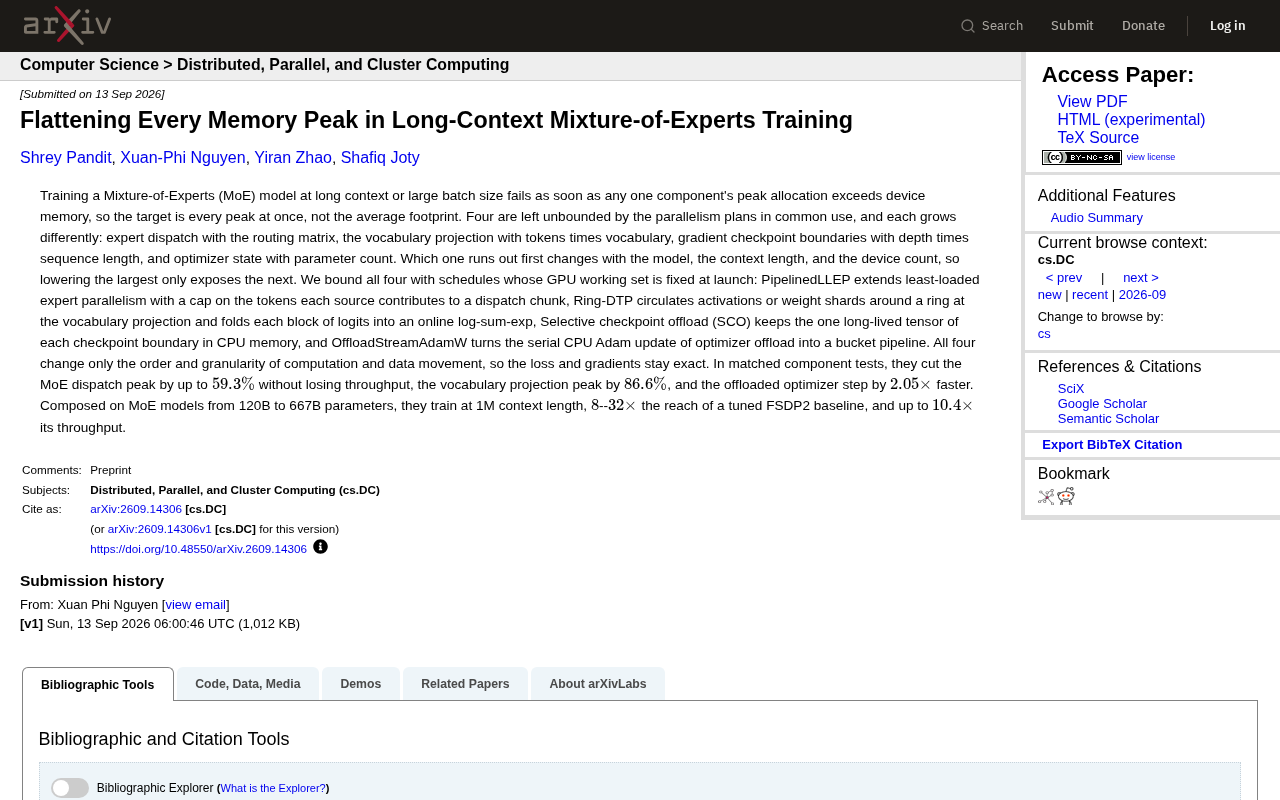
The article "Flattening Every Memory Peak in Long-Context Mixture-of-Experts Training," which sparked discussion on Hacker News, focuses on the memory peak problem in long-context Mixture-of-Experts (MoE) model training. Although the post didn't get much engagement, the technical direction it explores—how to smooth out memory fluctuations during training—is of critical importance for the practical deployment of large-scale MoE models. This article provides an in-depth analysis of the technical background, core challenges, and potential solutions surrounding this topic.
Memory Challenges from Combining Long Context with MoE
Mixture-of-Experts models dramatically increase model capacity through sparse activation, while long-context training requires the model to handle longer sequence dependencies. When combined, memory consumption exhibits pronounced peak characteristics: during attention computation and expert routing phases, intermediate activations momentarily balloon, causing dramatic fluctuations in GPU memory usage. These fluctuations not only limit the maximum trainable sequence length but can also trigger memory fragmentation, reducing hardware utilization.
Traditional optimization techniques such as gradient checkpointing and ZeRO sharding can reduce average memory usage, but they struggle to eliminate peaks. As a result, researchers have begun focusing on "peak-flattening" strategies—spreading memory demand across the time axis through scheduling and recomputation.
The core of Mixture-of-Experts (MoE) lies in replacing the single feed-forward network in traditional Transformers with multiple parallel "expert" sub-networks, and using a learnable router to sparsely activate a small number of experts (typically 1-2) for each token. This sparse activation mechanism allows the total parameter count to expand by dozens of times while the actual computation per token increases only marginally, thereby greatly boosting model capacity at nearly no additional computational cost. Representative examples include Switch Transformer and GShard. However, MoE's memory overhead is not proportional to activation sparsity: all expert parameters must reside in memory (or be quickly accessible), and the routing process generates additional intermediate tensors. When combined with long context, the sequence-dimension attention matrix and batch activations from expert routing further amplify instantaneous memory demand—this is the key background for understanding the memory peak problem.
Gradient checkpointing (also known as activation recomputation) is a classic technique that trades computation for memory: instead of saving all intermediate activations during the forward pass, it retains only a few checkpoints and recomputes missing activations from the nearest checkpoint during backpropagation. It can reduce activation memory from O(n) to O(√n) (where n is the number of layers), at the cost of approximately 33% additional forward computation. ZeRO (Zero Redundancy Optimizer) is a memory optimization scheme for data parallelism that eliminates redundant storage by sharding optimizer states, gradients, and parameters across different GPUs. Both approaches reduce average memory from the perspectives of single-GPU activations and cross-GPU states respectively, but neither schedules for instantaneous peaks within a training step—hence the article notes they "struggle to eliminate peaks," which is precisely where peak-flattening strategies come in.
Analysis of Peak-Flattening Technical Approaches
Dynamic Recomputation and Expert Caching
Given that MoE has large expert parameters but sparse activations, one approach is fine-grained recomputation of expert forward computation. By loading expert parameters only when needed and selectively recomputing activations during backpropagation, it avoids keeping intermediate results from all experts resident simultaneously. Combined with chunked attention processing for long contexts, this can decouple memory peaks from the sequence length dimension.
The KV cache (Key-Value Cache) is a key source of memory consumption in autoregressive generation and long-context training. In standard Transformer attention, computing the attention output for each position requires dot products with the Key and Value vectors of all previous positions; during training, these K/V tensors grow quadratically with sequence length (attention matrix) or reside linearly (K/V themselves). In long-context scenarios, the KV cache can account for the majority of GPU memory. The "offloading KV cache to CPU memory or NVMe" mentioned in heterogeneous memory scheduling leverages the temporal locality of KV cache access (recent tokens are accessed more frequently) to alleviate GPU memory pressure through tiered storage. Understanding the growth pattern of KV caches helps clarify why memory peaks in long-context MoE are particularly prominent during the attention phase.
Heterogeneous Memory Scheduling
Offload temporarily unused expert parameters or KV caches to CPU memory or NVMe storage, and prefetch before computation. By predicting routing decisions and scheduling needed experts in advance, data transfer latency can be hidden. The effectiveness of this method depends heavily on routing locality and prediction accuracy, and requires deep integration with the training framework.
Practical Significance and Open Problems
Peak-flattening techniques directly determine whether long-context MoE training can scale sequence length under limited memory. If memory peaks are effectively controlled, longer contexts can be trained on the same hardware, or a larger number of experts can be supported. However, the additional overhead from dynamic scheduling, the impact of recomputation on training throughput, and the implementation complexity at the framework level remain unresolved challenges.
Research in this direction also suggests that memory optimization is shifting from "reducing the mean" to "managing fluctuations," which places higher demands on co-design between system software and algorithms.
Conclusion
The peak-flattening ideas explored in "Flattening Every Memory Peak in Long-Context Mixture-of-Experts Training" offer a new perspective on the memory bottleneck in long-context MoE training. Although specific technical details have yet to be made public, its core idea—smoothing the memory curve through dynamic scheduling and recomputation—deserves continued attention from AI systems researchers.
One-line Summary
An analysis of memory peak issues in long-context MoE training and peak-flattening approaches such as dynamic recomputation and heterogeneous scheduling.
Paragraph Summary
This article examines the memory peak problem in long-context Mixture-of-Experts training, centered on the paper "Flattening Every Memory Peak in Long-Context Mixture-of-Experts Training." The combination of MoE's sparse activation with long-sequence attention computation causes intermediate activations and expert parameters to momentarily balloon at specific stages, resulting in dramatic GPU memory fluctuations that limit trainable sequence length and cause memory fragmentation. Traditional gradient checkpointing and ZeRO sharding only reduce average memory and struggle to eliminate peaks. The article outlines two peak-flattening paths: first, fine-grained dynamic recomputation of expert forward computation combined with attention chunking to decouple peaks from sequence length; second, offloading expert parameters or KV caches to CPU/NVMe and prefetching based on routing predictions to hide transfer latency. Finally, it notes that additional overhead, throughput impact, and framework implementation complexity remain open challenges, and that memory optimization is shifting from "reducing the mean" to "managing fluctuations."
Related articles

Gemini 4 Neon Review: Benchmark Scores Rival Carbon, API Pricing and Quota Breakdown
Google Gemini 4 Neon is now live, benchmark scores closely tracking Carbon, API pricing 3/15 at twice Hydrogen's rate. This article compiles Bilibili creator testing: Neon can replace 90% of Carbon scenarios, AntiGravity quota consumption is only one-third of Carbon, plus subscription channel restrictions and 2API ban risks.

Gemini 4 Helium Coming Soon? Signals of Google Loosening Subscription Restrictions
Google team member hints releases will continue; community speculates Gemini 4 Helium (Flash Lite) may be next. Subscription ban controversy gets a response as product lead says "Soon," suggesting restrictions may be lifted. This article covers Gemini developments, OpenAI Coding Agent and risk management, Doubao real-time audio-video API, and compute business dynamics.

AI-Assisted React Development in Practice: Optimizing a Video App and Handling Errors
A 14-year veteran developer demonstrates AI-assisted React video app optimization: compressing video from 80MB to 5MB (~94%) via ImageKit, plus reliable error handling and retry mechanisms. Includes planning, code understanding, and verification methods for working with AI.