Merkle Mountain Range Proven Optimal: Lower Bound on Accumulator Witness Update Frequency

MMR reduces accumulator witness updates to O(log n) and is proven theoretically optimal.
The article addresses the core issue of witness update frequency in cryptographic accumulators. Traditional Merkle trees invalidate on average half of the witnesses per insertion, causing each element to undergo a linear number of updates; simple multi-tree partitioning and RSA/bilinear accumulators also fail to escape linear updates. Merkle Mountain Range (MMR) uses a merge mechanism of power-of-two-sized Merkle trees so that each element participates in only O(log n) merges, and the k-ary generalization further reduces this to log n / log log n. MIT's Miranda uses a compression argument to prove that this construction achieves the optimal lower bound under the condition of only requiring polylogarithmic commitments and soundness, and the lower bound does not depend on the accumulator's internal structure, holding even for general accumulators supporting deletion and non-membership proofs. MMR has been independently discovered in blockchain UTXOs, distributed PKI, and registration-based encryption, and its update locality is also related to pebbling games.
Introduction: When Accumulators Meet "Offline Anxiety"
In systems like blockchains and distributed public key infrastructure (PKI), we often need to maintain a continuously growing set—such as all unspent transaction outputs (UTXOs), all registered users, or all valid certificates. Cryptographic accumulators are core primitives designed for such scenarios: they compress a large set into a short commitment and generate a membership witness for each element. Users only need to store their own witness to prove to others that they belong to the set.
However, as the set keeps expanding, a practical problem emerges: the addition of new elements may invalidate existing witnesses, forcing users to come back online to obtain updated proofs. If updates are too frequent, the user experience suffers greatly. This is exactly the core issue explored by MIT postdoc Miranda in this talk—how to quantify and optimize witness update frequency.
Accumulator Basics and the Dilemma of Merkle Trees
An accumulator consists of three algorithms: Setup generates public parameters, Accumulate compresses the set into a commitment C and generates a witness for each element, and Verify allows anyone to check membership using (C, element, witness). Its security requirements include completeness (true members always pass verification) and soundness (an adversary cannot forge a proof for an element not in the set).
The most well-known accumulator instance is the Merkle tree: elements are stored in leaf nodes, the commitment is the root, and the witness is the sibling nodes along the path from the leaf to the root. Verification only requires recomputing hashes and comparing with the root. The Merkle tree's commitment size is constant, which seems perfect.
But the problem lies in dynamic updates. Suppose the set already contains X1, whose witness includes sibling node X3. When a new element X4 is added at X3's position, the internal node hash changes, and X1's witness becomes invalid. Worse, on average, half of the witnesses in a Merkle tree change with each insertion, causing each element to undergo a linear number of witness updates over n insertions. For users who need to stay offline for long periods, this is almost unacceptable.
Merkle tree (also called hash tree) was proposed by Ralph Merkle in 1979. It is a structure that uses hash functions to organize large amounts of data into a binary tree: leaf nodes store hashes of data blocks, internal nodes store the hash of the concatenation of their two children's hashes, and the root is the commitment to the entire set. To verify the existence of an element, one only needs to provide the hash values of sibling nodes along the path from that leaf to the root (i.e., the witness); the verifier recomputes hashes bottom-up and compares with the root, without downloading all data. Merkle trees are therefore widely used in Git, BitTorrent, certificate transparency logs, and other systems. Their key limitation is that any leaf change alters ancestor hashes along the path, invalidating the witnesses of all other leaves that include those ancestors—this is exactly the root cause of the linear update problem described here.
From Multi-Tree Partitioning to Merkle Mountain Range
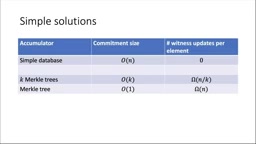
A simple improvement is to randomly partition the set into K parts, each maintaining a Merkle tree. This reduces each element's witness update count to n/K, but at the cost of K times larger commitment size—a trivial trade-off. RSA accumulators and bilinear accumulators, although having short witnesses, also perform poorly in witness update frequency, still at the linear level.
The real breakthrough comes from a data structure called Merkle Mountain Range (MMR). It consists of multiple Merkle trees whose sizes are powers of 2, resembling a range of mountain peaks. Each time a new element is added, it is placed in the smallest empty tree first; when two trees of the same size appear, they are merged into a larger tree.
This design cleverly exploits the frequency difference of "merges": the larger the tree an element belongs to, the fewer times it gets merged. By counting, one can prove that each element participates in only O(log n) merges over n insertions, so the witness is updated only O(log n) times. Compared to the linear updates of Merkle trees, this is an exponential improvement.
In the talk, Miranda also mentions a natural extension: generalizing the binary MMR to a k-ary MMR. In this case, each bucket holds at most k trees, and the merge threshold becomes k trees. The cost is that the commitment size increases to k log n. If we set k = log n, the witness update count further drops to log n / log log n, while maintaining a polylogarithmic commitment size. This result fills the gap of "small commitment + few updates" in the table.
RSA accumulator was proposed by Baric and Pfitzmann in 1997 and later refined by Camenisch and Lysyanskaya: it is based on the strong RSA assumption, mapping set elements to distinct primes, with the commitment being g raised to the product of primes modulo N, and the membership proof being exponentiation under the corresponding prime exponent. Its commitment and witness are both constant size and it supports non-membership proofs, but it requires trusted generation of the RSA modulus, and updating witnesses requires modular exponentiation with high cost; the witness update frequency is still linearly related to the number of insertions. Bilinear accumulators (such as the Nguyen scheme) are based on pairing-friendly elliptic curve groups, using bilinear maps to achieve constant-size commitments and proofs, with security relying on assumptions such as q-Strong Diffie-Hellman. Although both have advantages in proof size, they do not solve the core pain point of frequent witness updates for offline users, highlighting the unique value of MMR in the dimension of update complexity.
Optimality Proof: MMR Cannot Be Surpassed
MMR has been independently rediscovered in three separate fields: blockchains, distributed PKI, and registration-based encryption. This raises a key question: is it a coincidence, or is it a theoretical limit?
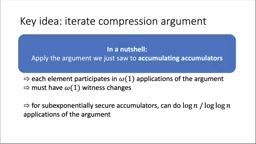
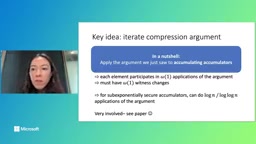
Miranda's work provides a clear answer: MMR is optimal in witness update complexity. For any accumulator with polylogarithmic commitment, most members' witnesses must undergo a super-constant number of updates; under sub-exponential security assumptions, the lower bound can be strengthened to log n / log log n, exactly matching the construction of log n-ary MMR.
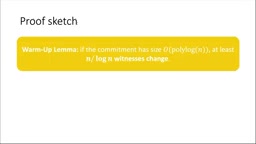
The core of the proof is an elegant compression argument. Alice wants to use an accumulator to transmit a random subset S (requiring n bits of information) to Bob. She sends the commitment C and a list L recording the indices of all elements whose witnesses have changed at least once. Bob then checks each element one by one: if an element's witness is unchanged and passes verification, or if the element appears in L, he adds it to his guessed set. Completeness and soundness guarantee that Bob can accurately recover S.
Now calculate the communication cost: the commitment occupies polylogarithmic bits, and the list L occupies (log n × number of witness changes) bits. Since the information-theoretic lower bound requires at least n bits, the number of witness changes must be at least n / log n. This weak version of the lower bound is iteratively strengthened—through a recursive construction of "accumulator of accumulators"—ultimately yielding the tight bound of log n / log log n.
It is worth noting that Miranda emphasizes this lower bound does not depend on the specific structure of the accumulator; it only needs to satisfy succinctness and soundness, and even holds for general accumulators supporting deletion operations or non-membership proofs. Subsequent work (Wei Qi) has removed the sub-exponential security assumption, proving the same bound under standard polynomial security.
Compression argument is a common technique in cryptography for proving lower bounds: if a scheme is too efficient, one can use it to compress an object of length N bits into far fewer than N bits for transmission, while the receiver can still recover the original object, violating the information-theoretic lower bound (the receiver can distinguish at most 2^m messages, where m is the number of received bits). In the text, Alice transmitting a random subset S to Bob follows exactly this idea: if the number of witness changes is extremely small, the total length of the commitment plus the list of changed indices will be less than n bits, yet Bob can uniquely determine S—a contradiction. The power of this argument lies in that it only invokes the completeness and soundness of the accumulator, without assuming internal structure, so the lower bound holds universally for any succinct accumulator.
Practical Significance and Open Problems
The value of MMR is not just theoretical optimality. In blockchain UTXO management, users do not need to frequently come online to update proofs; in distributed PKI, the proof update burden for certificate holders is greatly reduced. The Q&A session in the talk also points out that MMR updates have a natural locality—when merging trees, many Merkle paths remain unchanged, resulting in minimal write amplification. This has a deep connection with the tree function evaluation problem in pebbling games, potentially offering new perspectives for future research.
However, the lower bound currently mainly targets membership proofs and addition operations. Whether similar lower bounds exist for non-membership proofs and witness update frequency under deletion operations remains to be further verified. Miranda conjectures that similar conclusions should hold, but a rigorous proof remains an open problem.
Pebbling game is a theoretical model in cryptography for analyzing memory-hard functions and the space required for tree-based computation: given a directed acyclic graph (often a binary tree), the player must compute the root by "placing pebbles" (storing intermediate values) and "moving pebbles" (discarding), with the goal of minimizing the peak number of pebbles. The layer-by-layer hash computation of Merkle trees and the merge updates of MMR can both be viewed as evaluation processes under this model; the local update of a witness corresponds to recomputing only a few paths while the remaining pebbles stay unchanged. This connection provides a formal explanation for the update locality of MMR, and also suggests that pebbling lower bound tools can be used to analyze the memory and communication overhead of other dynamic accumulator structures.
Conclusion
Merkle Mountain Range has repeatedly emerged from engineering practice and is now proven to be the optimal solution for accumulator witness update frequency. This result not only provides theoretical backing for existing systems but also delineates the boundary for future optimization: while maintaining succinct commitments, no accumulator can significantly surpass MMR in witness update count. For engineers designing large-scale dynamic set systems, this is undoubtedly a conclusion worth remembering.
One-line Summary
MMR reduces accumulator witness updates to O(log n) and is proven theoretically optimal.
Paragraph Summary
The article revolves around the core issue of witness update frequency in cryptographic accumulators. Traditional Merkle trees invalidate on average half of the witnesses per insertion, causing each element to undergo a linear number of updates; simple multi-tree partitioning and RSA/bilinear accumulators also fail to escape linear updates. Merkle Mountain Range (MMR) uses a merge mechanism of power-of-two-sized Merkle trees so that each element participates in only O(log n) merges, and the k-ary generalization further reduces this to log n / log log n. MIT's Miranda uses a compression argument to prove that this construction achieves the optimal lower bound under the condition of only requiring polylogarithmic commitments and soundness, and the lower bound does not depend on the accumulator's internal structure, holding even for general accumulators supporting deletion and non-membership proofs. MMR has been independently discovered in blockchain UTXOs, distributed PKI, and registration-based encryption, and its update locality is also related to pebbling games.
Related articles
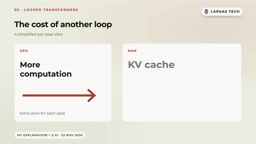
China's New GLM Model Adopts Loop Transformer: Will ChatGPT Follow Suit?
Zhipu's GLM adopts the Loop Transformer architecture, iterating multiple times to improve output quality as the first model to publicly confirm this design. This article explains the principles, KV cache cost, and surrounding developments in Google AI search and coding agent benchmarks.
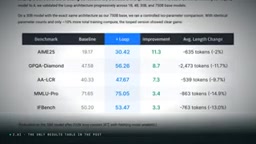
GLM-5.4 Is 5x Cheaper Than Claude — But at What Cost?
GLM-5.4 offers near-Claude coding ability at $18/month, about one-fifth the cost, but lacks flagship benchmarks and max effort can exhaust quotas on a single 7-hour task. This article combines the official paper and three independent reviews to explain the recurrent Transformer architecture and offer practical advice.
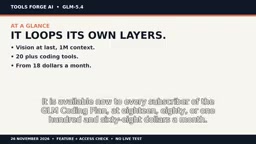
GLM-5.4 Open-Source Coding Model Tested: The Strongest, But It Takes 7 Hours
Z.AI releases GLM-5.4 coding model with Loop Transformer architecture, called the strongest open-source coding model by independent review, but it takes over 7 hours and ~15x tokens on the same benchmark. Here's the architecture, test scores, pricing, and competitive landscape.