Meta Launches Pocket: Play AI-Generated Games Like Scrolling TikTok

Meta's Pocket app lets users create AI-generated playable games via natural language and share them socially.
Meta launched Pocket on Product Hunt, a social app that turns natural language descriptions into playable interactive experiences called "gizmos." Supporting multimodal inputs like touch, motion, sound, and camera, these AI-generated creations can be shared and remixed TikTok-style. The app represents Meta's push into AI-native social content, combining vibe coding democratization with its social flywheel expertise to potentially create a new category of playable short-form content.
Meta's New Social Bet: Making Everyone a Game Creator
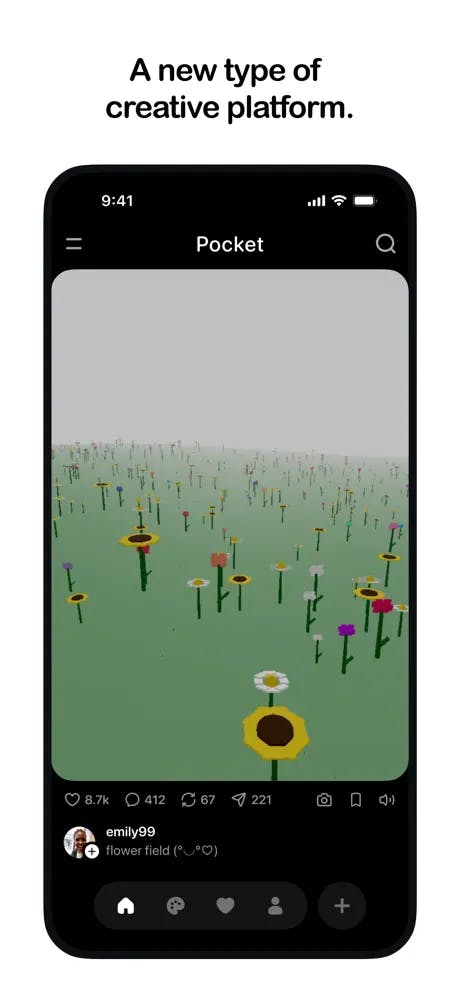
Meta recently launched a new social app called Pocket on Product Hunt, built around the concept of "vibe coding." Its core value proposition is straightforward — describe a game idea in natural language, and AI turns it into a playable interactive experience that you can share to a feed just like posting a TikTok video.
The app currently sits at #11 on Product Hunt's daily leaderboard, categorized under Android, Artificial Intelligence, and Gaming. While its vote count is still in the early stages (63 votes), it represents yet another exploration by Meta into AI-native social content.
What Is a Gizmo: AI-Generated Playable Interactive Experiences
Pocket's core concept revolves around what it calls a "gizmo" — a lightweight interactive experience generated by AI. Unlike traditional game development, users don't need to write any code; they simply describe an idea in a single sentence, and the system transforms it into an interactive creation.
From a technical implementation perspective, gizmos are likely built on large language models generating front-end code (such as HTML5 Canvas or WebGL), rendered in real-time on mobile devices through a sandboxed environment. This "text-to-executable-program" pipeline shares the same philosophy as AI coding tools like Replit and Bolt, but Pocket packages it as a zero-barrier experience for everyday consumers.
Multimodal Interaction Capabilities
Here's a notable detail: these gizmos aren't static content — they can respond to multiple input methods:
- Touch: Traditional tap and swipe interactions
- Motion: Leveraging the device's gyroscope and accelerometer
- Sound: Capturing audio input through the microphone
- Photos & Camera: Integrating real-world imagery into interactive experiences
This multimodal design sets Pocket's creations apart from typical AI text or image generators, making them more akin to truly playable mini-games or interactive toys. The introduction of multimodal input means the AI must call device APIs during code generation (such as Web Audio API, MediaDevices interface, DeviceMotion events, etc.), placing significant demands on the underlying model's code generation capabilities.
Turning Creation into Social Activity: Share, Play, and Remix
Pocket's real ambition isn't in "generation" — it's in "social." It TikTok-ifies the creative process, building a content loop composed of three elements: creation, play, and remix.
Remix Mechanism: Viral Evolution of Content
Users can not only create their own works but also play gizmos made by others, and more importantly, they can remix other people's creations, transforming them into something entirely new. This remix mechanism is exactly what drives explosive content growth on platforms like TikTok and Instagram Reels — it drastically lowers the creative barrier, enabling every consumer to easily become a creator.
The power of remix in social platforms has been proven repeatedly: TikTok's duet and stitch features let users create derivative content based on others' work, while Scratch's "See Inside and Remix" mechanism has cultivated tens of millions of young creators in the education space. Pocket applies this logic to AI-generated interactive content — users might only need to modify a single natural language prompt to spawn entirely new variants from someone else's work, creating exponential content proliferation.
For Meta, this logic is familiar territory. From Instagram to Reels, Meta deeply understands how low-barrier creative tools drive massive UGC content. The so-called UGC social flywheel works like this: creative tools lower barriers, increasing content supply; abundant content attracts more consumers; and consumers, incentivized by low barriers, convert into new creators, forming a self-reinforcing positive feedback loop. Pocket essentially applies this social flywheel to AI-generated interactive content.
Industry Significance: A New Form of AI-Native Social
Pocket's emergence reflects the convergence of several important trends:
First, the democratization of vibe coding. The concept of "vibe coding" was coined by Andrej Karpathy — former OpenAI researcher and Tesla AI director — in early 2024. It describes a programming paradigm where developers no longer write code line by line but instead express intent to AI through natural language, with models generating the implementation. The developer's role shifts from "coder" to "director," focusing more on creative direction than technical details. Over the past year, this concept has evolved from a buzzword in developer circles to something approaching mainstream. Pocket fully consumerizes it, enabling people who can't code to "program" playable content.
Second, social distribution of AI content. Standalone AI generation tools are becoming commoditized — ChatGPT, Midjourney, Claude, and others are powerful, but they're fundamentally single-player tools lacking network effects. Embedding generative capabilities within social networks to create a closed content consumption loop is the key to building a moat. Meta commands social infrastructure with over 3 billion monthly active users — a natural advantage over pure AI tool companies.
Third, interactive content as a potential challenge to short-form video. Compared to passively watched short videos, playable and interactive gizmos offer higher engagement. Research shows that interactive content typically delivers significantly higher user dwell time and repeat visit rates than passive content. If Pocket can prove the model works, it could open up a new category of "playable short-form content" — similar to how short video once disrupted image-and-text feeds.
Challenges and Future Outlook
Of course, Pocket faces significant challenges. Can the quality and diversity of AI-generated interactive content consistently attract users? Code generated by current large language models still suffers from logic errors and poor edge-case handling, which in a gaming context gets amplified into obvious bugs and poor feel. Will the remix mechanism lead to floods of low-quality, repetitive content? This is the "content inflation" problem all UGC platforms face, requiring robust recommendation algorithms and content governance systems. And most critically — can Meta replicate its social product success formula once again?
The app is still in its early stages, with limited reviews and interaction data. But as a clear bet by Meta in the AI social space, Pocket is worth watching closely. Whether it becomes the next breakout app remains a question that only the market and time can answer.
Key Takeaways
Related articles

Bilibili's Hit Dify Tutorial: A Practical Guide to Building 20+ AI Apps from Scratch
A distilled guide to Bilibili's top-rated Dify tutorial: Windows + Docker deployment, MySQL connection, five app types, model integration strategy, and publishing.

Agent Skills Beginner's Guide: From Concepts to Multi-Agent Collaboration in Practice
A comprehensive guide to Agent Skills: core concepts, components, the importance of Description, standardization, beginner learning paths, and multi-agent collaboration.

One Neuron Detects Both Cats and Cars? We Reproduced It and Found a New Explanation
The cat-car neuron reinterpreted: researcher Cammarata argues it distinguishes pointy from round, not cats from cars. We reproduced the experiment and found the new explanation holds on most inputs—but cars are the exception. The interpretability debate continues on language models.