Meta Launches Standalone Messaging App Direct, No Instagram Account Required
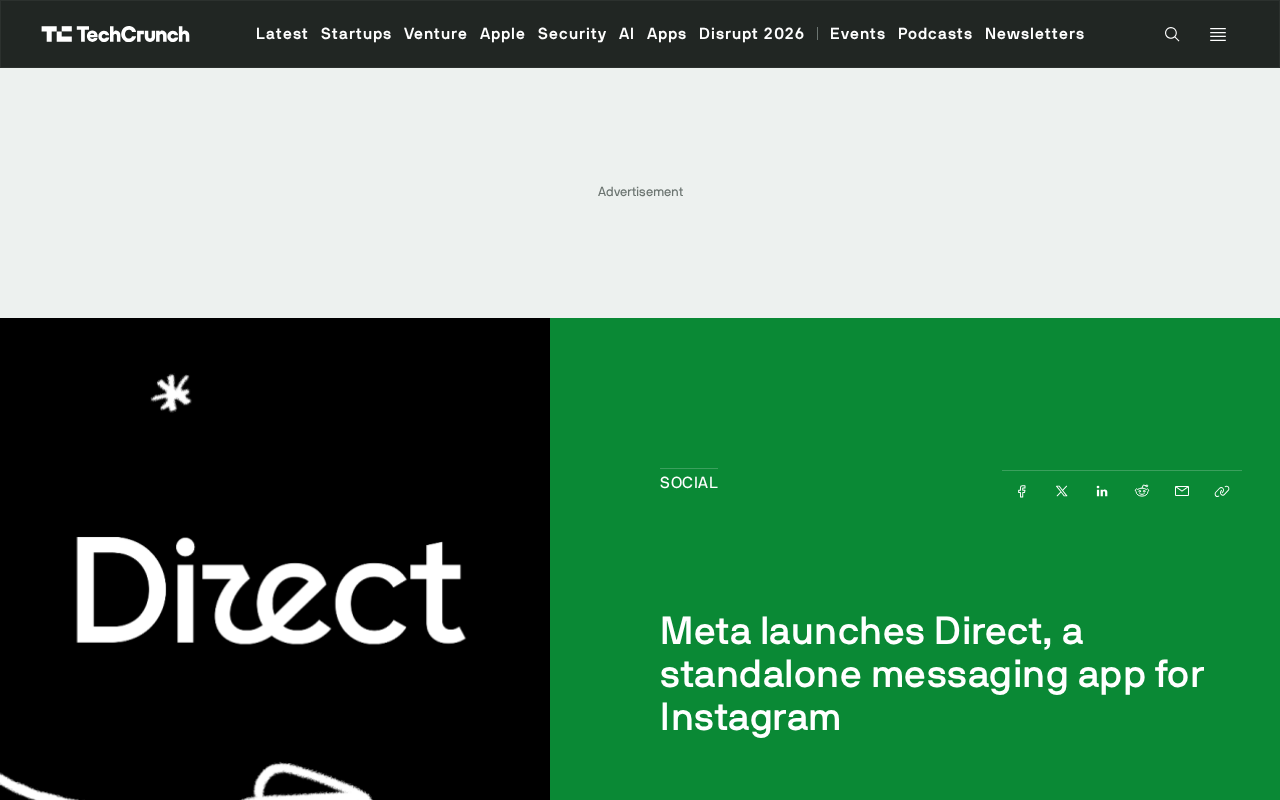
Meta spun Instagram DMs into standalone app Direct, launched in Turkey and Thailand and usable without an Instagram account.
Meta has launched Direct, a standalone messaging app that splits Instagram's DM feature out of the main app, debuting in Turkey and Thailand. Its biggest change is loosened account requirements: users can use it without an Instagram account—a sharp contrast to Threads' deep binding to Instagram accounts—giving Direct a standalone-messaging-tool positioning in some markets. Launching in just two markets fits Meta's cadence of testing small first, then expanding, allowing it to collect real data while controlling operational and compliance costs. Still, the messaging landscape is entrenched, with WhatsApp, Telegram, and Signal each holding ground; Direct's specific features, interoperability with the main app, and follow-up rollout plans are undisclosed, so whether it can become a truly standalone product remains to be seen.
Meta is spinning Instagram's direct messaging feature out into a standalone app. The new app, called Direct, has launched in Turkey and Thailand, and the biggest change is this: users don't need an Instagram account to use it.
From Feature to Product: What Direct Actually Changes
For years, Instagram's direct messages have been tied to the main app—users had to have an Instagram account before they could chat with anyone. Direct removes that dependency: according to the original report, the app "can be used with or without an Instagram account." That means in some markets, Direct effectively positions itself as a standalone messaging tool rather than just an add-on feature.
This approach contrasts with Meta's past strategy. Meta previously launched the standalone Threads app, which is deeply tied to the Instagram account system; Direct, by loosening the account requirement, is clearly taking a different path.
Threads is a standalone social app Meta launched in 2023, positioned as a decentralized text-conversation platform (a rival to X/Twitter). Its biggest structural feature is a tight binding to the Instagram account system: users log in with their Instagram account, and their username, avatar, and follow relationships carry over—and deleting a Threads account may even affect the Instagram account. This design lowers the cost of cold starts—users don't have to build a social graph from scratch—but it also means the app can't exist independently of Instagram, and its growth ceiling is highly coupled to the parent account system. Direct's choice to loosen the account requirement is precisely a correction to that model: it tries to verify whether, once account dependency is stripped away, a new app born from a mature product can independently attract and retain users, rather than serving merely as a subordinate entry point to the main app.
Why Turkey and Thailand First
Meta hasn't disclosed why it chose these two markets, but "launch small first, then expand gradually" is its usual product release cadence. Limiting the initial markets to two countries lets it collect real usage data while keeping operational and compliance costs within an acceptable range.
For Meta, messaging is a key scenario for user retention. Spinning out direct messages gives it an additional entry point—beyond the main app—to reach users and maintain opening frequency.
Launch small first, then expand gradually (soft launch / market seeding) is a release strategy commonly used by large internet products. Its value lies in: first, collecting real user behavior data in controlled markets—observing retention, usage frequency, and feature preferences—without bearing the risk of failure globally; second, compressing operational costs such as localization, content moderation, and data compliance into a limited scope—different countries have very different requirements for data localization, communications content, and minor protection, so testing in markets with relatively manageable regulatory environments allows experience to accumulate; third, if the product needs adjustment or even rollback, the impact is smaller and damage to brand and user trust is easier to contain. For a company like Meta with complex product lines, a phased launch also prevents a new app from too early competing for resources with the main app or creating internal positioning conflicts.
The Competitive Landscape for Standalone Messaging Tools
The messaging landscape is already quite entrenched—WhatsApp, Telegram, Signal, and others each hold their own territory, and WhatsApp itself is under Meta. For Direct to find a place in this market, "moving Instagram DMs elsewhere" alone won't be enough; the no-account-required design may be its key step toward lowering the barrier to use.
However, the source material does not disclose Direct's specific feature list, how much it interoperates with Instagram DMs, or Meta's follow-up rollout plans. These details will determine whether Direct becomes a truly standalone messaging product or just a regional feature experiment.
Network effects are the core competitive moat for messaging products: the value of a messaging tool depends on its user scale—the more users, the stronger its appeal to potential new users—making it hard for latecomers to撬动 existing relationship chains on feature differentiation alone. WhatsApp, Telegram, Signal, and others have each built stable user bases and social graphs; the cost of switching isn't just downloading another app, but also persuading contacts to switch along with you. For this reason, a common path for new products to break through is lowering the barrier to use (e.g., no account, no phone number required) or targeting underserved niche scenarios and regional markets. Direct's "usable without an account" design is, in a sense, circumventing the registration drop-off caused by account barriers—trying to separate "trying it out" from "establishing an identity," letting users first form a usage habit without any burden.
A Few Questions Worth Watching
- How the account system works: Under what identity do users without an Instagram account exist in Direct? The original report doesn't say.
- Relationship with the main app: After Direct launches, will the DM feature inside Instagram remain? There is currently no clear information.
- Rollout scope: Next steps after Turkey and Thailand have not been announced.
For readers following Meta's product moves, this Direct experiment is worth tracking—it tests whether the path of "spinning a mature feature out into a new product" can, after loosening account ties, actually bring in new users.
One-line Summary
Meta has spun Instagram DMs into a standalone app, Direct, launched in Turkey and Thailand and usable without an Instagram account.
Paragraph Summary
Meta has launched Direct, a standalone messaging app that splits Instagram's DM feature out of the main app, debuting in Turkey and Thailand. Its biggest change is loosened account requirements: users can use it without an Instagram account—a sharp contrast to Threads' deep binding to Instagram accounts—giving Direct a standalone-messaging-tool positioning in some markets. Launching in just two markets fits Meta's cadence of testing small first, then expanding, allowing it to collect real data while controlling operational and compliance costs. Still, the messaging landscape is entrenched, with WhatsApp, Telegram, and Signal each holding ground; Direct's specific features, interoperability with the main app, and follow-up rollout plans are undisclosed, so whether it can become a truly standalone product remains to be seen.
Related articles

Pure-Code Video Generation Tested: Which AI Model Actually Follows Instructions?
A Bilibili creator tested three AI models' pure-code video generation with unified prompts and three revisions each: Xiaonaomao has a high ceiling but lacks stability, GPT 6.2 Extra models well but only follows half the instructions, and OPAS 5.5 remains the benchmark.

GPT-6 Six-Tier Hands-On Test: Astra Ultra Dominates but Bills Double
GPT-6 six-tier test: Astra Ultra sweeps 3:0 in 3D tasks thanks to sub-agents and runs 14% faster, but hidden backend bills make its real cost 2.6x single-threaded.

GPT-6.2 Astra vs Fable 5.2: Huge Cost-Efficiency Gap Across 12 Real-World Tests
Bilibili creator tests GPT-6.2 Astra vs Fable 5.2 across 12 real tasks: Fable wins 7-5 but costs 7.2x more and takes nearly 5x longer. Token efficiency emerges as the key selection metric.