Meta Launches Tamagotchi-Style Wearable as a New Home for AI Assistant Muse

Meta launches a Tamagotchi-style wearable to give its AI assistant Muse an emotionally engaging physical form.
Meta has introduced a compact, Tamagotchi-inspired wearable device as another mobile home for its AI agent Muse. Unlike conventional AI tools, the device borrows the emotional bonding logic of classic digital pets to forge a stronger connection between users and AI. Muse follows a "one AI, many carriers" architecture, flowing seamlessly between smartphones and wearables for a consistent experience. The move reflects the broader industry race to own AI-native hardware real estate and reduce reliance on smartphones — though real-world performance and market reception remain to be seen.
Meta's Latest AI Hardware Experiment
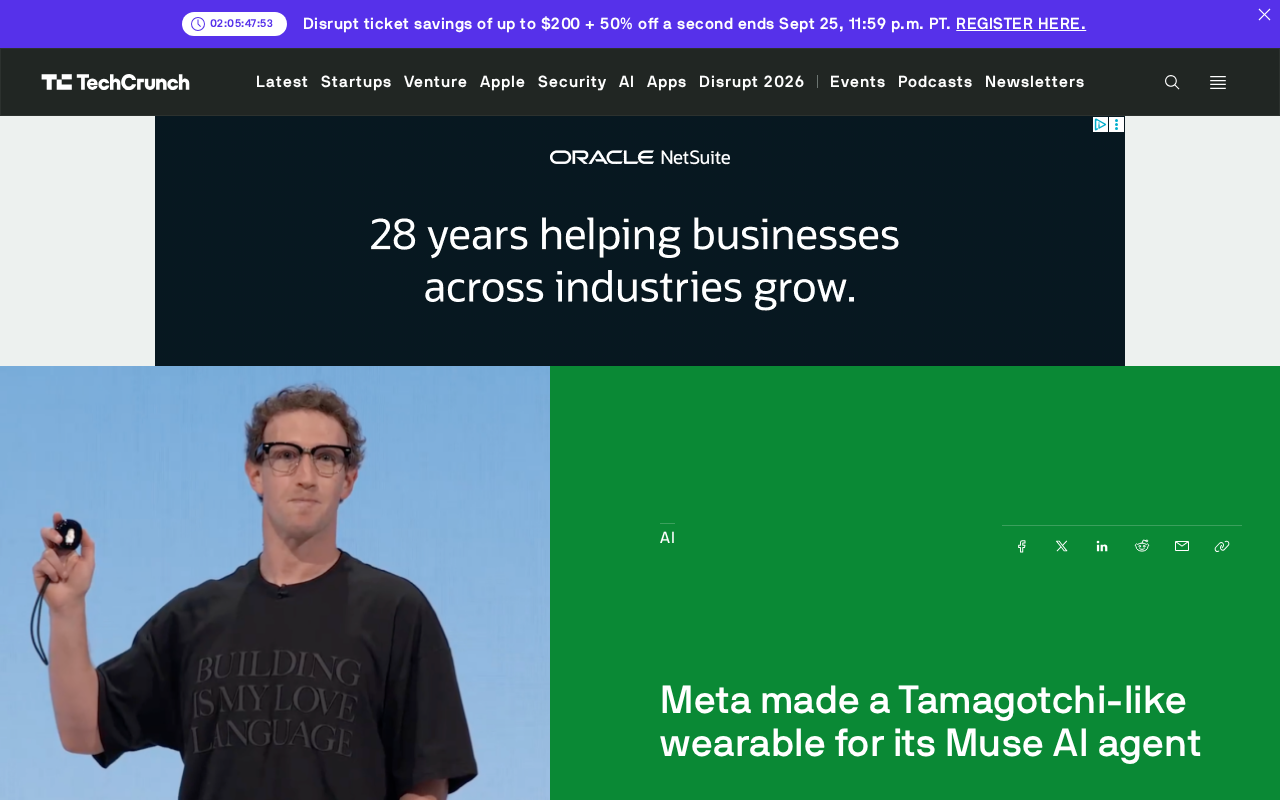
Meta has recently unveiled a compact wearable device that bears a striking resemblance to the iconic Tamagotchi electronic pets of the '90s. Rather than functioning as a traditional smartwatch or fitness tracker, this device is designed primarily as another "mobile home" for Meta's AI agent, Muse.
In other words, Meta wants its AI assistant Muse to break free from phones and screens, taking on a more personal, companionship-oriented physical form that travels with the user. This idea of "giving AI a body" is emerging as one of the key directions tech giants are exploring for the next evolution of human-computer interaction.
Why the Tamagotchi Form Factor?
Encasing an AI agent inside Tamagotchi-like hardware is a design choice loaded with meaning. The original Tamagotchi craze of the late '90s was driven precisely by a mechanic that required users to continuously care for, interact with, and emotionally bond with a virtual creature.
By borrowing this form factor, Meta is subtly signaling that Muse isn't meant to be a cold, purely utilitarian AI — it's designed to be a "digital companion" with genuine companionship qualities, available for interaction anytime and anywhere. Compared to a chat interface buried inside a phone app, a standalone physical device you can carry on your person is far more likely to foster long-term usage habits and emotional attachment.
The Tamagotchi was introduced by Bandai in 1996 as a handheld digital pet toy, requiring users to regularly feed, clean, and interact with it — otherwise the virtual pet would fall ill or "die." This design deliberately manufactured a sense of responsibility for something that "needs to be cared for," generating genuine emotional attachment in users. At its peak, global sales exceeded 70 million units. Its success was fundamentally about gamifying "companionship" and "emotional bonding." By invoking this cultural touchstone, Meta aims to trigger users' memories of that emotional connection model — positioning AI not as a passively responsive tool, but as a presence users must actively nurture. This is a textbook example of the current "parasocial AI" design philosophy: using form factor as a signal to reduce users' sense of alienation from AI.
An AI Agent With Multiple "Homes"
One key phrase in the original reporting deserves attention: this device gives AI agent Muse "another mobile home." This implies that Muse doesn't live on a single device, but can flow across multiple endpoints — smartphones, wearable hardware, and potentially other form factors.
This "one AI, many carriers" architecture reflects a broader trend in AI product design: the agent itself is the core, while hardware is simply the interface through which it expresses itself and interacts. In theory, users should receive a continuous, consistent experience with Muse regardless of which device they're using. For Meta, a multi-platform approach also helps embed its AI assistant into more moments of users' daily lives.
This "multi-carrier AI agent" architecture relies technically on cloud-based state synchronization: conversation history, user preferences, contextual memory, and other data are not stored locally on any specific device but hosted in the cloud, with each endpoint essentially acting as a "frontend" that renders the interaction interface. This contrasts sharply with traditional software that is tightly bound to a specific device. Amazon Alexa's cross-device continuity and Apple Intelligence's unified experience across iPhone, Mac, and iPad are established precedents for this approach. The architecture's strength lies in experiential continuity, but it also raises privacy and data sovereignty concerns — user behavioral data becomes highly centralized on the platform, deepening ecosystem lock-in.
The Race for AI Hardware Real Estate
Meta's move doesn't exist in a vacuum. From AI glasses and AI lapel pins to various wearables, tech companies are all competing for the "AI-native hardware" category, each trying to reduce dependence on the smartphone as the default AI interface.
For Meta, which has already invested in hardware like smart glasses, this new Muse-specific wearable represents a further extension of its AI strategy into the hardware layer. Whether it succeeds will largely depend on Muse's own capabilities and whether this device genuinely addresses a real user need — rather than simply riding on novelty.
Current competitors in the AI-native hardware space include: Humane's AI Pin (a lapel pin form factor that has already declared failure due to poor user experience), Rabbit's R1 standalone AI device, Meta's own Ray-Ban Meta smart glasses (widely considered one of the most successful AI wearable products to date), and Samsung and Google's strategies for deep AI integration at the smartphone level. The collapse of the Humane AI Pin demonstrates that standalone AI hardware that breaks away from the phone faces an extraordinarily high experience bar — compute constraints, battery life, interaction latency, and gaps in real-world use cases are all formidable challenges. Meta's choice of a smaller, lower-cost "Tamagotchi" form factor may be a deliberate move to sidestep the high-risk path of building a full-featured standalone device.
Conclusion
Publicly available information remains limited — details about this device's specific features, pricing, battery life, and how Muse actually performs on it have yet to be disclosed. What is clear is that Meta is actively exploring a path that takes AI beyond the screen and into physical, embodied companionship. The Tamagotchi-inspired design reveals the company's ambitions around emotionally resonant AI interaction. Whether this kind of product can win over the market will be a fascinating case study in the trajectory of AI hardware.
Related articles

REA: Reverse Engineer Any App with AI, No Coding Required
REA is a viral open-source AI reverse-engineering tool that lets Claude, Codex, and other AI agents analyze any app and generate functional clones—no coding required. This article covers how it works, installation, a hands-on test, and legal risks.

2026 AI Coding Tools Comparison: Claude, ChatGPT, Gemini — Which Is the Best?
A 2026 comparison of five mainstream AI coding tools — Claude Code, ChatGPT Codex, Gemini, DeepSeek, and GitHub Copilot — on real projects, pricing, and code quality, to help you decide where that $20/month should go.

ChatGPT Codex Can Clone Any Software? Testing the Risks and the Truth
YouTube shorts claim ChatGPT Codex or Claude Code can clone Adobe, Excel, and Figma for lifelong free use. We break down the feasibility, legal risks, and DM-funnel tactics—and explain what AI coding tools are truly good for.