Meta Muse Spark 1.3 In-Depth Review: The Truth Behind Top-Tier Coding Capability and Ultra-Low Pricing
Meta Muse Spark 1.3 offers top-tier coding at 1% market price—but the real cost is your data.
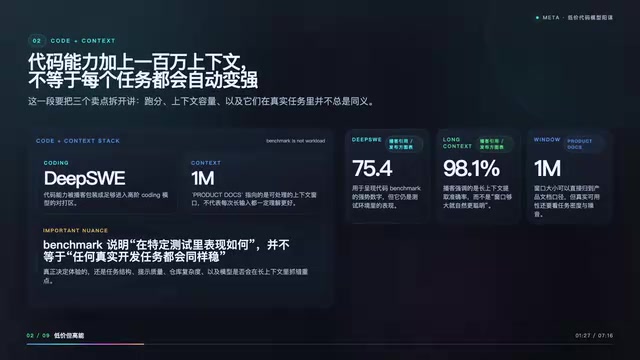
Meta Muse Spark 1.3 delivers impressive coding capabilities with 75.4 on DeepSway benchmarks and 98.1% accuracy on million-token contexts at ultra-low pricing ($0.1-$1.25 per million tokens). However, the "contributor package" exchanges compute for data—users grant Meta rights to their code for model training. While excelling at batch processing and large codebase analysis, it suffers from 27.5s first-token latency and spatial reasoning gaps. Ideal for personal projects, unsuitable for enterprise secrets.
A Disruptive Entry: Leveraging Top-Tier Coding Capability at 1% of Market Price
Meta's recently released Muse Spark 1.3 (MuSpark 1.3) has dropped a bombshell in the AI programming space. This model has an extremely clear positioning: offering top-tier code writing and long-text reasoning capabilities that allegedly match or even surpass Claude Opus 5 and GPT 5.6 SO, at a price far below market rates.
To put it simply, it's as if a top-tier programmer suddenly appeared on the market who can write 3D engines and fix complex bugs, but only charges 1% of the market rate—behind such an anomaly, there must be logic worth investigating.
Muse Spark 1.3 Core Performance: Impressive Data, But Discernment Required
Leading the First Tier in Code Benchmarks
Muse Spark 1.3 achieved a high score of 75.4 on the DeepSway code leaderboard. DeepSway is one of the industry-recognized benchmarks for evaluating AI coding capabilities, with its core characteristic being the realism of test scenarios. Unlike traditional HumanEval (which only tests function-level code completion) or MBPP (basic programming problems), DeepSway constructs complete software engineering scenarios: including the full workflow of requirement understanding, architecture design, code implementation, and debugging.
The evaluation standard is not whether code passes unit tests, but whether it can solve complex problems with ambiguous requirements, legacy code, and technical debt like a real engineer. This leaderboard specifically tests whether AI can solve real-world software engineering problems rather than simple multiple-choice questions, making it highly credible. A score of 75.4 means the model can provide usable solutions in approximately three-quarters of actual engineering tasks, placing it in the first tier among current mainstream models, approaching the performance of GPT-4 and Claude 3 Opus on coding tasks.
Million-Token Ultra-Long Context Processing
In ultra-long context tests with a million tokens, the model achieved an accuracy rate of 98.1%. Traditional large language models typically have context windows between 4K-32K tokens, equivalent to a few to several dozen pages of documents. A million-token context means the model can process approximately 750,000 English words or 500,000 lines of code at once—equivalent to an entire medium-sized software project codebase.
The technical challenge of this capability lies in the quadratic growth of attention mechanism computational complexity with context length, requiring architectural innovations such as sparse attention, sliding windows, and hierarchical caching. The 98.1% accuracy rate (typically verified through 'needle in a haystack' tests) means developers can directly feed hundreds of development documents or an entire medium-sized project's source code to the model and expect high-precision information extraction and analysis. The model can not only receive massive amounts of information but also precisely locate and extract key content. For engineering scenarios requiring global understanding in large codebases, this is an extremely valuable capability with revolutionary significance for code review, document retrieval, global refactoring, and similar tasks.
Benchmark Data Contains PR Manipulation
The impressive numbers aren't without issues. When showcasing OS World leaderboard results (testing how AI operates computer systems like humans), Meta deliberately used test sets from different time periods and compared against older model versions, artificially inflating the improvement margin. While this practice is not uncommon in the AI industry, it warrants caution from developers during evaluation.
Technical Architecture Analysis: Reasoning-First, Tool Calling Reduction

The "Master Craftsman Thinking" Architecture Philosophy
The core of Muse Spark 1.3's capability improvement lies in its learning to "do less." In AI programming assistant architectures, there are two problem-solving paradigms: tool-calling-based and reasoning-first. Tool-calling-based models (like early GPT-4 Code Interpreter) tend to iterate toward solutions by repeatedly executing code, examining errors, and adjusting parameters, similar to 'trial-and-error programmers.' Reasoning-first models strengthen internal chain-of-thought, conducting logical deduction and planning before outputting code, similar to 'design-oriented programmers.'
Previous large models tended to rely heavily on tool chain trial-and-error when writing code; this model significantly compresses invalid interactions, reducing tool calls by approximately 20%. This means it's more inclined to 'think before acting,' reducing ineffective attempts and lowering token consumption (each tool call incurs input-output costs). In its place is strengthened underlying reasoning—completing logical deduction internally before actually writing code.
This is like an experienced engineer who doesn't randomly try things with a wrench but first mentally locks onto the fault point before taking precise action. This approach not only improves accuracy but also significantly reduces token consumption, though the tradeoff is longer initial response time—the model needs more time for internal reasoning.
Engineering Closed-Loop Capability Practical Verification
In actual testing, Muse Spark 1.3 demonstrated mature engineering closed-loop capabilities:
- Writing a real-time strategy game Psychic Storm with a 3D engine from scratch in a single file
- Implementing a high-precision guitar tuner
- Fully automated troubleshooting and fixing of complex web project bugs
These cases demonstrate it possesses a fairly complete software engineering capability chain.
Pricing Strategy Deep Analysis: Bargain Packages and Meta's "Open Conspiracy"

Muse Spark 1.3 Pricing Structure
Muse Spark 1.3's pricing is remarkably aggressive: the standard version input costs only $1.25 per million tokens, far below most competitors. The "contributor package" input price is even lower at $0.1 per million tokens, which the developer community calls Meta's "DeepSeek pricing moment."
The Data Exchange Logic Behind Ultra-Low Pricing
There's no such thing as a free lunch. The contributor package is essentially a 'compute-for-data' business model. Choosing the contributor package means users agree to authorize their code and prompts to Meta for training future models. Every line of code, every prompt, every interaction submitted by users may be incorporated into Meta's training dataset to improve future models. This model isn't new in the AI industry—OpenAI also collected data through API usage agreements early on, until adjusting the policy after strong protests from enterprise customers.
For Meta, real engineering code data is more valuable than synthetic data: it contains actual business logic, error patterns, debugging approaches, and domain knowledge—things that cannot be obtained from GitHub public repositories. This is a precisely designed business loop: using near-free compute power to exchange for the scarcest resource in the current AI industry—high-quality real engineering logic data.
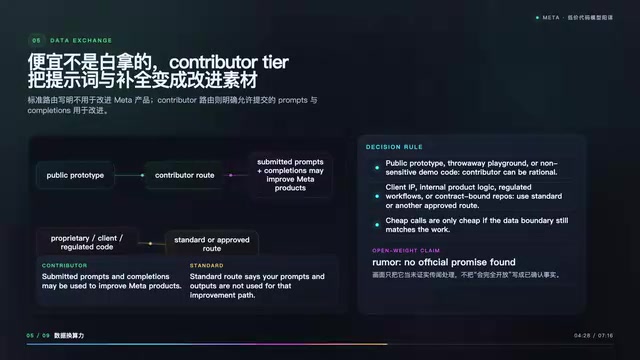
Developers need to realize that the cost of using $0.1 per million tokens is not just monetary—it's contributing one's programming thinking to Meta's model evolution. This is acceptable for personal projects or open-source code, but for enterprise core assets, it's a serious data leakage risk. For enterprise users, this point requires high vigilance. Core business logic, proprietary algorithms, and sensitive business code should absolutely not be transmitted through contributor package interfaces. Data isolation is not optional—it's mandatory.
Open Source Rumors Are Misinterpretations
Recent online circulation suggests Muse Spark 1.3 will soon be open weights (fully open-sourced, supporting local deployment)—this claim is a misinterpretation. Meta has never made an open-source commitment for version 1.3. Developers should not make technology selection decisions based on this expectation.
Real-World Shortcomings: High Latency and Spatial Understanding Limitations
First Response Latency Reaches 27.5 Seconds
The "doing less" architectural design comes with a cost. When running in maximum reasoning mode, Muse Spark 1.3's first token output latency reaches 27.5 seconds. The 27.5-second first-token latency stems from the model's 'slow thinking' mechanism. Modern large language models typically use autoregressive generation (token-by-token output), with first-token time referring to the thinking time before the model begins outputting the first character.
In high reasoning mode, Muse Spark 1.3 executes multiple rounds of internal chain-of-thought reasoning—similar to how human programmers draw flowcharts on scratch paper, list pseudocode, and consider edge cases before writing code. During this period, the model executes complex internal chain-of-thought reasoning, and while it improves final output quality, this process doesn't produce visible output but consumes significant computational resources. OpenAI's o1 series models use a similar strategy, with 'thinking time' reaching tens of seconds.
This design suits complex problem-solving (such as algorithm design and architecture optimization), but for development scenarios requiring real-time interactive feedback, the experience is extremely fragmented and unsuitable for scenarios requiring immediate feedback (such as code completion in IDEs, where users expect <1 second response). This means it's better suited as an "offline batch processing" programming assistant rather than a real-time code completion tool requiring quick responses. This also explains why the model is positioned as a 'batch processing programming assistant' rather than a 'real-time collaboration tool.'
Three-Dimensional Physical Space Understanding Has Blind Spots
In spatial reasoning, the model has obvious shortcomings. Current large language models are essentially performing pattern matching and statistical reasoning in two-dimensional symbolic space (text token sequences), lacking true three-dimensional spatial cognition. In testing, when asked to generate CAD model code for a 3D-printed sports car, while the code could run, it completely reversed the direction of the chassis and screw holes—this would cause direct losses in real manufacturing scenarios.
While models can learn the syntax rules and common patterns of CAD code, they cannot 'visualize' three-dimensional structures in their minds like human engineers. The error of reversing chassis and screw hole directions exposes the model's blind spot in spatial relationship understanding—it knows code should include 'chassis' and 'screw holes,' but doesn't understand the relative positional constraints of these two physical entities in three-dimensional space.
Such problems are particularly prominent in scenarios involving physical simulation, mechanical design, and architectural modeling. For tasks involving physical space modeling, mechanical design, and three-dimensional simulation, additional manual verification is required. Solutions may require multimodal architectures (combining vision and text) or specialized spatial reasoning modules, but current pure text large models still have fundamental limitations in this area.
Muse Spark 1.3 Applicable Scenarios and Usage Recommendations
Based on the above analysis, Muse Spark 1.3 is suitable for the following scenarios:
- Personal Development and Learning: Ultra-high cost-effectiveness, suitable for independent developers handling non-sensitive projects
- Low-Cost Prototype Validation: Quickly building functional prototypes, reducing trial-and-error costs
- Large Codebase Analysis: Million-token context capability offers clear advantages in global code understanding
- Non-Real-Time Programming Tasks: Batch code generation or refactoring tasks that can accept longer thinking delays
Unsuitable scenarios are equally clear: enterprise-level code development involving trade secrets (especially the contributor package), IDE inline completion requiring real-time interaction, and three-dimensional physical space modeling tasks.
Conclusion: Cost-Effective Tool or Data Collection Trap?
Muse Spark 1.3 is a double-edged sword. It genuinely lowers the barrier to using top-tier coding capabilities to an unprecedented level, representing genuine technological inclusion for independent developers and small teams. But the underlying logic of its business model is equally clear: Meta is systematically collecting developers' real engineering thinking data using near-free compute power to fuel its next-generation model evolution.
When evaluating an AI tool, price is never the only cost. Data sovereignty, privacy boundaries, and fit with use cases are dimensions more worthy of deep consideration. In this era of rapid AI capability iteration, rationally distinguishing between "tools" and "exchange conditions" is a fundamental judgment skill every developer needs to develop.
Key Takeaways
Related articles
AI Model Distillation Explained: Global Competition and Compliance Boundaries
Deep dive into AI model distillation: principles, applications, and controversies. Explore how knowledge distillation reduces training costs while navigating service terms and IP protection challenges in the global AI race.
MOSS-VL-Realtime Hands-On: 11B-Parameter Real-Time Video Understanding on Consumer GPUs
MOSS Intelligence's MOSS-VL-Realtime model hands-on: 11B open-weight parameters supporting watch-while-answering, active silence, and dynamic updates. Successfully deployed locally on dual RTX 4070Ti Super with ~13.3GB memory usage. 256K context with 1fps sampling suits real-time scenarios like live monitoring and experimental observation.

AI Test Automation Learning Roadmap: A Complete Guide from Beginner to Expert
Complete AI test automation learning roadmap covering foundation building, AI testing-specific skills, and toolchain practice. Master data quality testing, model performance testing, adversarial testing, and more to achieve rapid career transformation.