Meta Muse Spark 1.3 Lands in Cursor: A New Option for AI-Assisted Coding
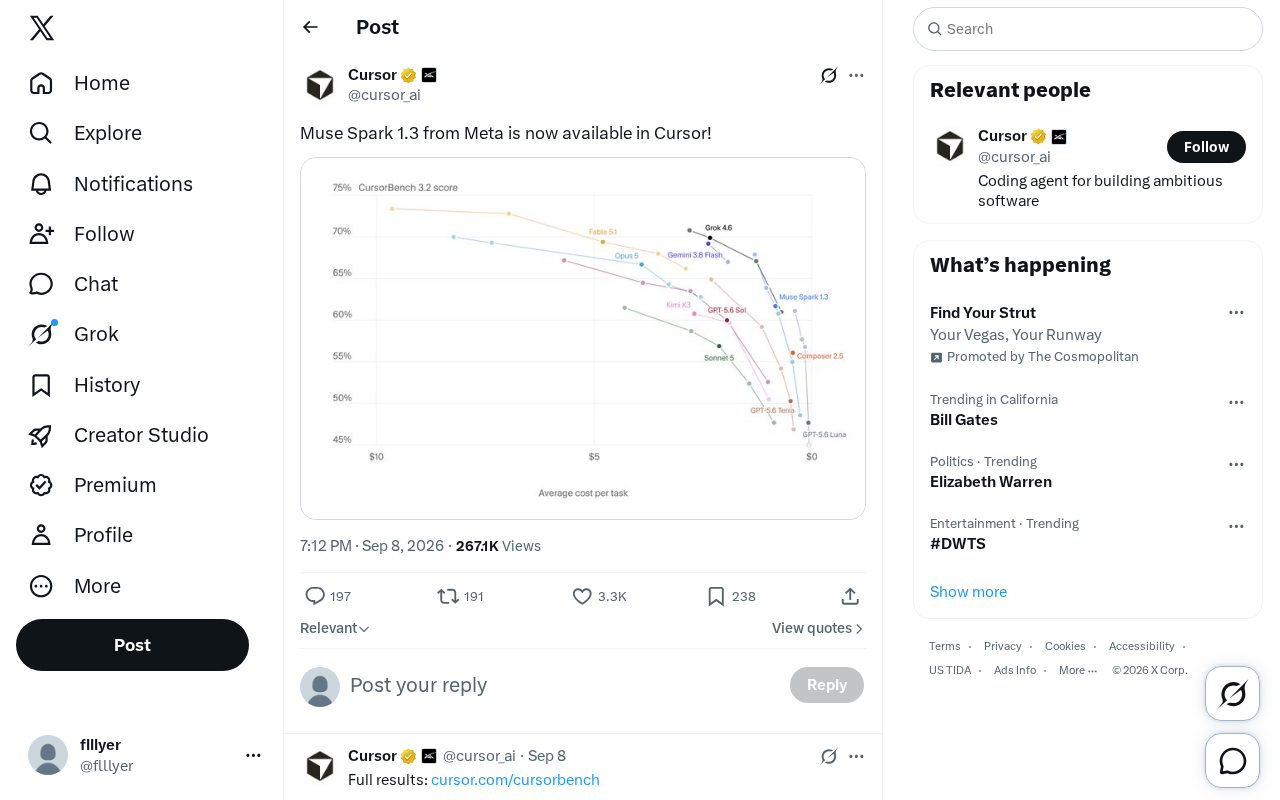
Meta Muse Spark 1.3 is now available in Cursor, giving developers a new AI model option for coding.
Meta's Muse Spark 1.3 model has officially launched in the AI code editor Cursor, allowing developers to use it directly for code completion, generation, and assisted development. Cursor is known for its support of multiple swappable models — including those from OpenAI and Anthropic — and this integration expands that selection further. For Meta, entering an editor that developers use daily is a key step toward real-world model adoption and gathering genuine coding feedback. Official details remain limited, with no performance benchmarks or pricing published yet, so developers are advised to test it on non-critical tasks before committing to long-term use.
Quick Take
Meta's Muse Spark 1.3 model is now available in the AI code editor Cursor. This means developers using Cursor can call this Meta-built model directly within the editor for code completion, generation, and assisted development.
For developers who closely follow AI coding tools, this is yet another signal of an ever-expanding model ecosystem. Cursor, one of the most popular AI-native editors today, continues to integrate more mainstream and emerging large models — letting users choose the engine that best fits their workflow.
Why This Integration Matters
Cursor's core strength lies in the fact that it isn't locked to a single model. Instead, it's built around a swappable, composable model layer. Developers can use models from Anthropic, OpenAI, and other major providers, while also experimenting with newer entrants for specific tasks. The addition of Muse Spark 1.3 expands that selection even further.
For Meta, pushing its own model into a third-party developer platform like Cursor is an important way to broaden real-world usage and gather genuine coding feedback. Compared to closed testing within its own products, landing directly in an editor developers use every day offers a much faster path to validating model performance on real code tasks.
What Model Diversity Means for Developers
Different models vary in coding style, context comprehension, response speed, and cost. In a multi-model environment, developers can:
- Choose a model with stronger reasoning capabilities for complex refactoring tasks
- Use a faster, more cost-efficient model for everyday completions
- Run side-by-side comparisons to find the combination that best fits their personal or team workflow
The arrival of Muse Spark 1.3 essentially adds a new variable to this decision-making framework. Its real competitive edge still needs to be validated through hands-on use in actual projects.
Cursor is an AI-native code editor developed by Anysphere — a company founded by former OpenAI researchers. Built on top of VS Code, it retains the full plugin ecosystem and the familiar interface developers already know, while deeply integrating large model capabilities. Its core features include multi-line code completion (Tab completion), conversational code generation (Cmd+K / Ctrl+K), codebase-level semantic search, and an Agent mode capable of autonomously making changes across multiple files. The biggest differentiator from tools like GitHub Copilot is that Cursor lets users freely switch the underlying model within the interface. Currently supported models include GPT-4o, Claude 3.5 Sonnet, the Gemini series, and more — with support for custom model endpoints via API key. This open architecture makes Cursor an attractive distribution channel for model providers looking to reach developers.
A Note on Limited Information
It's worth noting that publicly available information remains fairly sparse. The official announcement confirms only one fact: Muse Spark 1.3 is now available in Cursor. No detailed performance benchmarks, pricing structure, or comparative data against other models have been released alongside it.
For that reason, developers considering whether to incorporate this model into their workflow should approach it with measured expectations: try it on non-critical tasks first, observe its code generation quality, context retention, and how well it integrates with Cursor's existing features — then decide whether it's worth adopting long-term.
Public information on Muse Spark 1.3 is notably scarce in Meta's official materials. There is currently no official data on parameter scale, training data composition, context window length, or inference latency. When evaluating whether a new model is suited for coding tasks, several dimensions are typically worth examining: scores on code benchmarks like HumanEval or SWE-bench, long-context retention in real codebases, and actual response speed within Cursor's specific features such as Tab completion and Agent mode. In the absence of official benchmark data, community-sourced impressions — from developer discussions on Reddit, Discord, and similar platforms — often provide the most timely and practical first-hand assessments.
Takeaway
Meta Muse Spark 1.3 arriving in Cursor is a snapshot of the AI coding tool ecosystem's ongoing evolution. For developers, more model choices mean greater flexibility. For model providers, getting into a mainstream editor is a critical step toward real-world adoption. As always, the true value judgment belongs to the experience of everyday coding.
Related articles

Letting AI Build AI Tools: A 7-Day, 31-Commit Bootstrapping Post-Mortem
An engineer ran a fully autonomous AI-builds-AI pipeline for 7 days, 31 commits, with a 1-in-6 success rate. This post-mortem covers 5 failure types, 11 structural rules, and how every mistake became a permanent immunity gate.

Building an AI-Powered E-Commerce Business from Scratch: A Real-World Account of Multi-Agent Architecture for Print-on-Demand
A blogger builds a print-on-demand e-commerce company from scratch using AI agents — documenting specialized Agent profiles, GPT-5.6 vs Claude Fable multi-model orchestration, and reusable skill accumulation.

AI Agent Earns $10K in One Week: 3 Key Upgrades Explained
A blogger shares how he earned $10K in a week with an AI Agent — not by adding more skills, but through verification, approval gates, and subagents to raise trust and enable true automation.