Meta Muse Surpasses 10 Million Users, Shopping Emerges as Core Use Case

Meta's AI app Muse tops 10 million users, with shopping and productivity as its main use cases.
Meta disclosed in its quarterly earnings call that its AI app Muse has surpassed 10 million users, with shopping and personal productivity ranking among top use cases rather than pure chitchat. The data release signals AI ROI to investors: shopping intent is among the most valuable ad signals, and Muse could become a closed-loop entry from discovery to checkout. However, Meta has not disclosed shopping conversion or monetization details, and the share of users actually transacting remains unknown. The article notes AI app competition is shifting from user scale to use-case depth and retention, and Muse's ecosystem-tied approach has a clear commercial loop but heavy dependence on Meta's product matrix.
Meta disclosed during its latest quarterly earnings call that its AI app Muse has surpassed 10 million users. More noteworthy is the user behavior data: shopping and personal productivity rank among the top use cases, rather than pure chitchat or entertainment.
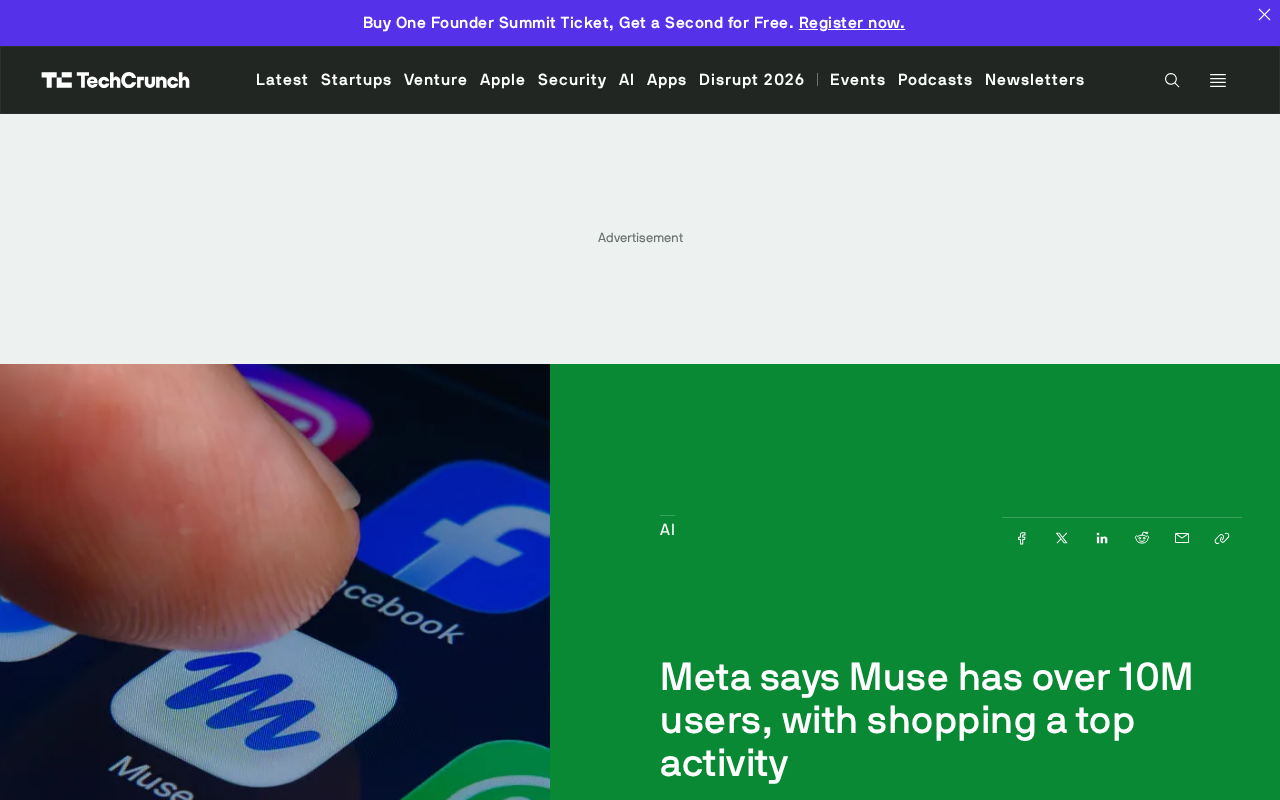
The Use-Case Shift Behind 10 Million Users
Meta's official signal is clear—Muse is not just a conversational AI toy. Among its 10 million users, a significant proportion use it as a shopping decision assistant and productivity tool. This positioning differs from the "general-purpose Q&A" approach of most current AI apps.
Shopping becoming a high-frequency use case shows that users are already using AI for product comparison, price assessment, and purchase recommendations. This type of demand naturally carries transactional attributes, which is a direct boon to Meta's advertising and e-commerce business. The productivity use case points to everyday tasks like writing, information organization, and schedule planning.
Meta's choice to release this data during an earnings call itself carries the intent of explaining its AI return on investment to investors. User scale is the surface-level number; shopping behavior is the commercial signal it really wants the outside world to see.
"Closed loop" in the context of internet business refers to a complete chain from user touchpoint to final conversion, where data at each stage is trackable and optimizable. The traditional advertising chain typically goes: impression—click—landing page—order, with multiple jumps and drop-offs along the way. The potential advantage of a conversational entry point lies in compressing the chain: users complete need expression, product comparison, and purchase decisions within the same conversation, and the platform can insert product recommendations or transaction entry points without interrupting the experience. Whether a closed loop holds depends on three conditions: sufficiently accurate intent recognition, sufficiently complete product supply, and a sufficiently smooth transaction chain. Meta currently has the foundation for the first two; the third depends on the maturity of its e-commerce infrastructure, which is why the outside world is watching its conversion data.
Why Shopping Is Especially Important for Meta
Meta's main revenue comes from advertising, and shopping intent is one of the most valuable advertising signals. When users express "what I want to buy" in Muse, they are proactively handing over a high-precision interest tag.
If this chain works, Muse could become a closed-loop entry point from "discovery" to "checkout." Compared with guessing user intent in the feed, needs captured through direct conversation are clearer and the conversion path is shorter.
However, Meta has not disclosed Muse's shopping conversion data or monetization details, and the proportion of its 10 million users who actually generate transactions remains unknown. Shopping is a "popular activity," but large-scale monetization remains to be seen.
To understand why shopping is especially important for Meta, one must return to the underlying logic of digital advertising: what advertisers pay for is essentially "certainty of purchase intent." Traditional display ads and interest targeting rely on behavioral inference—browsing history, clicks, dwell time, and other indirect signals—essentially guessing what users want to buy, so conversion rates have long been limited by signal noise. In conversational interaction, users proactively state "I want to buy a pair of running shoes, budget under 500 yuan"—this is explicitly expressed intent, with precision and contextual richness far exceeding behavioral inference. This is the meaning of the so-called "high-precision interest tag": it is not just that the tag is more accurate, but that it upgrades from probabilistic speculation to demand confirmation. For Meta, such signals can also feed back into its ad delivery system, improving targeting quality for other ad placements on its platforms and creating a compounding effect at the data level.
AI App Competition Enters the Use-Case Validation Phase
Surpassing 10 million users is a milestone, but the focus of competition among AI apps is shifting from "how many people use it" to "what they use it for." Retention and use-case depth say more than download numbers.
By making shopping and productivity its primary use cases, Muse is effectively avoiding head-on competition with general-purpose chat assistants and choosing an angle strongly tied to Meta's own ecosystem. The advantage of this route is a clear commercial closed loop; the risk is heavy dependence on Meta's product matrix.
The metrics worth watching next are retention rate and per-user usage frequency. If the shopping use case can settle into a stable habit, Muse will be more than a traffic entry point in Meta's AI landscape—it will be a transaction entry point.
"Use-case validation" is a key concept in the current AI app evaluation framework, referring to whether a product can form stable user habits and measurable value delivery on specific tasks, rather than just acquiring one-time trial traffic. Its counterpart is "scale validation"—looking only at surface metrics like downloads and monthly active users. The industry generally believes that the low switching costs of AI apps lead to very rapid user churn, and retention curves for pure general-purpose Q&A products often decline sharply in the following month. Therefore, retention rates (especially day-1, day-7, and day-30 retention) and per-user usage frequency have become more credible indicators. The core question of use-case validation is: have users formed a conditioned reflex of "when I encounter this kind of problem, I open this app" for a specific task? This is also why the article emphasizes that use-case depth says more than download numbers.
One-line Summary
Meta's AI app Muse surpasses 10 million users, with shopping and productivity as its main use cases.
Paragraph Summary
During its latest quarterly earnings call, Meta disclosed that its AI app Muse has surpassed 10 million users, emphasizing that shopping and personal productivity are among its top use cases rather than pure chitchat and entertainment. The release of this data carries the intent of explaining its AI return on investment to investors: shopping intent is one of the most valuable advertising signals, and Muse is expected to become a closed-loop entry point from discovery to checkout. However, Meta has not disclosed shopping conversion data or monetization details, and the proportion of its 10 million users who actually generate transactions remains unknown. The article notes that the focus of AI app competition is shifting from user scale to use-case depth and retention. Muse has chosen an angle strongly tied to Meta's ecosystem, with a clear commercial closed loop but heavy dependence on the parent product matrix; retention rates and usage frequency should be watched going forward.
Related articles

Free Unlimited Claude Code Solution: Agnes AI + CC Switch Setup Guide
No paid subscription needed — pair the free AI platform Agnes AI with the open-source tool CC Switch to provide a backend for Claude Code, enabling unlimited free calls to text, image, and video models. This guide covers the full setup, test results, and usage boundaries.

A Complete Zero-Cost Guide to Getting Started with Claude Code for Beginners in China
A beginner's guide to Claude Code for users in China: two installation methods (command line and IDE plugin), full configuration steps for replacing the official API with the free domestic LongCat model, and a hands-on demo of building a small tool with natural language, plus tips.

When the NSA Gets Involved: The AI Supply Chain Crisis Behind Open-Source CVEs and API Key Hijacking
Multiple open-source projects disclosed severe CVEs in one day, PHP flaws alarmed the FBI, and Railway and OpenCode were breached with API keys stolen. This article breaks down the vulnerability window, AI-accelerated exploitation, and the AI supply chain crisis behind the API key black market, with a developer defense checklist.