Meta Open-Sources Muse Spark: 816B Coding Model Lands on NVIDIA GB300

Meta open-sources the 816B MoE coding model Muse Spark Open, with NVIDIA completing GB300 NVL72 adaptation.
Meta has officially released and open-sourced Muse Spark Open, an MoE coding model with 816B total parameters, 42B activated parameters, and a 1M-token context window, positioned for Agentic Coding workflows. NVIDIA announced the model has been adapted for the GB300 NVL72 rack-scale platform, offering a deployable solution for enterprise private deployment. The article covers its technical specs, the demands of Agentic Coding, GB300 NVL72's role, and the reality that its 816B scale confines it to enterprise and cloud hosting.
Meta Description
Meta has open-sourced its coding LLM Muse Spark Open: an 816B MoE architecture with 42B activated parameters and a 1M-token context, now adapted for the NVIDIA GB300 NVL72 platform and targeting enterprise-grade Agentic Coding workflows.
Article Content
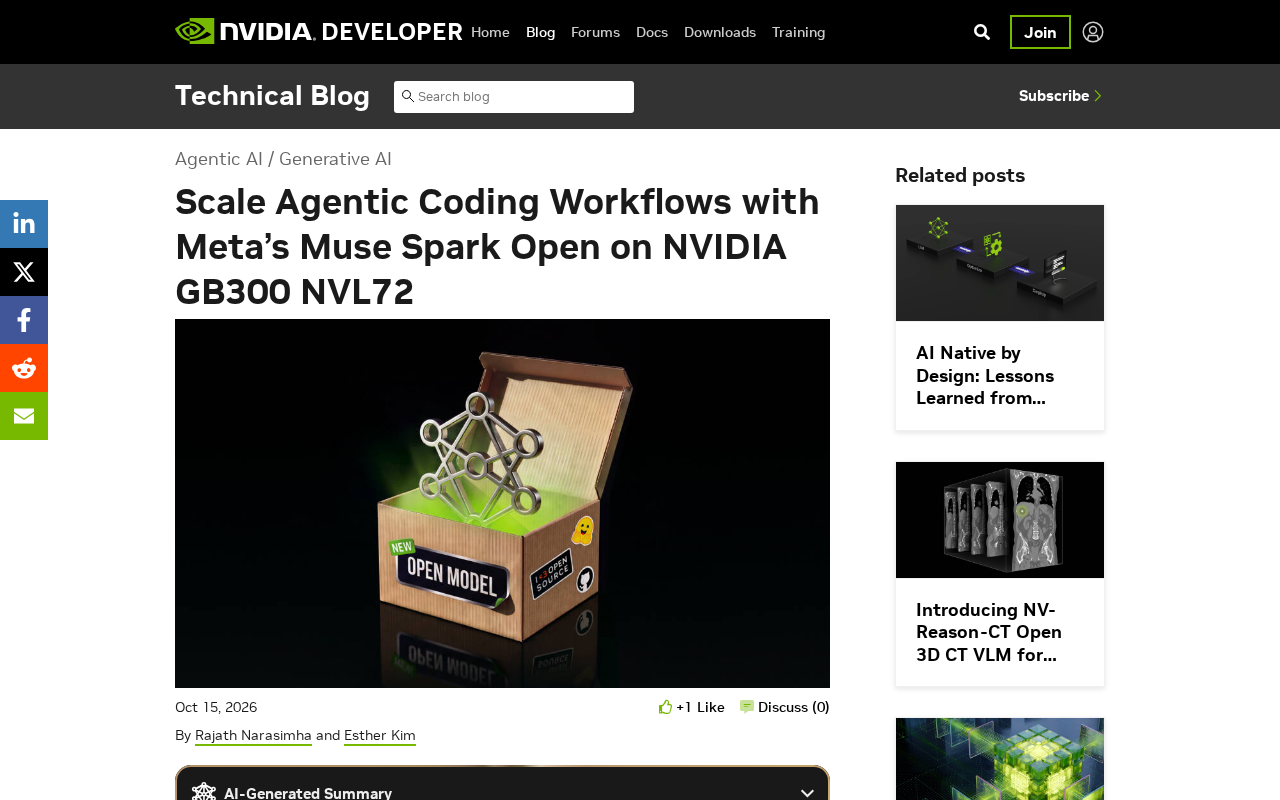
Meta has taken another step forward in its developer ecosystem. According to the NVIDIA developer blog, Meta has officially released and open-sourced Muse Spark Open—a Mixture-of-Experts (MoE) large model optimized for coding scenarios, with a parameter scale of 816B, 42B activated parameters, and support for a 1M-token context window. That said, NVIDIA announced that the model has been adapted and performance-validated on the GB300 NVL72 platform, offering a directly deployable solution for enterprise-grade Agentic Coding workflows.
Muse Spark Open's Technical Specs: Parameters and Architecture
From the publicly available information, Muse Spark Open's core positioning is very clear: coding and agentic workflows.
In terms of specific specs, the combination of 816B total parameters with 42B activated parameters means the model only invokes about 5% of its total parameters during inference. This MoE design approach is consistent with the trend of previous generations of open-source models—using an extremely large parameter pool to carry broad knowledge, and sparse activation to control unit inference cost.
The 1M-token context window is another metric worth noting. For Agentic Coding scenarios, long context means the model can accommodate snippets of an entire codebase, multi-turn tool-call records, and historical conversations within a single session, reducing task failures caused by context truncation.
Mixture-of-Experts (MoE) is an architecture that splits a large model into multiple "expert" sub-networks. Each input token does not pass through all parameters during inference; instead, a router network selects the few most relevant experts to activate for computation. As a result, an MoE model's total parameter count can be very large, but the number of parameters actually involved in a single inference (i.e., activated parameters) is much smaller. The benefit of this design is that the model's knowledge capacity expands with total parameters, while unit inference cost is mainly determined by activated parameters. The trade-off is that VRAM still needs to hold all expert weights, and both training and inference place high demands on expert routing load balancing and communication bandwidth, typically requiring purpose-built infrastructure.
Why Agentic Coding Needs a Dedicated Model
The essential difference between Agentic Coding and traditional code completion lies in the length of the task chain.
Traditional completion only needs to understand the local context of the current file, whereas Agentic Coding requires the model to autonomously plan steps, call tools, read errors, modify multiple files, and verify results. This process imposes higher demands on the model's instruction-following ability, long-range memory, and code semantic understanding.
Meta's choice to cover this scenario with a dedicated model rather than a general-purpose one is logical: coding tasks have relatively clear feedback signals (whether the code runs, whether tests pass), making them suitable for targeted post-training optimization. Muse Spark Open's 816B scale also shows that Meta believes Agentic Coding needs sufficient parameter capacity to support complex reasoning, and sparse activation is a means of balancing effectiveness and cost.
Post-training refers to the further training phase a model undergoes after large-scale pre-training, typically including supervised fine-tuning (SFT), reinforcement learning from human feedback (RLHF), and preference optimization for specific tasks. For coding tasks, post-training often uses unit test pass rates, compiler feedback, or code execution results as reward signals, teaching the model to generate code that actually runs. Compared with natural language tasks, code feedback signals are more objective and automatically verifiable, which makes reinforcement learning post-training for coding scenarios particularly effective—and is one of the important reasons why dedicated coding models can outperform general-purpose models of the same scale.
What NVIDIA GB300 NVL72 Brings
In its blog, NVIDIA positions GB300 NVL72 as the scale-out running platform for Muse Spark Open.
GB300 NVL72 is a rack-scale system for large-scale AI inference, designed to support low-latency inference for extremely large models within a single cluster. For an MoE model at the 816B level, VRAM capacity, interconnect bandwidth, and expert routing efficiency are the key bottlenecks. By releasing Muse Spark Open together with GB300 NVL72, NVIDIA is effectively signaling to enterprises: open-source large models can also run on data-center-grade hardware, without having to rely on closed-source APIs.
For teams that need data isolation or controllable costs, this is an option worth evaluating.
Rack-scale system refers to a server form factor designed around an entire rack as the unit, integrating dozens of GPUs into a single logical compute resource through high-speed interconnects. Its core value lies in solving the VRAM wall and communication wall problems of extremely large models: a single GPU has limited VRAM, and an 816B-level model cannot fit on a single card, so weights must be split across multiple cards; meanwhile, MoE's expert routing requires frequent cross-card data exchange, making it extremely sensitive to interconnect bandwidth. Rack-scale systems use unified high-speed interconnects (such as NVLink) and shared memory pools to keep this cross-card communication at relatively low latency, thereby supporting real-time inference for large models.
The Realities of Open Source and Deployment
Muse Spark Open's "Open" is reflected in its open weights, but the actual deployment barrier is not low.
816B parameters means that even with sparse activation, the complete weights still require a massive amount of VRAM. Rack-scale systems like GB300 NVL72 are themselves designed for this kind of workload, and an ordinary developer's single-machine environment would struggle to support it. Therefore, the model's realistic use cases center on two paths: enterprise-grade deployment and cloud provider hosting.
This move by Meta continues its strategy on open-source large models: building ecosystem influence by opening weights, while partnering with hardware vendors to reduce deployment friction. NVIDIA's involvement ensures first-hand optimization support for the model on its own platform.
Practical Implications for Developers
From a developer's perspective, the emergence of Muse Spark Open offers several possibilities:
First, if your team is already using NVIDIA's inference infrastructure, Muse Spark Open can be evaluated as a candidate model for Agentic Coding without building an environment from scratch.
Second, the combination of a 1M-token context and 42B activated parameters is suited to workflows that need to handle large codebases or multi-step automation tasks.
Third, open weights mean you can do private fine-tuning, adapting the model to specific coding standards or internal toolchains.
Of course, the model's actual coding ability, tool-calling accuracy, and other metrics still need to be verified through more third-party evaluations and community feedback. NVIDIA's blog currently provides deployment feasibility information rather than comprehensive performance comparison data.
Summary
The release of Meta Muse Spark Open, along with its adaptation for NVIDIA GB300 NVL72, forms a complete enterprise-grade solution from model to hardware. The three numbers—816B MoE, 42B activated, 1M context—point to Agentic Coding's real needs for long context and complex reasoning. For teams focused on open-source coding models and private deployment, this is a combination worth tracking.
One-line Summary
Meta open-sources the 816B-parameter MoE coding model Muse Spark Open, with NVIDIA completing GB300 NVL72 adaptation.
Paragraph Summary
Meta has officially released and open-sourced Muse Spark Open, an MoE large model for coding scenarios, featuring a sparse architecture with 816B total parameters and 42B activated parameters, supporting a 1M-token context window and positioned for Agentic Coding workflows. NVIDIA announced that the model has been adapted on the GB300 NVL72 rack-scale platform, providing a directly deployable solution for enterprise-grade private deployment. The article analyzes its technical specs, Agentic Coding's need for long context and complex reasoning, GB300 NVL72's supporting role in VRAM and interconnect, and notes that the 816B scale means its use cases center on enterprise and cloud hosting, with ordinary developers unable to run it on a single machine, while open weights support private fine-tuning.
Related articles

AI-Powered SRC Vulnerability Hunting: A Hands-On Guide to Building the Hermes Agent Workbench
Based on a hands-on Bilibili video: how to build an AI-powered SRC vulnerability hunting workbench—three-step method, four report elements, Agent mode vs web chat, and tool selection.

CLI-Anything Complete Beginner's Guide: How AI Operates Software — Principles and Practice
A complete beginner's guide to CLI-Anything: how AI Agents operate professional software via the command line, covering the three-layer architecture, CLI Hub installation, DrawIO practice, generator principles, and limits.

Carbon-X: A 14.8B Open-Source Model That Handles DNA and Text Simultaneously
Carbon-X is a 14.8B open-source multimodal model on Hugging Face where DNA and text share a token stream. 6-mer tokenization, 302B token mid-training, deployable on a single 80GB GPU, 66.7% average on five DNA benchmarks, Apache 2.0 license.