Meta Releases Muse Spark Open Weights: 816B Parameters, 1M Context, and Deployment Guide

Meta open-sources the 816B sparse MoE model Muse Spark: strong performance, but high hardware and license barriers.
Meta released Muse Spark open weights in October 2026, a sparse Mixture-of-Experts model with 816B total parameters, 42B activated parameters, and native 1M token context. It continues Llama's open weights plus custom license model. Inference cost is close to a 42B dense model, but all weights must stay in VRAM—about 816GB under FP8—and 1M-context KV Cache overhead is even greater. Benchmarks show strong code and math performance, close to but not surpassing top closed-source models, with gaps in complex chain-of-thought reasoning and multilingual scenarios. The license has potential restrictions. For deployment, vLLM or TensorRT-LLM is recommended, and cloud multi-GPU instances are more realistic than local setups.
Meta Releases Muse Spark Open Weights: 816B Parameters, 1M Context, and Deployment Guide
Meta officially released the open weights for Muse Spark on October 15, 2026. It is a sparse Mixture-of-Experts model with 816B total parameters and 42B activated parameters, natively supporting a 1M token context window. For the open-source community, this is another aggressive bet by Meta on open-sourcing ultra-large models after the Llama series. But open weights do not mean out-of-the-box usability—hardware thresholds, license terms, and performance shortcomings all need careful scrutiny.
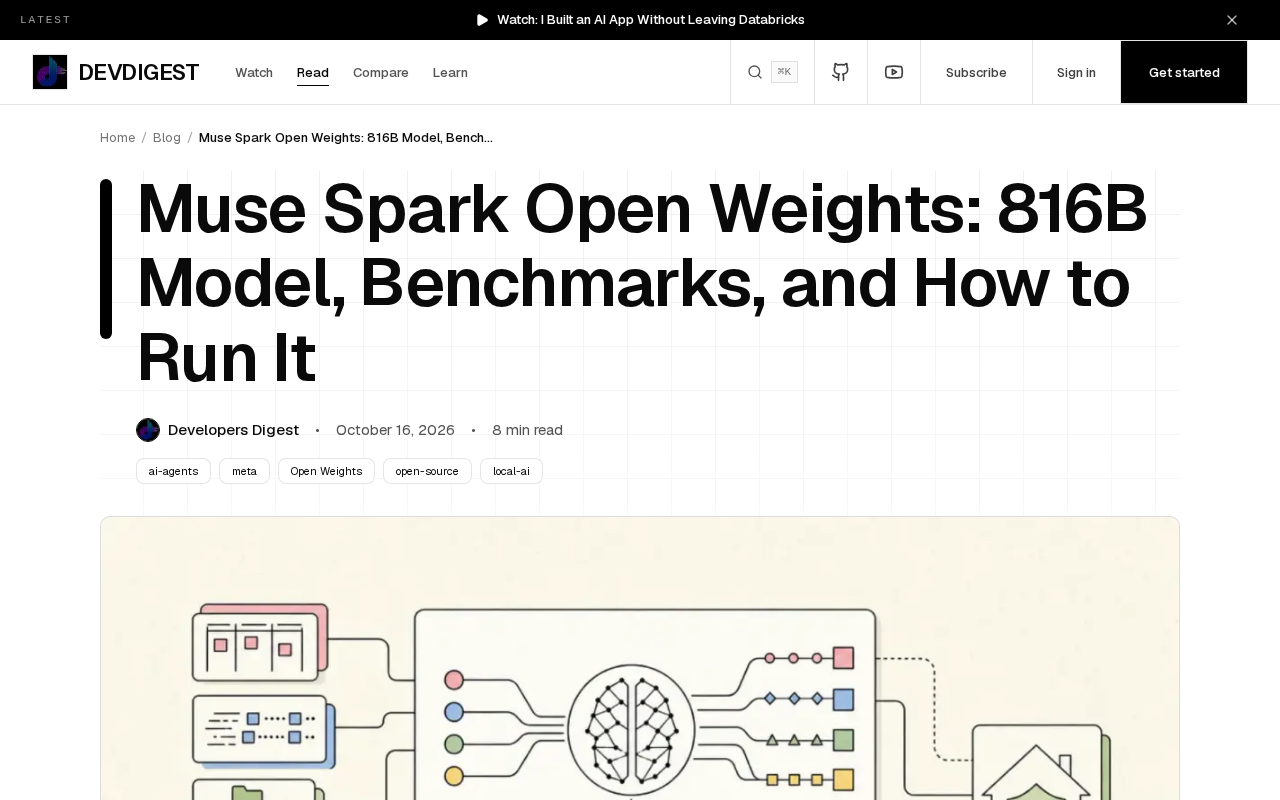
Muse Spark Core Specs: Sparse MoE Architecture
Muse Spark uses a sparse Mixture-of-Experts (MoE) design with 816B total parameters, but only 42B parameters are activated per forward pass. This means inference compute overhead is close to that of a 42B dense model, while model capacity benefits from the 816B total parameter reserve. The 1M token context window is another significant upgrade, directly targeting the long-context capabilities of Gemini and Claude.
From an architectural choice perspective, Meta is clearly trying to balance inference cost and model capability. The 42B activation makes single-card or multi-card inference feasible, while the 816B total ensures the model's performance on knowledge storage and complex reasoning tasks. This design approach follows the same lineage as MoE models like DeepSeekAd-V3 and Mixtral, but at a larger scale.
Sparse Mixture-of-Experts (MoE) is an architecture that splits a model into multiple "expert" subnetworks. During each input token's forward pass, a gating network (router) selects and activates only a few experts, while the rest remain dormant. This produces two key metrics: total parameter count determines the model's capacity ceiling (how much knowledge it can store), and activated parameter count determines the actual compute per inference. Mixtral 8x7B and DeepSeek-V3 both use this design—the former has 47B total but activates only about 13B, while the latter has 671B total and activates 37B. Muse Spark's 816B/42B ratio is similar, meaning it can run at a compute cost close to a 42B dense model, but all parameters must reside in VRAM. This is the fundamental reason its memory threshold remains so high.
1M token context window refers to the maximum input length the model can "remember" in a single pass. 1M tokens is roughly 700,000 to 800,000 English words, or several long novels, or an entire medium-sized codebase. The core mechanism supporting long context is attention computation, whose overhead grows quadratically with sequence length and requires caching Key and Value vectors for each token (the KV Cache). At 1M context, the KV Cache can reach hundreds of GB, making actual long-context deployment far harder than the advertised window size suggests. This is also the technical root of the article's point that "effective utilization may be discounted."
Hardware Threshold: How Much VRAM Is Needed at Minimum
The biggest practical issue with open weights is hardware. Even with FP8 or INT8 quantization, Muse Spark's 816B parameters require about 816GB of VRAM to load all weights. With 4-bit quantization, the theoretical minimum is about 408GB, but actual deployment must also account for KV Cache and activation memory overhead—and the KV Cache at 1M context is itself extremely substantial.
Pragmatically, a single 8×H100 machine (80GB×8=640GB) can barely load it under FP8, but actual inference at 1M context requires more aggressive sharding or quantization strategies. For most developers, cloud on-demand instances or multi-machine Tensor Parallel are more realistic choices. The runtime recipe Meta provides at release should include configuration examples for vLLM or TensorRT-LLM, but deployment complexity is clearly higher than for 7B-70B class models.
Benchmark Performance: The Gap With Leading Models
According to release information, Muse Spark is close to but does not surpass the current strongest closed-source models on most benchmarks. It performs strongly on code generation and mathematical reasoning, where the 42B activated parameters are highly efficient. But on long-context retrieval and multi-turn dialogue consistency, the actual effective utilization of the 1M window may fall short of marketing claims—a common ailment of all long-context models.
Meta officially acknowledges that Muse Spark still lags on certain tasks, specifically complex tasks requiring deep chain-of-thought reasoning and some multilingual scenarios. This candor is uncommon in open-source releases, and it also signals that users need to evaluate it specifically for their task types rather than blindly replacing existing models.
Long-context retrieval is often evaluated with tests like "Needle in a Haystack": a fact is randomly embedded in a long text, and the model is tested on whether it can accurately locate and recall it. Many models claim a 1M window, but recall drops noticeably in the middle of the sequence or with extremely long inputs—a phenomenon called "context rot." Multi-turn dialogue consistency refers to the model's ability to remember earlier agreements and avoid self-contradiction after dozens of interaction turns. Long-context models often degrade in later turns due to attention dilution.
Chain-of-Thought reasoning means the model generates intermediate reasoning steps before giving an answer, which is especially critical for math, logic, and code tasks. MoE models with fewer activated parameters are prone to "breaking the chain" or skipping steps on long reasoning chains because the activated expert capacity is limited. Lag in multilingual scenarios often stems from uneven training corpus distribution—when English data dominates, representation ability for low-resource languages is noticeably weaker than for mainstream languages. This is also why multilingual tasks must be tested in the target language rather than judged only by English benchmarks.
License Terms: Open but Conditional
Muse Spark's license is not fully unrestricted Apache 2.0. According to release information, there is a "license catch" to watch for—possibly including a monthly active user threshold, commercial use restrictions, or prohibitions in specific scenarios. For teams planning commercial use, be sure to read the full license carefully before deployment, especially provisions involving competitor use, model distillation, and redistribution.
Open weights and open-source licenses are two different things. Meta has already established an "open weights + custom license" model with the Llama series, and Muse Spark most likely continues this strategy. Developers need to confirm whether their use case falls within the permitted scope.
Open weights means the model parameter files can be publicly downloaded, but it does not mean they can be used freely—it is a different concept from open-source licenses (such as Apache 2.0, MIT). Apache 2.0 grants almost unrestricted rights to use, modify, and commercialize; while the custom community license Meta used for the Llama series usually attaches conditions, such as: companies with more than 700 million monthly active users must apply for separate authorization, using model outputs to train competing models is prohibited, and products must be labeled "Built with Llama."
For Muse Spark, key clauses to check include: monthly active user threshold (determines whether your company triggers additional authorization), competitor use restrictions (whether use in developing competing models is prohibited), model distillation terms (whether its outputs can be used to train smaller models), and redistribution rules (whether weights can be redistributed or integrated into commercial products). Practical advice: hand the license to legal for clause-by-clause comparison, especially when planning to embed the model in a SaaS product or distribute it after fine-tuning—boundary clauses often determine project feasibility.
How to Run It: Deployment Paths and Toolchain
Actually running Muse Spark requires several key decisions: quantization scheme (FP8/INT8/4-bit), inference framework (vLLM, TensorRT-LLM, SGLang), and parallelism strategy (Tensor Parallel, Pipeline Parallel). For most teams, it is advisable to start with cloud multi-GPU instances and use vLLM's OpenAI-compatible interface to quickly validate results.
For local deployment, 8×H100 or 8×H200 is a more realistic starting point, but 1M context requires additional memory planning. The runtime recipe Meta provides should include Docker images and recommended configurations, which can significantly reduce onboarding difficulty. If you are only evaluating model capability, you can also first try it via API or a hosted service, then decide whether to invest in hardware resources.
Conclusion
Muse Spark's open weights are an important open-source move by Meta on ultra-large MoE models. Its 816B total parameters and 1M context represent the current capability boundary of open-source models. But hardware thresholds, license restrictions, and performance gaps on some tasks mean it is better suited to teams with ample compute resources and technical capability. For individual developers and small teams, waiting and watching or using a hosted service may be the more rational choice.
One-line Summary
Meta open-sources the 816B sparse MoE model Muse Spark: strong performance, but high hardware and license barriers.
Paragraph Summary
Meta released Muse Spark open weights in October 2026, a sparse Mixture-of-Experts model with 816B total parameters and 42B activated parameters, natively supporting a 1M token context. It continues Llama's "open weights + custom license" model. Inference cost is close to a 42B dense model, but all weights must reside in VRAM—about 816GB under FP8—and the KV Cache overhead at 1M context is even greater. Benchmarks show strong performance on code and math tasks, close to but not surpassing the strongest closed-source models, with remaining gaps in complex chain-of-thought reasoning and multilingual scenarios. The license contains potential restrictive clauses that must be carefully checked before commercial use. For deployment, vLLM or TensorRT-LLM is recommended, and cloud multi-GPU instances are more realistic than local deployment.
Related articles

Uber Deploys ChatGPT Work Company-Wide: AI in the Workplace Enters the Scaled Implementation Phase
Uber deploys ChatGPT Work to 30,000+ employees, extending it from engineering to all roles. We analyze its expert-engineer pairing, end-to-end automation, and questions of AI control and power concentration—insights for scaling AI in the workplace.

Shift at Midnight Hands-On: When "ID Verification" Becomes Alien Hunting
Shift at Midnight blends ID verification with horror survival in a four-player co-op game. We break down its inspection mechanics and chaotic humor.

Zelensky Recounts the Outbreak of War: I Need Ammunition, Not a Ride
Zelensky recalls the first day of war in a YouTube interview: farewell to family, rejecting Biden's evacuation offer with "I need ammunition, not a ride," and how Bucha shaped his stance on compromise and peace talks.