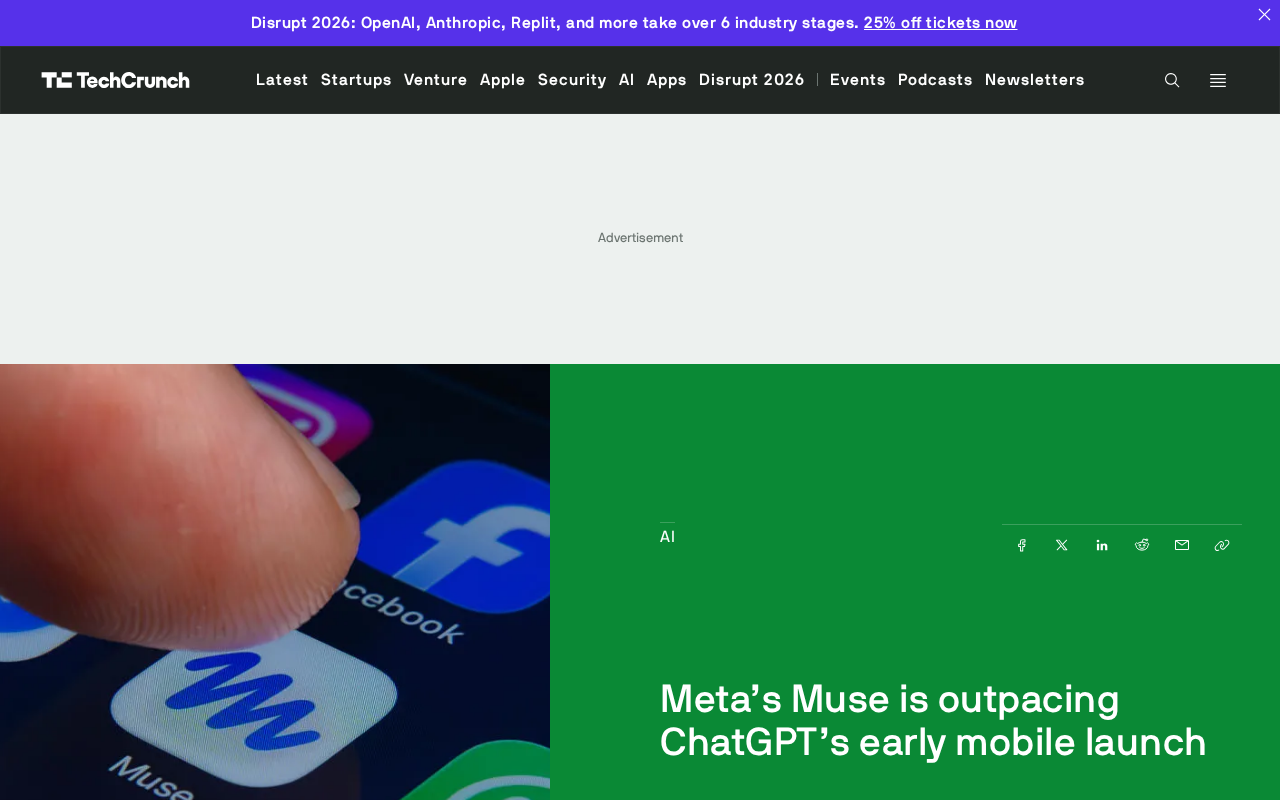
Meta's Muse Is Outpacing ChatGPT's Early Mobile Launch

Meta's Muse outpaces ChatGPT's early mobile numbers in downloads and DAU across the US and Canada.
According to third-party analytics firm Appfigures, Meta's AI agent Muse has outperformed ChatGPT's mobile launch in downloads and daily active users across the US and Canadian markets. Much of this early lead stems from Meta's massive distribution network across Facebook, Instagram, and WhatsApp — a very different starting point than OpenAI's word-of-mouth-driven cold start. Still, leading on both acquisition and retention metrics is a meaningful competitive signal, and analysts suggest consumer AI competition is shifting from model quality toward distribution and user retention capabilities.
Meta's AI Assistant Muse Is Off to a Strong Start
According to the latest estimates from app analytics firm Appfigures, Meta's newly launched AI agent Muse has put up impressive numbers in the US and Canadian markets — in the same post-launch time window, both its download count and daily active users (DAU) have surpassed what ChatGPT's mobile app achieved when it first launched.
This comparison is worth noting precisely because ChatGPT's mobile app was long regarded as the gold standard for consumer AI product growth. It shot to the top of app store charts almost immediately after launch, becoming a cultural phenomenon. Muse beating that benchmark on key metrics signals that Meta is moving through the consumer AI space faster than many expected.
Why Muse Is Growing So Quickly
Meta has a growth engine that few other AI companies can match. Its family of super-apps — Facebook, Instagram, WhatsApp, and Messenger — forms a massive distribution network that gives any new product a head start through an existing user base and built-in entry points. By contrast, when OpenAI launched the ChatGPT mobile app, it relied primarily on word-of-mouth and media buzz to drive growth.
So when comparing Muse's early numbers directly to ChatGPT's, it's important to recognize that the two products did not start from the same line. Muse's rapid uptake is largely a function of Meta's existing reach, not purely its product appeal. That doesn't diminish the significance of the data, but it does provide necessary context.
This kind of advantage is sometimes called the "Super-App Ecosystem Effect." As of 2024, Meta's apps collectively have over 3.8 billion monthly active users — more than half of all internet users worldwide. Within that ecosystem, new products can reach existing users through push notifications, feed recommendations, and in-app banners, with almost no need for additional user education. This is fundamentally different from the path taken by independent AI companies like OpenAI and Anthropic, which must build user awareness from scratch and rely on media coverage and organic word-of-mouth. Meta has leveraged similar distribution advantages before — most notably with Reels against TikTok and Messenger Rooms for video calling — though not every product has gone on to achieve lasting market dominance.
What the Data Signals for the Competitive Landscape
Downloads and DAU are the core metrics for gauging a consumer app's early momentum. Downloads reflect acquisition breadth; daily actives better capture real usage and stickiness. The fact that Muse is leading ChatGPT's early performance on both fronts suggests it isn't just pulling users in — it's holding onto them, at least initially.
That said, whether early high growth translates into long-term retention and commercial value remains to be seen. AI assistant products broadly face a "high download, low retention" challenge, and whether users form daily habits after the initial novelty wears off is what ultimately determines a product's success. Appfigures' estimates paint a picture of the starting sprint, not the finish line.
Appfigures is a third-party mobile market analytics firm whose data draws on app store rankings, estimated download models, and user behavior sampling — it is not official data published by the App Store or Google Play. As a result, the download and DAU figures cited here are estimates with inherent methodological margins of error, and results may differ from other firms such as Sensor Tower or data.ai. The value of this kind of third-party data lies in providing a comparative reference point rather than precise absolute figures. When interpreting early growth data for AI products, the limitations of the source are worth keeping in mind.
Implications for the Consumer AI Market
Muse's strong opening marks an acceleration in the pace at which large tech companies are embedding AI capabilities into their own product ecosystems, directly challenging native AI companies like OpenAI. With distribution channels, user scale, and capital reserves on its side, Meta has the ability to put AI products in front of hundreds of millions of users in a very short time.
For the broader industry, this means competition in consumer AI is gradually shifting from "whose model is stronger" to "who can reach and retain users more efficiently." Technical superiority still matters, but ecosystem and distribution capabilities may become the decisive variables in determining market share. Muse's current lead is a signal worth watching closely — its trajectory going forward will reveal whether Meta can truly convert its traffic advantage into a durable moat in the age of AI.
Related articles

Bilibili's Hit Dify Tutorial: A Practical Guide to Building 20+ AI Apps from Scratch
A distilled guide to Bilibili's top-rated Dify tutorial: Windows + Docker deployment, MySQL connection, five app types, model integration strategy, and publishing.

Agent Skills Beginner's Guide: From Concepts to Multi-Agent Collaboration in Practice
A comprehensive guide to Agent Skills: core concepts, components, the importance of Description, standardization, beginner learning paths, and multi-agent collaboration.

One Neuron Detects Both Cats and Cars? We Reproduced It and Found a New Explanation
The cat-car neuron reinterpreted: researcher Cammarata argues it distinguishes pointy from round, not cats from cars. We reproduced the experiment and found the new explanation holds on most inputs—but cars are the exception. The interpretability debate continues on language models.