Meta Tests Standalone Messaging App Direct: Instagram DMs Split Off
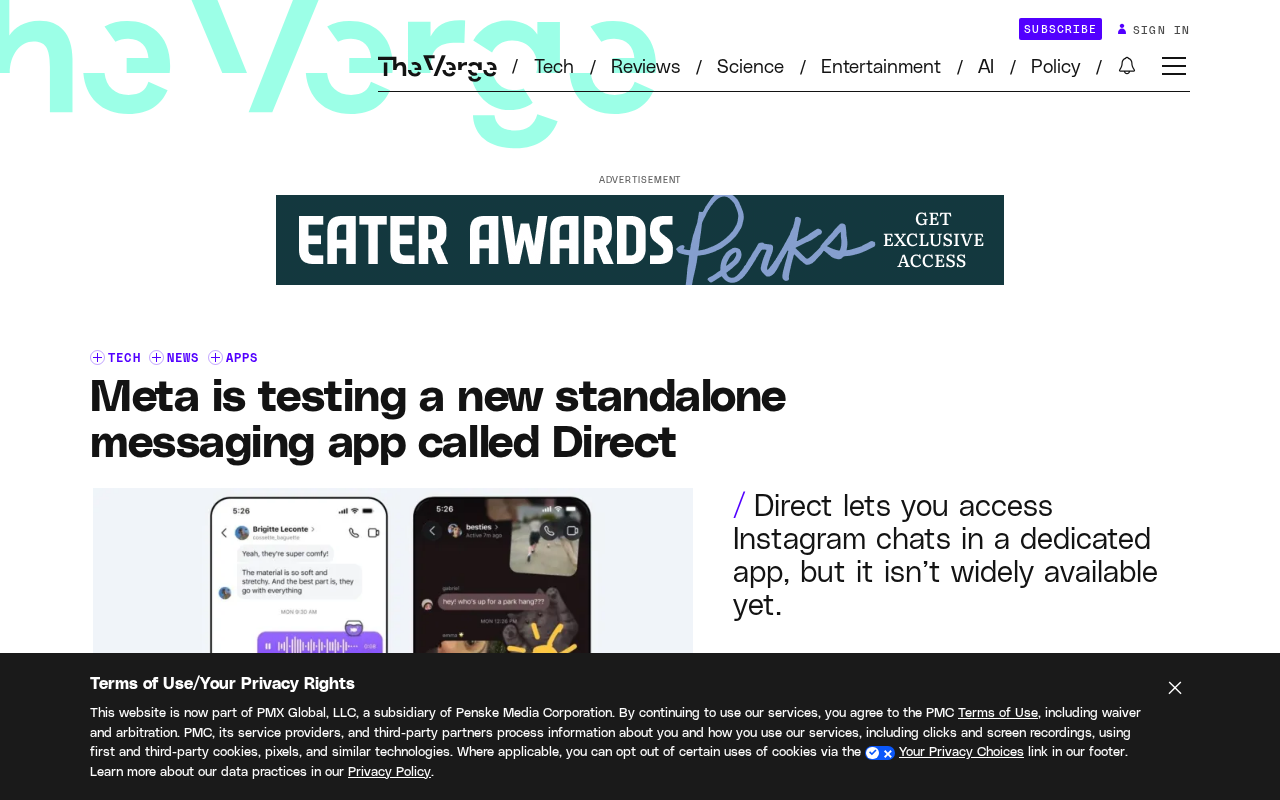
Meta is testing the standalone messaging app Direct in Turkey and Thailand, extracting Instagram DMs.
Meta is testing the standalone messaging app Direct in Turkey and Thailand, essentially the Instagram DM module stripped of social features like the feed, Reels, and Stories. After logging in with the same account, chats sync between Instagram and Direct to provide a more focused conversation experience. Choosing emerging markets for early testing continues the strategy of reducing trial-and-error costs. Direct's split logic is similar to Messenger's, but the starting point and account system differ: Instagram DMs were already embedded, so the split must prove incremental value; account sync lowers migration costs but also makes it hard to exist independently of the Instagram ecosystem. Testing-phase details are limited, and launch timing and expansion plans have not been announced; long-term positioning depends on user retention and engagement data.
Meta Tests Standalone Messaging App Direct: Instagram DMs Split Off
Meta is splitting Instagram's direct messaging feature into a standalone app. According to RSS source reports, the new app, called Direct, is currently being tested in Turkey and Thailand on both iOS and Android. Essentially, Direct is the DM module with all other Instagram features stripped away.

What Direct Is: A "Pure" Version of Instagram DMs
According to Meta's announcement, Direct retains the core Instagram DM experience but no longer carries social content like the feed, Reels, or Stories. After logging in with the same account, chats on Instagram sync between the two apps. This means users can focus on conversations in Direct without being distracted by Instagram's social browsing scenarios.
Meta also stated that users can register and log in through other methods. However, the original information did not disclose the specifics of that registration method, only mentioning "you can also sign up with..." From a product logic perspective, this continues Meta's recent approach of splitting Messenger from the main Facebook app—extracting messaging functionality to lower the barrier to use while providing a purer entry point for DM scenarios.
Instagram Direct Message is Instagram's built-in chat feature, supporting one-on-one and group conversations, disappearing messages, message reactions, and more. It is deeply integrated into the main Instagram app, allowing users to view and reply to messages directly while scrolling the feed without switching apps. But this also means DM scenarios are always intertwined with social browsing, and notifications and attention are easily disrupted. Meta splitting DMs into the standalone app Direct is essentially stripping away modules like the feed, Reels, and Stories to return messaging to pure conversation. This "feature extraction" strategy is common in tech products: when a feature is used frequently enough and user demand is independent enough, a standalone app can provide a more focused experience—but it may also face installation cost and retention challenges.
Why Turkey and Thailand
Meta chose Turkey and Thailand as the first test markets rather than the US or core European markets. This strategy is not uncommon among tech companies: users in emerging markets tend to be more receptive to lightweight, single-purpose apps, and the regulatory environment is relatively flexible, making rapid iteration easier.
From a competitive landscape perspective, WhatsApp dominates the global messaging market, while Instagram DMs have strong stickiness among younger users. Making DMs standalone as Direct can be seen as another layered attempt by Meta in the messaging arena—WhatsApp covers a broad population, while Direct targets younger users within the Instagram ecosystem who prefer light social interaction.
Testing in emerging markets first is a common strategy for tech companies to reduce trial-and-error costs. Turkey and Thailand have large young mobile internet user bases and higher acceptance of lightweight, single-purpose apps. Compared with core Western markets, these regions have relatively flexible regulatory environments, making product iteration and localization adjustments easier to advance. In addition, Meta already has a deep user base in Turkey and Thailand, making it easy to quickly gather test feedback. This strategy is also common in other products: many social apps choose to launch new features first in markets like India, Indonesia, and Brazil to validate performance in regions with high growth potential and an unsettled competitive landscape before deciding whether to roll out globally.
Similarities and Differences with the Messenger Split Logic
Meta previously split Facebook Messenger into a standalone app, ultimately making it a messaging platform with billions of monthly active users. Direct's path is similar, but its starting point is different: Instagram DMs are already embedded in Instagram, and users can use them without an additional download. After the split, Direct needs to prove it can deliver "more focused" value rather than merely adding another app icon.
Another difference lies in the account system. Messenger initially required a Facebook account and only gradually opened up later; Direct emphasizes syncing with Instagram accounts from the start, with chats seamlessly connecting across apps. This design lowers migration costs, but it also means Direct can hardly exist independently of the Instagram ecosystem.
The history of the Messenger split is important context for understanding the Direct strategy. In 2011, Facebook spun off chat functionality from the main app and launched the standalone Messenger app; in 2014, Facebook forced users to download Messenger to send and receive DMs, which sparked controversy but ultimately pushed its monthly active users past one billion. Messenger initially required linking a Facebook account and later gradually opened up phone number registration, becoming a cross-platform messaging tool. Direct's path is similar, but its starting point is different: Instagram DMs were already embedded in the main app, and users could use them without an additional download, so Direct must prove incremental value through "greater focus" rather than simply replicating Messenger's forced migration strategy. In addition, Direct emphasizes syncing with Instagram accounts from the start, with chats seamlessly connecting across apps, which lowers migration costs but also makes it difficult to exist independently of the Instagram ecosystem.
Impact on Users and Developers
For ordinary users, Direct offers a choice: if you mainly use Instagram DMs to communicate rather than scrolling the feed, a standalone app can reduce distractions. But this also raises new questions—whether notification management and privacy settings will sync between the two apps is not explained in the original information.
For developers, Meta's continued unbundling in the messaging space signals a subtle shift in platform strategy. Whether Instagram's DM API and business messaging features will migrate to Direct remains unclear. Given Meta's history of product integration, Direct's long-term positioning remains uncertain.
Uncertainty During the Testing Phase
To be clear, Direct is still in the testing phase, and Meta has not announced an official launch date or expansion plans. The test results in Turkey and Thailand will determine whether the app expands to more markets. Historically, Meta has tested multiple standalone apps, some of which were eventually integrated or shut down. Whether Direct can move beyond testing depends on user retention and engagement data.
From a product strategy perspective, Meta is building a multi-layered matrix in messaging: WhatsApp focuses on cross-platform messaging, Messenger carries Facebook's social relationships, and Direct serves Instagram's DM scenarios. Whether this split works depends on whether users are willing to install an additional app for a single function.
This article's information mainly comes from Meta's official announcement and RSS source reports. Test details are limited, and further developments remain to be seen.
One-line Summary
Meta is testing the standalone messaging app Direct in Turkey and Thailand, extracting Instagram DMs.
Paragraph Summary
Meta is testing the standalone messaging app Direct in Turkey and Thailand, essentially the Instagram DM module stripped of social features like the feed, Reels, and Stories. After logging in with the same account, chats sync between Instagram and Direct, aiming to provide a more focused conversation experience. Choosing emerging markets for early testing continues the strategy tech companies use to reduce trial-and-error costs. Direct's split logic is similar to Messenger's, but the starting point and account system differ: Instagram DMs were already embedded, so the split must prove incremental value; account sync lowers migration costs but also makes it difficult to exist independently of the Instagram ecosystem. Testing-phase details are limited, and official launch timing and expansion plans have not been announced. Long-term positioning depends on user retention and engagement data.
Related articles

Pure-Code Video Generation Tested: Which AI Model Actually Follows Instructions?
A Bilibili creator tested three AI models' pure-code video generation with unified prompts and three revisions each: Xiaonaomao has a high ceiling but lacks stability, GPT 6.2 Extra models well but only follows half the instructions, and OPAS 5.5 remains the benchmark.

GPT-6 Six-Tier Hands-On Test: Astra Ultra Dominates but Bills Double
GPT-6 six-tier test: Astra Ultra sweeps 3:0 in 3D tasks thanks to sub-agents and runs 14% faster, but hidden backend bills make its real cost 2.6x single-threaded.

GPT-6.2 Astra vs Fable 5.2: Huge Cost-Efficiency Gap Across 12 Real-World Tests
Bilibili creator tests GPT-6.2 Astra vs Fable 5.2 across 12 real tasks: Fable wins 7-5 but costs 7.2x more and takes nearly 5x longer. Token efficiency emerges as the key selection metric.