Metacognitive Calibration: The True Value of Human Reviewers in Human-AI Collaboration

Study: reviewer value hinges on metacognitive calibration, not behavior; behavioral profiles invert experts and novices.
The study proposes a trait theory of reviewer value, arguing that in human-AI collaboration, human reviewers' core value is metacognitive calibration—the alignment of confidence with actual correctness—not activity, speed, or seniority. Using six months of AI-assisted accounting data, it finds behavioral expert profiles invert reality, and calibration is more an individual trait. It also argues human and model calibration are the same construct.
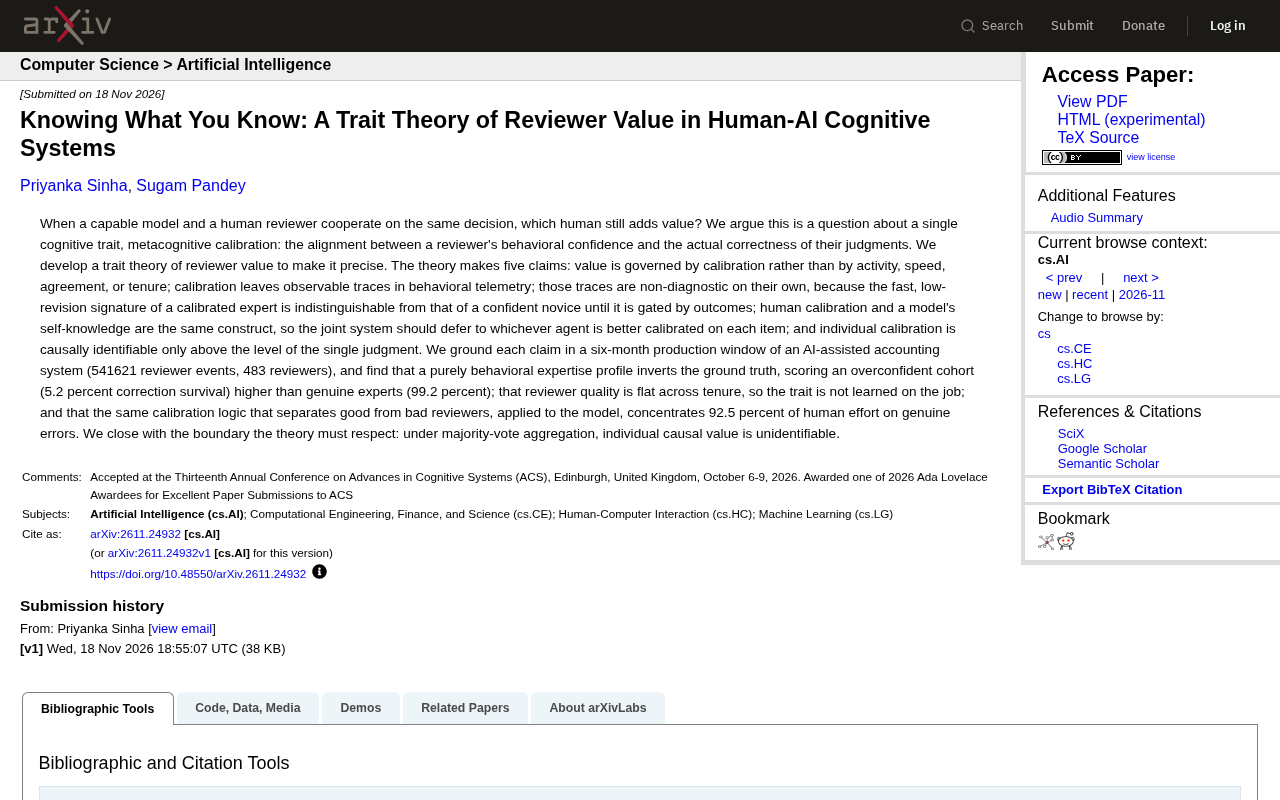
When powerful AI models and human reviewers participate in the same decision, what value do humans actually contribute? A study titled "Knowing What You Know: A Trait Theory of Reviewer Value in Human-AI Cognitive Systems" offers a counterintuitive answer: a reviewer's value doesn't depend on activity level, speed, agreement rate, or seniority—it depends on metacognitive calibration, i.e., the degree to which a reviewer's behavioral confidence aligns with the actual correctness of their judgments.
Core Thesis: Calibration Beats All Behavioral Metrics
The study proposes a "Trait Theory of Reviewer Value" comprising five progressively layered claims. First, reviewer value is dominated by calibration rather than activity, speed, agreement rate, or seniority. Second, calibration leaves observable traces in behavioral telemetry. Third, these traces are not diagnostic on their own—a well-calibrated expert exhibiting a "fast, low-edit" pattern is indistinguishable from a confident novice before outcome gating is applied. Fourth, human calibration ability and model self-knowledge are the same construct, so a joint system should defer to whichever party is better calibrated on each item. Fifth, individual calibration is causally identifiable only at a level beyond single judgments.
The value of this theoretical framework lies in transforming the vague anxiety of "are human reviewers still useful?" into an operational, measurable question about a cognitive trait.
Metacognitive calibration is a core concept in metacognition research, referring to the degree of match between an individual's subjective confidence in the correctness of their judgments and their actual accuracy rate. A well-calibrated reviewer is indeed more likely to be correct when they are confident, and more likely to be wrong when they hesitate; poorly calibrated individuals exhibit overconfidence (high confidence, low accuracy) or underconfidence. Common measures include the Brier score, calibration curves, and expected calibration error (ECE). What makes this concept crucial is that it turns "confidence" from a subjective feeling into an objective attribute that can be statistically tested, thereby making "whether a reviewer has value" a measurable question rather than one relying on proxy indicators such as seniority or activity level.
The Paradox Revealed by Production Data
The study draws on a six-month operational window of an AI-assisted accounting system, covering a large number of reviewer events and hundreds of reviewers. Data analysis revealed a sobering phenomenon: a purely behavioral "expert profile" completely inverts the true situation. This profile gives high scores to an overconfident group whose correction survival rate is extremely low; by contrast, the corrections of true experts have a survival rate near perfect. In other words, if only behavioral signals are considered, the system mistakes confident novices for experts and ranks true experts lower.
Another key finding is that reviewer quality is essentially flat along the seniority dimension. This means calibration ability is not acquired through on-the-job experience but is more like an individual trait. This conclusion poses a challenge to organizational designs that rely on "senior reviewers."
Correction survival rate is a metric for measuring the quality of reviewer edits: the proportion of corrections a reviewer makes to model output that are not overturned or reverted in subsequent processes (such as upstream review, final audit, or outcome verification). A high survival rate means the correction genuinely fixed an error; a low survival rate indicates the correction itself may have been a mistaken edit or wasted effort. Its fundamental difference from behavioral metrics such as "number of edits" or "edit speed" is that it requires outcome gating—i.e., it can only be computed after downstream verification, and therefore cannot be obtained at the moment of a single judgment. This is precisely why the study emphasizes that "calibration traces are not diagnostic on their own": behavioral signals are immediately available but misleading, while outcome signals are reliable but lagging.
Applying Calibration Logic Back to the Model
The study further points out that the calibration logic used to distinguish good reviewers from bad ones can equally be applied to the models themselves. When the system concentrates human effort on genuine errors, the majority of human input is directed toward meaningful corrections rather than futile repeated confirmations. This suggests a design principle for joint systems: rather than simply dividing tasks between human and machine, dynamically determine which party's calibration is more reliable on the current item.
Model self-knowledge (also called model calibration or confidence calibration) refers to whether a model's confidence estimates about the correctness of its outputs align with its actual accuracy. Modern large language models generally suffer from overconfidence: the probabilities they output or the confidence they verbally express tend to exceed their true accuracy rates. The study argues that human calibration and model calibration are the same construct, meaning a unified measurement framework can compare the two and let the more reliably calibrated party lead the decision on each item. This approach differs from traditional "human-machine division of labor" or "human-in-the-loop" designs, which presuppose that humans always serve as the final gatekeeper, whereas the calibration framework allows the model to make autonomous decisions on items where it is more reliable.
The Boundary of the Theory: Non-Identifiability Under Majority Voting
The study does not shy away from the theory's limitations. Under majority-voting aggregation mechanisms, the causal value of individuals is non-identifiable—you cannot isolate a single reviewer's contribution from the collective output. This boundary condition reminds us that calibration theory is not a master key; it needs to be used in conjunction with specific aggregation mechanisms and decision architectures.
Causal non-identifiability stems from a classic problem in causal inference: when multiple individuals' judgments are aggregated into a single output, only the collective result is observed, and it is impossible to infer each individual's independent causal contribution to the outcome. Under majority-voting mechanisms, an individual's vote only affects the output when it becomes the decisive vote, and such cases are difficult to systematically observe in data. To identify individual value, one needs to introduce randomization, leave-one-out methods, or item-level paired data recording individual judgments and outcomes. This limitation is not unique to this study but is a general methodological challenge faced by all collective decision systems when evaluating individual contributions.
Implications for Enterprise and AI Product Design
For teams building human-AI collaborative systems, this research conveys several practical signals. A reviewer's behavioral speed, low edit rate, or high agreement rate should not be used alone as quality indicators; outcome gating needs to be introduced to validate calibration traces. If reviewer training attempts to improve calibration through accumulated experience, the effect may be limited; a more effective approach is to identify and match individual calibration levels. Concentrating human attention on items where the model is poorly calibrated can significantly improve the efficiency of joint systems.
The study is currently presented as a preprint, and its conclusions are based on production data from a single accounting system; cross-domain external validity remains to be tested. However, the proposition that "metacognitive calibration is the core of reviewer value" provides a new coordinate system for quality assessment in human-AI collaboration that deserves serious consideration.
One-line Summary
Research proposes that reviewer value depends on metacognitive calibration rather than behavioral metrics, and that behavioral profiles invert experts and novices.
Paragraph Summary
This study proposes a "Trait Theory of Reviewer Value," arguing that in human-AI collaboration, the core value of human reviewers is metacognitive calibration—the alignment between behavioral confidence and actual correctness—rather than activity, speed, agreement rate, or seniority. Based on six months of production data from an AI-assisted accounting system, the study finds that a purely behavioral expert profile completely inverts reality, scoring an overconfident group higher than true experts; reviewer quality is essentially flat along the seniority dimension, suggesting calibration is more of an individual trait than an on-the-job acquisition. The study further argues that human calibration and model self-knowledge are the same construct, and joint systems should defer to the better-calibrated party on each item. The theoretical boundary is that individual causal value is non-identifiable under majority-voting aggregation. For enterprises, behavioral metrics should not be used alone as quality evidence; outcome gating should be introduced and individual calibration levels identified.
Related articles

Gemini 4 Neon Review: Benchmark Scores Rival Carbon, API Pricing and Quota Breakdown
Google Gemini 4 Neon is now live, benchmark scores closely tracking Carbon, API pricing 3/15 at twice Hydrogen's rate. This article compiles Bilibili creator testing: Neon can replace 90% of Carbon scenarios, AntiGravity quota consumption is only one-third of Carbon, plus subscription channel restrictions and 2API ban risks.

Gemini 4 Helium Coming Soon? Signals of Google Loosening Subscription Restrictions
Google team member hints releases will continue; community speculates Gemini 4 Helium (Flash Lite) may be next. Subscription ban controversy gets a response as product lead says "Soon," suggesting restrictions may be lifted. This article covers Gemini developments, OpenAI Coding Agent and risk management, Doubao real-time audio-video API, and compute business dynamics.

AI-Assisted React Development in Practice: Optimizing a Video App and Handling Errors
A 14-year veteran developer demonstrates AI-assisted React video app optimization: compressing video from 80MB to 5MB (~94%) via ImageKit, plus reliable error handling and retry mechanisms. Includes planning, code understanding, and verification methods for working with AI.