MFG: A New Multi-Turn Feedback-Guided Framework for Molecular Optimization

MFG uses reinforcement learning to enable LLMs to leverage multi-turn feedback, significantly boosting molecular multi-objective optimization success rates.
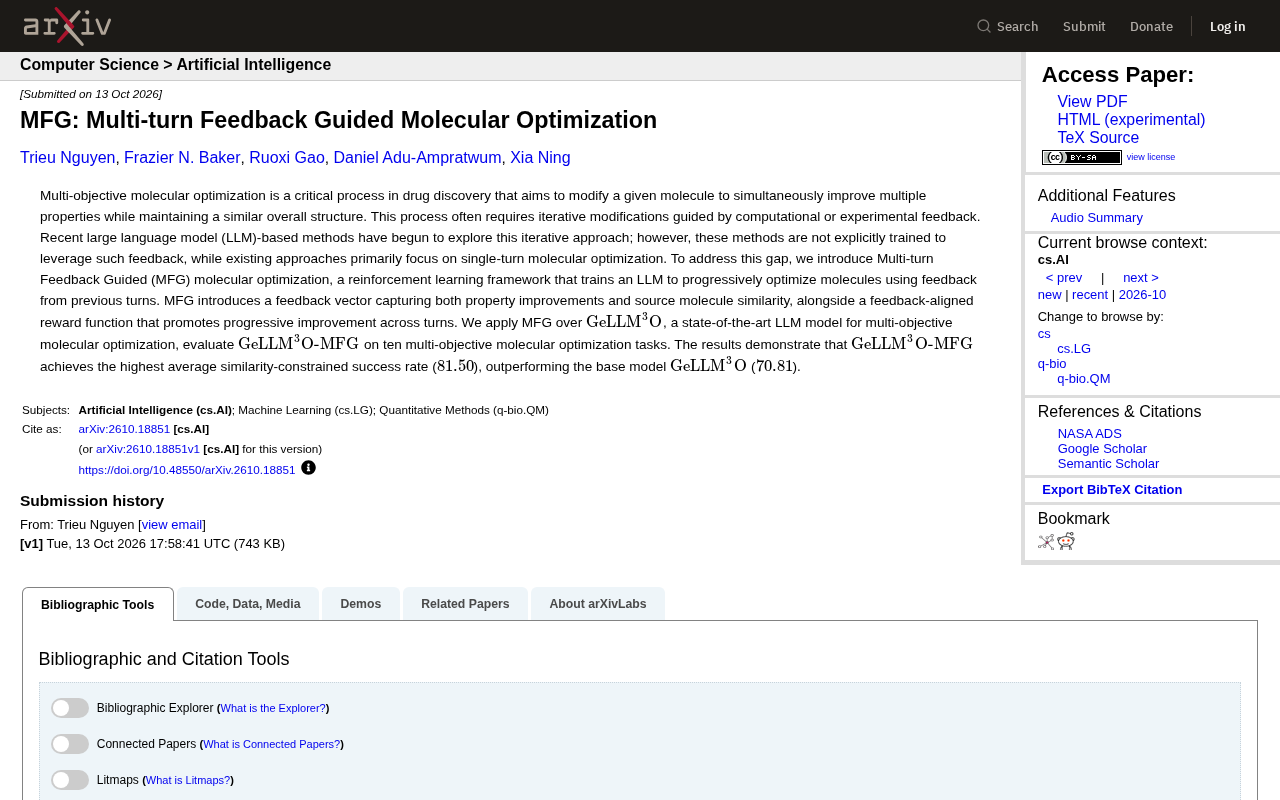
This study proposes the MFG framework, formalizing multi-turn feedback-guided molecular optimization as a reinforcement learning problem to train LLMs to iteratively improve molecules. MFG features two core designs: a feedback vector (capturing property improvement and structural similarity) and a feedback-aligned reward function (encouraging progressive cross-round improvement). On ten multi-objective molecular optimization tasks, GeLLM³O-MFG achieved an average success rate of 81.50% under similarity constraints, significantly outperforming the base model's 70.81%. This approach transforms LLMs from single-turn generators into iterative optimizers, offering a new paradigm for AI-assisted drug design with future potential for closed-loop integration with wet-lab feedback.
Molecular optimization is a core step in drug discovery, aiming to simultaneously improve multiple physicochemical properties while maintaining overall structural similarity of the molecule. Traditional optimization workflows rely on computational or experimental feedback for iterative modification, but how to enable large language models to truly learn from this feedback remains an open question. A recent study titled "MFG: Multi-turn Feedback Guided Molecular Optimization" proposes a new solution.
Limitations of Single-Turn Optimization and the Necessity of Multi-Turn Feedback
Most existing LLM-based molecular optimization methods focus on single-turn generation: given a source molecule, the model directly outputs an optimized candidate structure. This approach overlooks a key fact—real-world medicinal chemistry optimization is typically iterative across multiple rounds, where each round's results influence the next round's strategy.
More critically, even when some works begin to attempt iterative optimization, the LLM itself is not explicitly trained to leverage feedback signals from previous rounds. The model passively receives historical information rather than actively learning "which modification directions are effective and which are not." This causes the optimization process to easily fall into local optima or oscillate repeatedly in multi-objective trade-offs.
MFG's starting point is precisely to fill this gap: formalizing multi-turn feedback-guided molecular optimization as a reinforcement learning problem, enabling the LLM to learn step-by-step molecular improvement during training.
MFG's Core Mechanisms: Feedback Vector and Reward Alignment
The MFG framework contains two key designs.
Feedback Vector: After each optimization round, the system constructs a feedback vector that captures two types of information—the degree of improvement in target properties and the structural similarity between the candidate molecule and the source molecule. This vector serves as an explicit signal for the next round's input, telling the model "what was done in the previous round and how effective it was."
Feedback-aligned Reward Function: During reinforcement learning training, the reward function is designed to encourage progressive improvement across rounds rather than only looking at the final result. This means that if the model can consistently improve properties and maintain similarity across multiple rounds, it will receive a higher cumulative reward.
The combination of these two mechanisms transforms the LLM from a "one-shot generator" into an "iterative optimizer."
Basic Principles of Combining Reinforcement Learning (RL) with LLMs: Reinforcement learning learns optimal behavior by having an agent execute actions in an environment, receive rewards, and update its policy in a loop. When applying RL to LLMs, policy gradient methods (such as PPO, GRPO) are typically used, treating the LLM's text generation as a sequence of actions and using reward functions to guide the model toward generating outputs that better match the objective. In molecular optimization scenarios, "actions" correspond to the molecular structures generated by the model (such as SMILES strings), and "rewards" come from comprehensive evaluation of target property improvement and structural similarity. Unlike supervised fine-tuning, RL allows the model to explore multiple optimization paths and learn long-term strategies through cumulative rewards—this is precisely the key technical foundation that enables MFG to train models to leverage feedback signals across rounds.
Molecular Similarity Metrics: In molecular optimization, maintaining structural similarity to the source molecule is crucial, because molecules that completely deviate from the parent scaffold may lose their original activity or drug-likeness. Commonly used similarity metrics include Tanimoto similarity (based on Morgan fingerprints), MACCS fingerprint similarity, and others. The structural similarity dimension in MFG's feedback vector is typically calculated using such fingerprint similarities, with values ranging from 0 to 1, where closer to 1 indicates greater similarity to the source molecule. The success rate metric under similarity constraints requires generated molecules to satisfy improvement conditions for multiple target properties while maintaining similarity above a certain threshold (such as 0.4 or 0.6). Therefore, this metric comprehensively reflects the model's ability to balance between "optimizing well" and "staying similar."
Experimental Validation Based on GeLLM³O
The research team applied MFG to GeLLM³O—an advanced LLM for multi-objective molecular optimization—yielding GeLLM³O-MFG. They evaluated it on ten multi-objective molecular optimization tasks.
The results showed that GeLLM³O-MFG achieved an average success rate of 81.50% under similarity constraints, significantly outperforming the base model GeLLM³O's 70.81%. This improvement demonstrates that explicit multi-turn feedback training indeed makes the model better at improving multiple properties while maintaining the molecular scaffold.
You may not have noticed that the success rate metric considers both property improvement and structural similarity dimensions, so the 81.50% result means the model has found a better balance between "optimizing well" and "staying similar."
About GeLLM³O: GeLLM³O is an advanced large language model designed for multi-objective molecular optimization. In its name, "Ge" typically refers to Generation, while "LLM³O" emphasizes the multi-objective capabilities of large language models in molecular optimization. The model is typically fine-tuned on pre-trained chemical language models (such as ChemBERTa, MolT5, etc.) and can accept molecular structures (such as SMILES) and optimization objective descriptions as input, outputting optimized candidate molecules. GeLLM³O itself already possesses single-turn multi-objective optimization capabilities, but lacks an explicit training mechanism for utilizing historical feedback in multi-turn iterations. Therefore, MFG uses it as the base model and injects multi-turn feedback guidance capabilities through reinforcement learning to form GeLLM³O-MFG.
Implications for AI-Assisted Drug Design
MFG's significance extends beyond the molecular optimization task itself. It demonstrates a general approach: when LLMs are embedded in iterative workflows, using reinforcement learning to teach the model to leverage historical feedback can significantly enhance its performance on complex multi-objective problems.
For AI-assisted drug design, this means that LLMs are no longer just tools for generating candidate structures, but can become intelligent agents truly participating in optimization decisions. Of course, MFG's current validation is still focused on computational metrics, and whether it can form a closed loop with wet-lab experimental feedback in the future is a direction worth watching.
One-line Summary
MFG uses reinforcement learning to teach large language models to leverage multi-turn feedback, significantly improving molecular multi-objective optimization success rates.
Paragraph Summary
This study proposes the MFG framework, which formalizes multi-turn feedback-guided molecular optimization as a reinforcement learning problem to train LLMs to iteratively improve molecules. MFG contains two core designs: a feedback vector (capturing property improvement and structural similarity) and a feedback-aligned reward function (encouraging progressive improvement across rounds). On ten multi-objective molecular optimization tasks, GeLLM³O-MFG based on GeLLM³O achieved an average success rate of 81.50% under similarity constraints, significantly outperforming the base model's 70.81%. This method transforms LLMs from single-turn generators into iterative optimizers, providing a new paradigm for AI-assisted drug design, with future potential to form a closed loop with wet-lab experimental feedback.
Related articles

Bilibili's Hit Dify Tutorial: A Practical Guide to Building 20+ AI Apps from Scratch
A distilled guide to Bilibili's top-rated Dify tutorial: Windows + Docker deployment, MySQL connection, five app types, model integration strategy, and publishing.

Agent Skills Beginner's Guide: From Concepts to Multi-Agent Collaboration in Practice
A comprehensive guide to Agent Skills: core concepts, components, the importance of Description, standardization, beginner learning paths, and multi-agent collaboration.

One Neuron Detects Both Cats and Cars? We Reproduced It and Found a New Explanation
The cat-car neuron reinterpreted: researcher Cammarata argues it distinguishes pointy from round, not cats from cars. We reproduced the experiment and found the new explanation holds on most inputs—but cars are the exception. The interpretability debate continues on language models.