MH-RAG-DIVE: A New Framework for Multi-Hop RAG Evaluation
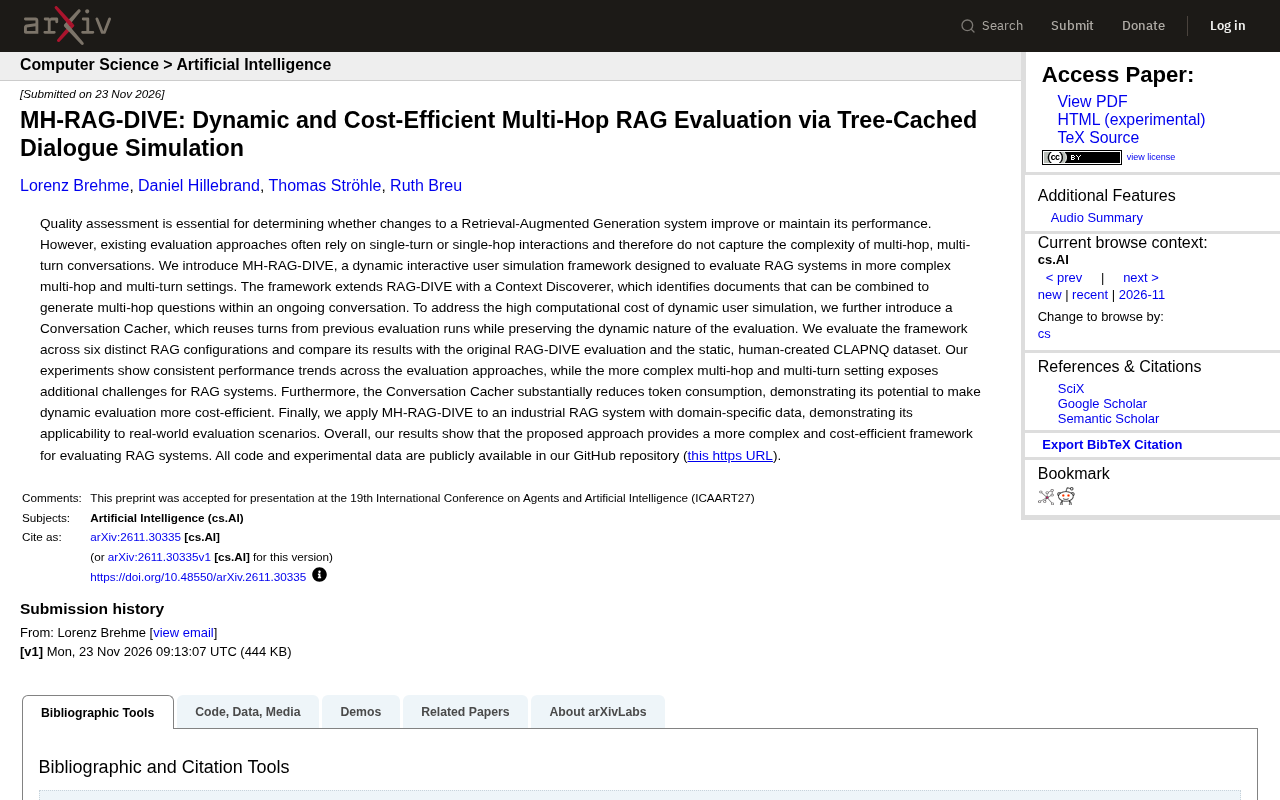
MH-RAG-DIVE evaluates RAG with dynamic multi-hop, multi-turn dialogues and controls costs via conversation caching.
The article introduces the arXiv paper's MH-RAG-DIVE framework, designed to overcome the limitations of single-turn, single-hop RAG evaluation. It adds two components to RAG-DIVE: a Context Discoverer that dynamically identifies documents combinable into multi-hop questions during ongoing conversations, and a Conversation Cacher that reuses past dialogue turns to substantially cut token costs while keeping evaluation dynamic. Tests on six RAG configurations against original RAG-DIVE and static CLAPNQ show consistent trends, indicating no evaluation bias, though multi-hop scenarios expose broken retrieval chains and lost context. Code is open-sourced on GitHub.
Why Does RAG Evaluation Need Multi-Hop, Multi-Turn Conversations?
Quality evaluation of Retrieval-Augmented Generation (RAG) systems has long relied on single-turn or single-hop interaction tests. While simple, such methods fail to reflect the complexity of real-world scenarios where users ask follow-up questions in succession and reason across documents. A recent paper on arXiv proposes the MH-RAG-DIVE framework, attempting to fill this gap with dynamic conversation simulation.
According to the paper, MH-RAG-DIVE builds on RAG-DIVE by adding two core components: a Context Discoverer and a Conversation Cacher. The former is responsible for identifying, during an ongoing conversation, which documents can be combined to generate multi-hop questions; the latter reuses conversation turns from previous evaluation runs, thereby substantially reducing computational overhead while preserving the dynamic nature of the evaluation.
RAG (Retrieval-Augmented Generation) is a technical paradigm that combines external knowledge retrieval with large language model generation: the system first retrieves snippets relevant to the question from a document corpus, then feeds these snippets as context to the model to generate an answer. Since answer quality depends on both the retriever and the generator, evaluating RAG systems is more complex than evaluating pure generative models. Traditional evaluation mostly adopts a single-hop setting, where a question requires only one retrieval and can be answered based on a single document or a small number of documents; in contrast, multi-hop questions require the model to chain information across multiple documents—for example, first determining an entity from Document A, then using that entity to find the answer in Document B. Multi-turn conversations further require the system to maintain contextual consistency across multiple interaction rounds. These two scenarios are precisely the most common situations in which real users interact with RAG systems, and the ones most likely to expose broken retrieval chains and lost context—making them the direct motivation for the evolution of evaluation methods.
How Does the Context Discoverer Construct Multi-Hop Questions?
The difficulty of multi-hop questions lies in the fact that answers are often scattered across multiple documents: the model must first find Document A, then use information from A to locate Document B, and finally synthesize both to answer. MH-RAG-DIVE's Context Discoverer dynamically identifies such document combinations during the conversation, rather than relying on a pre-fixed question set.
This design brings evaluation closer to real user behavior—users do not ask questions according to a preset script, but adjust subsequent questions based on the previous round's answer. The paper reports that the framework was tested on six different RAG configurations and compared against both the original RAG-DIVE evaluation and the statically human-created CLAPNQ dataset.
Conversation Cacher: The Key to Reducing the Cost of Dynamic Evaluation
The price of dynamic user simulation is high token consumption. Each conversation round requires the LLM to generate both the user question and the system answer; as evaluation scale grows, the cost becomes prohibitive. The idea behind the Conversation Cacher is to reuse conversation turns from previous evaluation runs while maintaining the dynamic nature of the evaluation.
Experiments in the paper show that the Conversation Cacher substantially reduces token consumption (as stated in the original text), making dynamic evaluation more cost-feasible. This is particularly important for industrial-grade RAG systems that require frequent regression testing—after every change to the model or retrieval strategy, re-evaluation is needed, and cost sensitivity is extremely high.
Token consumption is a core metric for measuring the cost of large model calls. In LLM-simulated dynamic evaluation, each conversation round involves at least two model calls—one to generate the user question and one to generate the system answer—and historical conversation accumulates as context, causing the per-round cost to rise with the number of turns. When evaluation needs to be repeated across dozens of configurations and hundreds of questions, costs grow multiplicatively. The idea of conversation caching aligns with cache reuse in software engineering: persist high-quality conversation turns produced in previous runs and reuse them conditionally in new evaluation runs, thereby skipping duplicate LLM calls. The key design challenge is that reuse must not break the dynamic nature of the evaluation—i.e., subsequent turns must still adapt to the current system's actual answers rather than mechanically replaying a script.
What Do the Experimental Results Reveal?
Experiments on six RAG configurations show that different evaluation methods (MH-RAG-DIVE, the original RAG-DIVE, and the static CLAPNQ dataset) exhibit consistent performance trends. This indicates that the new framework does not introduce evaluation bias but instead provides more complex test scenarios.
At the same time, the more complex multi-hop, multi-turn setting exposes additional challenges for RAG systems—configurations that perform well in single-hop evaluation may reveal broken retrieval chains or lost context in multi-hop scenarios. The paper also applies the framework to an industrial RAG system with domain-specific data, validating its applicability in real-world scenarios.
CLAPNQ is a question-answering dataset for retrieval-augmented generation, whose questions and answers are statically constructed by humans and is often used as a control benchmark for RAG evaluation. The advantages of static datasets are reproducibility, low cost, and controllable annotation quality; the disadvantage is that they cannot reflect the real interaction pattern in which users dynamically adjust their questions based on system answers. When comparing a dynamic simulation framework with a static dataset, the core concern is not absolute scores but the consistency of evaluation conclusions—i.e., whether the relative ranking of different RAG configurations remains stable under both evaluation approaches. If the rankings are consistent, it indicates that the new framework increases scenario complexity without introducing systematic bias; if they diverge, it often means that static evaluation misses certain flaws that only surface in real interactions. This is also the methodological basis for the paper choosing "consistent performance trends" as its core validation conclusion.
Practical Implications for RAG Developers
The code and experimental data for MH-RAG-DIVE have been made public on GitHub (https://github.com/Daniel-Innsbruck/MH-RAG-DIVE). For RAG system developers, the value of this framework lies in two aspects: first, it provides an evaluation method closer to real conversations; second, it controls evaluation costs through a caching mechanism.
However, it should also be noted that the complexity of dynamic simulation evaluation itself introduces barriers to parameter tuning and result interpretation. The quality of multi-hop question generation depends heavily on the design of the Context Discoverer, and performance may vary considerably across different domain data. Although the paper validates applicability in industrial scenarios, more details still need to be verified by the community in practice.
One-line Summary
MH-RAG-DIVE evaluates RAG with dynamic multi-hop, multi-turn conversations while controlling costs through conversation caching.
Paragraph Summary
The article introduces the MH-RAG-DIVE framework proposed in an arXiv paper, which aims to address the shortcomings of traditional RAG evaluation that relies only on single-turn, single-hop interactions. The framework adds two components to RAG-DIVE: a Context Discoverer that dynamically identifies documents that can be combined into multi-hop questions during an ongoing conversation, bringing evaluation closer to real users' successive follow-up behavior; and a Conversation Cacher that reuses conversation turns from previous evaluations, substantially reducing token consumption while maintaining dynamism. Compared against the original RAG-DIVE and the static CLAPNQ dataset on six RAG configurations, the paper finds consistent performance trends, indicating no evaluation bias was introduced—though multi-hop scenarios expose additional challenges such as broken retrieval chains and lost context. The framework is also validated on an industrial RAG system with domain-specific data, and the code and experimental data are open-sourced on GitHub.
Related articles
Google Officially Supports Pi Coding Agent: The AI Programming Tool Ecosystem Expands Further
Google adds official Google AI plan support for the open-source coding agent Pi, signaling accelerating integration between large model vendors and coding agent tool ecosystems. This article analyzes the impact on developer workflows, the tool ecosystem landscape, and model binding relationships.

Loom: One Machine for Weaving, Knitting and Braiding
Loom is a device that aims to seamlessly combine weaving, knitting and braiding in a single machine, drawing attention on Hacker News. This article examines its engineering challenges, significance for flexible manufacturing, and lessons for makers and hardware developers.
Running Local AI Agents on Mac: A Full Breakdown of the MLX Four-Layer Stack
A breakdown of Apple engineer Joanna's local Mac AI agent solution: the MLX four-layer stack, a three-step setup, and how the neural network accelerator, continuous batching, and distributed inference solve local agent performance bottlenecks.