Microsoft 365 Outage Causes Pool Chlorine Leak: The Heavy Cost of Cloud Dependency

Microsoft 365 outage caused hotel pool chlorination to run out of control, triggering chlorine poisoning and exposing the physical safety risks of cloud dependency.
A German hotel's pool chlorination equipment malfunctioned during a Microsoft 365 service outage, leaving multiple guests with chlorine poisoning symptoms. The root cause: the hotel connected water quality monitoring and dosing control to workflows built on Microsoft 365 authentication and Power Automate, and local devices lacked fail-safe logic to fall back to a safe state when the cloud failed. Hacker News discussion produced three voices: debate over responsibility, architectural reflection (prohibiting safety control logic in the cloud), and questions about the report's causal completeness. The article notes that cloud centralization risk is seeping from business continuity into personal safety boundaries, and developers should retain local closed-loop control and redundant alerting rather than assuming the cloud is always available.

A seemingly routine cloud service failure ultimately escalated into a chemical incident at a hotel pool. According to a report by German broadcaster WDR, a hotel in the Rhein-Erft district experienced abnormal operation of its pool chlorination equipment after its control system was affected by a Microsoft 365 service outage, leaving multiple guests with chlorine poisoning symptoms. The story garnered 244 points and 117 comments on Hacker News — and the tech community's reaction is far more intriguing than the incident itself.
The Chain of Events: From Cloud to Pool
According to WDR's report, the incident stemmed from a technical defect in the hotel's pool water treatment system, which was linked to a Microsoft 365 service outage. When the cloud-based control or monitoring component failed, the chlorination device failed to regulate as expected, ultimately causing abnormal chlorine levels in the pool area and leaving multiple guests with poisoning symptoms requiring medical attention.
The report points to a "technical defect" (technischer Defekt) as the direct cause, with the Microsoft 365 outage as one of the triggering conditions. The key question here is: how does a SaaS suite designed for office scenarios come to have a causal link to a hotel's physical infrastructure? The answer lies in modern building and facility management's deep integration with cloud platforms.
Why Office Software Can Affect Pool Equipment
The Hacker News discussion quickly zeroed in on the core issue: Microsoft 365 is not just a collection of Word and Excel. Its identity authentication, device management, and automation workflows (Power Automate) are being used as infrastructure by a large number of IoT and building automation systems.
When a hotel connects pool water quality monitoring, dosing pump control, and alert notifications to workflows built on Microsoft 365's account system or automation tools, a cloud service outage can push these processes into undefined states. In some cases alerts can't be sent; in others control commands can't be delivered; and in still others automation scripts execute incorrect compensatory actions upon recovery.
Practitioners in the comments pointed out that such system designs often lack "fail-safe" logic — meaning that when the cloud is unavailable, local devices should fall back to a safe default state rather than continuing to execute potentially dangerous commands. The chlorine incident is an extreme manifestation of this design gap.
Fail-safe is a fundamental principle in control system design, meaning that when a fault occurs (such as power loss, communication interruption, or component failure), the system should automatically enter a known safe state that causes no harm or minimizes damage. In the pool chlorination scenario, this means that when cloud control commands cannot be delivered, the local controller should default to stopping dosing or maintaining a minimum disinfection level, rather than continuing potentially excessive chlorination. A closely related concept is fail-dangerous, where the system enters a dangerous state upon failure — this incident is a textbook case of fail-dangerous. Achieving fail-safe typically requires independent local hardware interlocks, watchdog timers, and redundant sensors, rather than relying solely on software logic or the availability of a remote cloud platform. Industrial functional safety standards IEC 61508 and IEC 61511 for the process industry both set explicit requirements for the fail-safe behavior of safety instrumented systems, but in building automation and IoT scenarios, implementation of these standards is often sacrificed for cost or integration convenience.
Power Automate is a low-code workflow automation service in the Microsoft 365 suite that allows users to visually connect different applications, data sources, and devices to orchestrate trigger-action workflows. In building and facility management scenarios, Power Automate is often used to chain sensor alerts, form submissions, or scheduled tasks to email notifications, ticketing systems, or even control commands for IoT devices. For example, when a pool water quality sensor detects low residual chlorine, it can trigger an automated workflow to send a start command to the dosing pump or push an alert to the administrator. The problem is that such workflows were designed to improve office efficiency, not to meet the stringent requirements of industrial control for determinism, real-time performance, and fail-safe behavior. Once Microsoft 365's authentication service, connectors, or workflow engine experience an outage, the automation chain depending on them may fail silently or enter an undefined state — and downstream physical devices are none the wiser. Using office automation tools like Power Automate for safety-related control loops essentially blurs the boundary between IT (information technology) and OT (operational technology), which is precisely the architectural risk the tech community repeatedly discussed in this incident.
Three Voices in the Community Discussion
Based on the various perspectives in the Hacker News thread, three typical reactions can be identified.
The first is the debate over responsibility. Some commenters argued that handing a safety-critical facility like a pool over to cloud service control is itself a design error — Microsoft's outage merely exposed the problem rather than created it. Others emphasized that SaaS providers do not promise availability for critical infrastructure in their service level agreements, and that users must bear the architectural risk themselves.
The second is architectural reflection. Some developers mentioned that their projects have explicitly prohibited placing safety-related control logic on external cloud platforms and require retaining closed-loop control capability locally. This view gained considerable agreement in the discussion, though it was also countered as "difficult to implement universally due to cost."
The third is questioning the report itself. Some comments noted that the headline attributes the incident to Microsoft 365, but the original report's description of causality is insufficient, and details of the direct technical defect behind the chlorine leak have not been made public. This voice reminds readers that the chain between the cloud failure and the chemical incident still awaits more complete investigative disclosure.
Service Level Agreement (SLA) is an availability and performance commitment between a cloud service provider and its customers, typically expressed as a monthly uptime percentage (e.g., 99.9%), and specifies compensation methods when targets are missed (usually service credits rather than direct damages). SLAs for SaaS products like Microsoft 365 are designed primarily for office collaboration scenarios, and their terms typically explicitly exclude liability for indirect losses, personal injury, or critical infrastructure interruptions. The Hacker News comment that "SaaS providers do not promise availability for critical infrastructure" refers precisely to this legal and commercial reality: even if a cloud service meets its promised availability level, it falls far short of the reliability requirements for control systems involving personal safety. More critically, "available" in an SLA usually means only that the service endpoint is responsive — it does not guarantee the correct execution of a specific automation workflow or end-to-end latency. Therefore, when facility managers entrust safety-related logic to such services, they are effectively using office-grade commitments to cover industrial-grade risks, creating a responsibility vacuum.
Cloud Dependency Risks Are Manifesting in the Physical World
What makes this incident noteworthy to the tech community is not its scale but the trend it reveals: cloud service reliability issues are seeping from the level of "can't send email" and "can't open documents" into the safety boundaries of the physical world.
Over the past few years, industry discussion of cloud centralization risk has mostly stayed at the business continuity level — for example, a single cloud provider outage causing many websites to go down simultaneously. This incident provides a sharper case: when cloud services become indirect dependencies of industrial control, building management, and medical devices, the consequences of a service outage may no longer be economic loss but personal injury.
For developers and facility managers, the actionable takeaways are clear: when designing any automation system involving safety thresholds, you must assume the cloud can disappear at any moment, and local loops must be able to maintain safe operation when disconnected; alert channels must be redundant and cannot rely solely on a single cloud platform's email or messaging push.
The specific liability determination for this chlorine poisoning incident still awaits local investigation, but it has already sounded the alarm for all teams that entrust critical control logic to the cloud.
Related articles
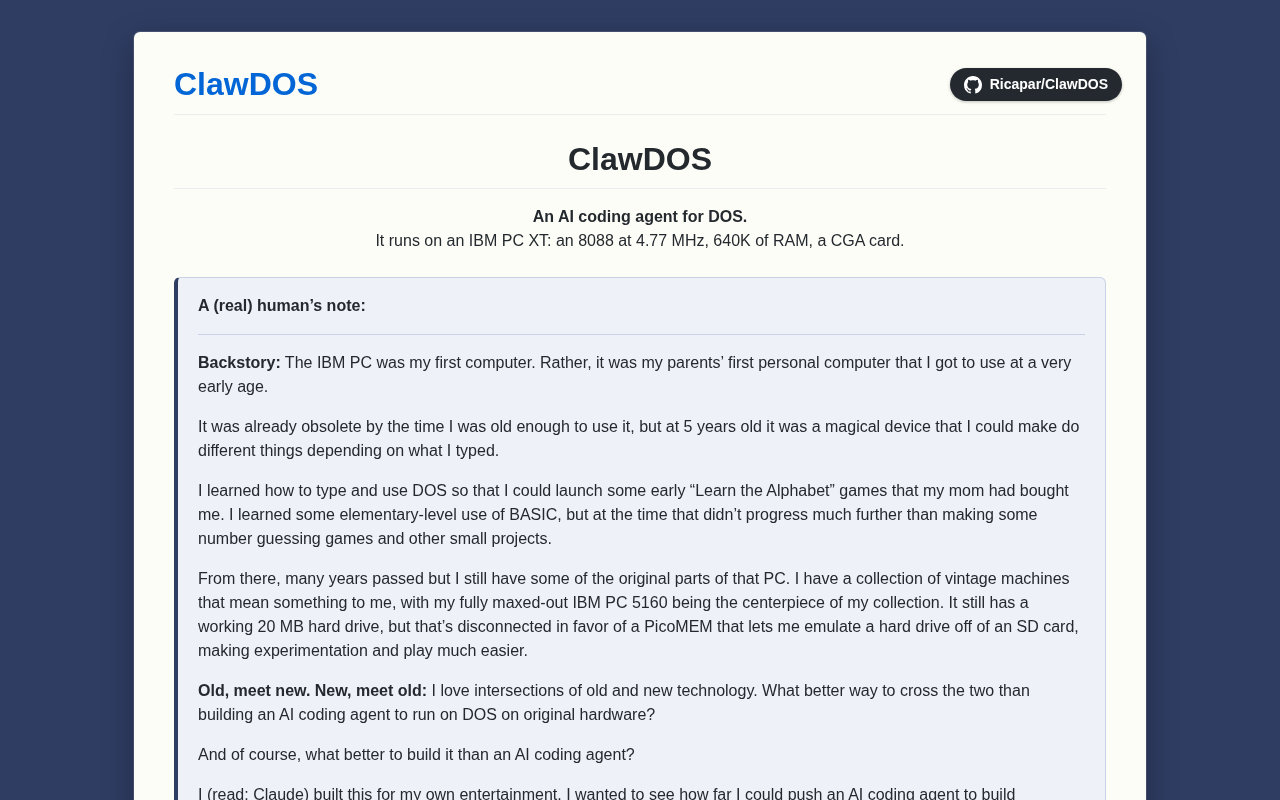
ClawDOS: Bringing AI Coding Capabilities to DOS
ClawDOS is an AI coding agent project for DOS, exploring the possibility of bringing AI coding assistance into resource-constrained retro computing environments. This article analyzes its positioning, use cases, and community response.

Baseten Releases Bison-1 and Groundhog-1, Topping the Decision Model Leaderboard
Baseten releases open-weight decision models bison-1 and groundhog-1 built on Gemma 4; bison-1 scores 76 on the AA Decision Index v2.1 to top the leaderboard. Both support 128k context and image input—here we analyze their capability combination, benchmark significance, and selection advice for developers.

Cline CLI v3.0.75 Released: Yolo Mode Now Default for One-Shot Runs
Cline CLI v3.0.75: one-shot runs now default to yolo mode, --timeout and Ctrl+C can interrupt the first round, read_files is no longer truncated to 8k chars, plus reasoning parameter fixes and 94 new providers.