Microsoft and Meta Release New Models on the Same Day: Why Enterprise AI Is the Real Focus

Microsoft and Meta released foundation and open-weight models the same day, spotlighting enterprise AI's cost and sovereignty battle.
The article argues that the week's real enterprise news was not Muse Wonder or Gemini 4 Argon but two low-key releases. Microsoft's MAI Base 2 (2.8T total/80B active MoE) claims to beat the GPT-5.6 Sol foundation on a quarter of the compute and pairs with Frontier Tuning for custom models, addressing intelligence-layer sovereignty. Meta's MuseSpark Open (816B total, 1M context) ranks 7th among open models and marks the return of U.S. open weights, addressing cost and private deployment. Both point to enterprises moving from single vendors to multi-model architectures.
Microsoft and Meta Release New Models on the Same Day: Why Enterprise AI Is the Real Focus
This week, the AI world's excitement belonged to the Muse Wonder series and Google's Gemini 4 Argon. But according to AI Daily Brief's assessment in its video, what really deserves enterprise attention are the two Thursday releases from Microsoft and Meta that barely made it onto trending lists. There were no SOTA-breaking benchmark results and no frenzy on X—yet they address the two most practical problems enterprises face with AI today: cost and sovereignty.
Microsoft MAI Base 2: A "Late" Frontier Pre-training
Microsoft AI CEO Mustafa Suleiman revealed at an internal town hall that the newly released MAI Base 2 is a 2.8-trillion-parameter foundation model using a MoE architecture with 80 billion active parameters, comparable in scale to Kimi K3. It is a fully from-scratch pre-training run that did not distill any other model.
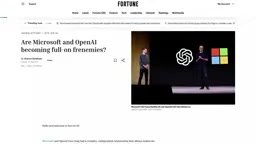
Suleiman was remarkably direct: "The pre-trained foundation model we now have is stronger than the model that powers GPT-5.6 Sol, and we used only a quarter of the compute OpenAI used to train that model." This comparison is based on non-public information Microsoft has access to as an investor, and the details have not been disclosed publicly. On the public side, Microsoft compared MAI 2 with all open models exceeding one trillion parameters, claiming comprehensive leadership on pre-training benchmarks, pre-training efficiency more than 12 times that of DeepSeekAd v4 Pro, and training on 16,000 GB200 Blackwell GPUs over 38 days.
For Microsoft, the significance of this pre-training goes beyond the model itself. From the $13 billion invested in OpenAI starting in 2019 to the turmoil of Altman's ouster and reinstatement in 2023, Microsoft's leadership gradually realized that no matter how close the partnership, fiduciary duty demands more independence. After bringing in DeepMind co-founder Suleiman to head a new AI division in March 2024, the outside world mostly saw reports of friction—until the MAI-1 series arrived and the new strategy came into view.
MAI-1 was not spectacular on benchmarks, but it carried a business model called Frontier Tuning—allowing customers to fine-tune their own models on Microsoft's foundation models. The timing of this product is critical: enterprises are discovering that handing all intelligence needs to the very best model is not cost-effective, especially in the agentic era, where token bills grow far faster than expected. Nadella repeatedly emphasizes that enterprises must own an "intelligence layer" beyond the model, rather than ceding that layer to model vendors.
MoE architecture and active parameters: Mixture of Experts (MoE) models split the feed-forward layers into multiple "expert" sub-networks, activating only a small subset during each forward pass. Thus "total parameters" and "active parameters" are two different concepts—total parameters determine model capacity and memory footprint, while active parameters determine the compute per inference. MAI Base 2's 2.8 trillion total parameters and 80 billion active parameters mean it is an ultra-large-scale model in terms of storage, but the compute cost per token is close to that of an 80-billion-parameter dense model. This also explains why models of "comparable parameter scale" can differ in inference cost by dozens of times—a key metric enterprises must distinguish when evaluating token bills.
Pre-training vs. distillation: Pre-training refers to training a foundation model from random initialization on large-scale unlabeled corpora—the highest cost and longest cycle; distillation lets a new model imitate the output distribution of an existing strong model—lower cost but capped by the teacher model. Suleiman's emphasis that MAI 2 was "fully pre-trained from scratch, without distilling any model" is meant to show that its capabilities come from proprietary data and compute investment rather than borrowing competitors' model outputs—important for enterprise customers' compliance and vendor-independence narrative.
Meta MuseSpark Open: The Return of U.S. Open-Weight Models
Meta's other thread this week was the Muse Wonder series returning to the frontier, but what really caught Smart Money's attention was MuseSpark Open. Meta calls it "the strongest open-weight model from the U.S. to date": 816 billion total parameters, 42 billion active, a 1-million-token context window, aimed at coding and long-horizon agentic tasks.
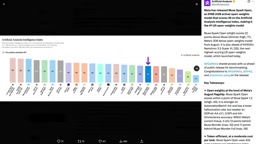
Artificial Analysis scored MuseOpen at 39, tied for 17th overall, 7th among open models, about 7 points behind the open-source SOTA but roughly 13 points ahead of Nemotron and Inkling. On agentic benchmarks such as JobBench and MCPAtlas, Meta claims open-source SOTA. Open-model researcher Nathan Lambert's assessment captures community sentiment well: "I've waited so long for U.S. open-weight models to matter again." He noted that U.S. models had been trailing Chinese models, and MuseOpen "at least halved the gap."
Meta's open-source path took a detour. In the Llama 3 era, Meta kept pace with OpenAI at the open-source frontier; the failure of Llama 4 and the absence of Behemoth directly triggered Zuckerberg's complete rebuild of the AI division. When Meta re-released models, many assumed open source was a thing of the past, and some doubted Alexander Wang's promise to return to open source. MuseSpark Open delivers on that promise.
An easily overlooked detail is Apple's first-party support. The two companies have never exactly been friends, but Apple updated its MLX toolkit to ensure Spark Open runs smoothly on its hardware. Zuckerberg posted a video of Muse running on a Mac Studio and thanked Apple's John Ternus, who responded that "this is a good way to announce that the new Apple CEO is going to do things differently." Of course, the full model requires 1TB of memory—roughly two fully specced M5 Ultra Mac Studios, about $40,000—out of reach for individuals but not unaffordable for small startups that care about private inference.
Open-weight vs. open-source models: Most "open-source models" in the industry only release model weights; training data, training code, and data mixtures are often undisclosed, so strictly speaking they are "open-weight" rather than open source under the OSI definition. This distinction matters practically for enterprises: open weights allow local deployment, private inference, and fine-tuning to meet data-residency requirements, but do not let enterprises fully reproduce or audit the training process. MuseSpark Open, the Llama series, and Chinese open models all fall into this category; the key metrics for assessing their value include license terms (commercial restrictions, user-scale thresholds), context window, and deployment hardware requirements.
MLX and local inference hardware: MLX is Apple's machine learning framework designed for its own chips, optimized for the unified memory architecture so large models can be loaded and inferred directly in Mac memory without discrete GPU VRAM. The advantage of unified memory is capacity (a fully specced Mac Studio can reach hundreds of GB); the disadvantage is lower bandwidth than high-end data-center GPUs. Thus configurations like "1TB memory, about $40,000 for two fully specced Mac Studios" target small teams sensitive to data sovereignty with modest throughput needs, not large-scale production inference.
The Real Divide in Enterprise AI: Cost and Sovereignty
Viewed together, the Microsoft and Meta releases point to the same trend. Enterprises are becoming "model omnivores," wanting to move between models based on task needs rather than being locked into a single vendor's ecosystem. Box's Aaron Levy believes this will further accelerate AI diffusion: enterprises can use frontier models for orchestration and high-end tasks, and low-cost, customized post-trained models for repetitive workflows, with overall token consumption and workload rising significantly.
Microsoft's Frontier Tuning answers the sovereignty question, and Meta's open-weight model answers the cost question. The open-source camp already had Chinese models to choose from, but given Microsoft's existing embeddedness in enterprise ecosystems, many companies would rather have Microsoft fine-tune for them than build their own local deployment infrastructure on Chinese foundations. Now Meta has filled in the U.S. open-weight piece, giving enterprises considerably more options than a few months ago.
In the short term, most enterprises will still choose turnkey solutions like Claude or ChatGPT subscriptions, and that won't realistically be overturned. But companies with technical capability are designing more complex model architectures, switching flexibly based on performance, capability, cost, or efficiency constraints. That is the signal most worth tracking from this week's two low-key releases.
Model routing and "model omnivores": Multi-model architectures typically use an orchestration layer (router/orchestrator) to dispatch requests to different models based on task type, difficulty, latency, and cost budget: high-value, open-ended tasks go to frontier closed-source models, while repetitive, structured tasks go to lower-cost post-trained or open models. The technical prerequisites are increasingly standardized model interfaces and the ability to make comparable assessments of per-token cost and quality across models. The side effect is rising operational complexity—requiring unified observability, caching, evaluation, and cost attribution systems, which is why the "intelligence layer" is becoming a standalone product category.
Post-training and Frontier Tuning: Post-training refers to injecting domain capabilities on top of a foundation model through supervised fine-tuning, preference optimization, and similar methods; it costs far less than pre-training but depends heavily on foundation and data quality. The core selling point of managed fine-tuning services like Frontier Tuning is not the model itself but giving enterprises a dedicated model without owning training infrastructure, keeping domain data and prompt engineering within controllable boundaries—a compromise between "using the strongest model" and "owning your own intelligence layer."
Other Notable Developments
Anthropic Brings in Third-Party Safety Evaluators
Anthropic has embedded its first batch of third-party evaluators into the organization; a six-person team from METR received "employee-like permissions," including access to company computers, office space, and internal tools. SecureBio and Accenture are also among the evaluators, with early talks underway with Hugging Face and others. The controversy centers on independence: Anthropic says it does not fund METR, but the two share many EA-community funders. Anthropic established three tiers of auditor permissions, with METR holding the highest tier; evaluators "cannot veto releases" but can request redactions of customer data, legally privileged information, and model architecture details, and can publicly assess whether redactions are reasonable. Embroidery founder Zach Korman bluntly called it "security theater," though others see it at least as a risk-management prototype that will eventually evolve into a business for the Big Four accounting firms.
Cognition Manages Token Budgets with a "Credit Score"
Cognition designed dynamic token budgets for engineers using Devin: the system uses AI to estimate how many human hours a session is equivalent to, and when engineers hit the cap, their token efficiency is evaluated—a passing score automatically raises the limit. VP Calvin Giroud likens it to a credit card limit increase. Developer reaction has been broadly negative; some say software engineering has become a factory job, others point out that "how many human hours" measures the wrong thing and incentivizes building the most complex rather than the most valuable things. But some argue that whether or not the method is sound, token allocation will ultimately become a core skill.
White House AI Working Group Holds First Meeting
The White House AI Working Group held its first meeting on Thursday, with its primary task being oversight of AI safety reports to be issued within 120 days, covering AI risk and cybersecurity, critical infrastructure, biosecurity and dual-use applications, and model control and accountability. The group also established subgroups to implement the White House agreements signed by frontier labs, including board-level safety oversight and cooperation with external auditors. The agreements are voluntary, and enforcement remains unresolved; a White House official told Semafor that export controls could be one means of pressure.
"Hive-Coding" a Game with Opus 5.5
YouTuber Max Blade and streamer friends vibe-coded a 100-player competitive game called Kong Royale, billed as "the world's first AAA vibe-coded battle royale." He had tried before but model capabilities fell short; this time, using Opus 5.5 and two Claude Max accounts, he completed it in a few weeks. He calls the method hive-coding: putting multiple agents into the live chat, reviewing viewer-suggested changes overnight, and picking the best to merge into the next morning's build. The development process was essentially crowdsourced by the audience.
One-line Summary
Microsoft and Meta released foundation and open-weight models on the same day, pointing to the battle over cost and sovereignty in enterprise AI.
Paragraph Summary
The article notes that what really deserves enterprise attention this week is not Muse Wonder or Gemini 4 Argon but two low-key releases from Microsoft and Meta. Microsoft's MAI Base 2 is a 2.8-trillion-parameter, 80-billion-active-parameter MoE foundation, claimed to surpass the pre-trained foundation powering GPT-5.6 Sol using a quarter of the compute, paired with Frontier Tuning to let enterprises fine-tune their own models—addressing intelligence-layer sovereignty. Meta's MuseSpark Open is an open-weight model with 816 billion total parameters and a 1-million-token context, ranked 7th on Artificial Analysis's open-source leaderboard and seen as the return of U.S. open-weight models—addressing cost and private deployment. Together they point to enterprises shifting from single vendors to multi-model architectures. The piece also covers Anthropic's third-party safety evaluations, Cognition's token credit score, the White House AI Working Group meeting, and vibe-coded game development.
Related articles

GPT-Next Leak, Gemini 4 Argon Imminent: AI News Roundup
GPT-Next leak suggests extreme efficiency; OpenAI's 28-day shipping pledge boosts speed 50%; Gemini 4 Argon nears release; Anthropic subscription value report sparks debate.

GPT-Next Leaked, Gemini 4 Argon Speeds Up, Fable 5.5 May Launch Today
OpenAI's GPT-Next model leaks, expected to be extremely low-cost and possibly part of the 28-day release plan; Gemini 4 Argon internal testing accelerates, NanoBanana 2.1 is live; Semi Analysis tests show Claude Max's equivalent API value is about 5 times that of ChatGPT Pro; Fable 5.5 may launch today.

Gemini 4 Argon Launches Globally: Key Highlights from the AI Daily Brief
Google opens Gemini 4 Argon globally across Pro and Ultra subscriptions and the API, and demonstrates robot control. This article rounds up open-source models, Agent infrastructure, cost transparency, and safety governance updates.