Microsoft Launches Maia 300: In-House AI Chip Boosts Energy Efficiency by 40%

Microsoft plans multi-gigawatt Maia deployment and launches Maia 300 with 40% better energy efficiency.
Microsoft announced major in-house chip progress: it plans to scale the Maia series to multi-gigawatt deployment starting next calendar year as the primary inference system for its products and services. The new Maia 300 claims 40% higher tokens per watt than leading GPUs, while Maia 200 already delivers up to 1.7x efficiency gains in Teams and Copilot across the US, Europe, and Australia. The move continues the cloud self-designed AI chip trend to cut inference costs and strengthen supply chain autonomy, with Microsoft maintaining long-term coexistence of in-house and external hardware, and its 40% figure awaiting third-party verification.
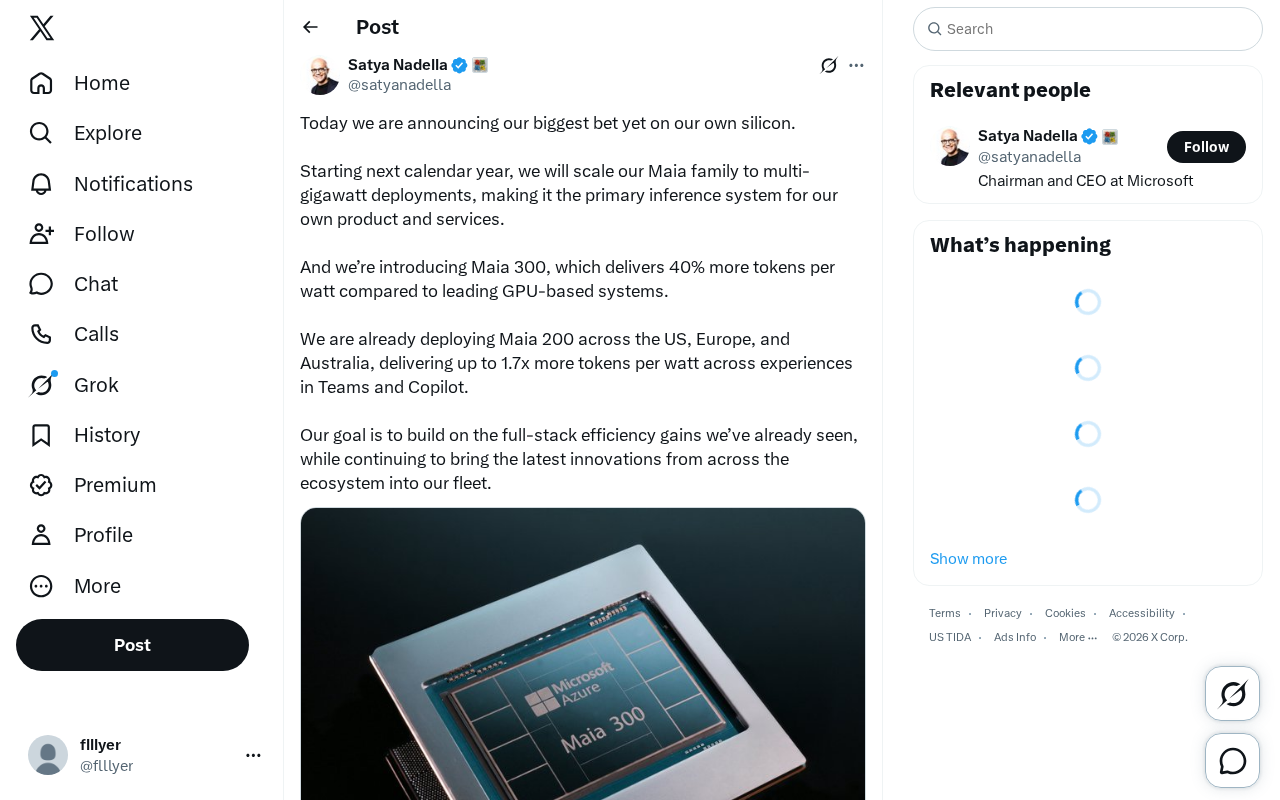
Microsoft has taken its biggest step yet on the road to in-house silicon. According to its latest announcement, Microsoft plans to scale its Maia series chips to multi-gigawatt deployments starting next calendar year, making them the core inference system for its own products and services. At the same time, Microsoft officially unveiled the Maia 300, claiming a 40% improvement in tokens per watt throughput compared to leading GPU solutions.
From Maia 200 to Maia 300: The Energy Efficiency Race Accelerates
In its announcement, Microsoft revealed that Maia 200 has already achieved up to 1.7x tokens-per-watt efficiency gains in experiences like Teams and Copilot. This data covers deployments across the United States, Europe, and Australia.
Maia 300 pushes this energy efficiency advantage even further. Microsoft claims that compared to leading GPU systems, Maia 300 can output 40% more tokens per watt. As AI inference costs increasingly weigh on enterprises, improvements in energy efficiency directly translate to the economics of per-unit compute.
This progress is not an isolated event. Microsoft emphasized that its goal is to build on full-stack efficiency gains while continuously bringing the latest ecosystem innovations into its own compute clusters.
Tokens per watt throughput is a core metric for measuring AI inference chip energy efficiency, referring to the number of tokens a chip can output per second under unit power consumption, typically measured in tokens/watt. For large-scale inference services, this metric directly determines the operating cost per unit of compute: given the rigid costs of electricity, cooling, and data center space, more energy-efficient chips can serve the same scale of user requests at lower cost — which is the main driver behind cloud providers developing their own inference chips in recent years. By contrast, general-purpose GPUs, while dominating the training phase thanks to their ecosystem advantages, are more easily outperformed in energy efficiency by specialized chips in inference scenarios where workloads are relatively stable and architectures can be optimized. It should be noted that such figures typically depend on specific models, sequence lengths, batch sizes, and other test conditions, and direct cross-vendor comparisons should be made with caution.
What Multi-Gigawatt Deployment Means
Scaling the Maia series to multi-gigawatt deployment is a weighty commitment. Gigawatt-level power consumption is typically comparable to a large data center campus or regional grid load, and multi-gigawatt means Microsoft will roll out its in-house inference chips across multiple sites worldwide simultaneously.
More critically, the positioning is shifting: Maia is moving from "experimental deployment" to "the primary inference system for its own products and services." This means the inference workloads behind Teams, Copilot, and other Microsoft services will increasingly run on in-house silicon rather than external GPUs.
For Microsoft, this is both a restructuring of its cost base and a strengthening of supply chain autonomy.
Gigawatt (GW)-level power consumption is a new scale for measuring the size of hyperscale data centers. 1 GW is roughly equivalent to the power load of a million-kilowatt nuclear reactor unit or a large industrial park, typically requiring dedicated substations and long-term power purchase agreements. The reason the AI industry describes compute planning in "gigawatts" is that once chip counts and continuous operating hours reach a certain level, power supply and cooling capacity often become bottlenecks earlier than chip procurement itself. Multi-gigawatt deployment means Microsoft needs to secure power, cooling, and land resources simultaneously across multiple regions, and bear the corresponding capital expenditure. This scale also reflects the magnitude of inference workloads — unlike one-time training, inference is a continuous, around-the-clock workload with a stronger dependence on stable power.
Industry Signals from In-House Chips
Microsoft's move continues the trend of major cloud providers developing their own AI chips. By optimizing chip architectures for their own workloads, vendors can achieve higher energy efficiency and lower unit costs than general-purpose GPUs in inference scenarios.
Maia 300's 40% energy efficiency improvement figure, if it can be delivered in real production environments, would put it in a favorable position in the inference chip competition. However, Microsoft did not disclose the specific benchmark conditions, and actual performance still requires third-party verification.
Microsoft stated it will continue to integrate the latest ecosystem innovations into its own clusters. This suggests its strategy is not entirely closed — in-house chips and external hardware solutions will coexist long-term, with the optimal solution chosen by scenario.
Cloud providers developing their own AI chips was first pioneered by Google's TPU around 2015, followed by Amazon's Trainium/Inferentia, with Meta, ByteDance, and others also entering the space. The common logic is: cloud providers understand the characteristics of their own workloads, allowing them to customize chip architectures and memory hierarchies to achieve better energy efficiency and cost than general-purpose GPUs in inference. The challenge lies in the software ecosystem — mature toolchains like CUDA carry high migration costs, so in-house chips are typically refined in internal services first before being gradually offered externally. This also explains why Microsoft emphasizes "long-term coexistence of in-house chips and external hardware" — when the ecosystem is not yet complete, hybrid deployment by scenario is the more realistic path.
Key Takeaways
- Microsoft plans to scale the Maia series to multi-gigawatt deployment starting next calendar year, making it the primary inference system for its own products and services.
- Maia 300 delivers 40% higher tokens per watt throughput compared to leading GPU systems.
- Maia 200 has already been deployed in the United States, Europe, and Australia, achieving up to 1.7x tokens-per-watt efficiency gains in Teams and Copilot.
- Microsoft's goal is to build on full-stack efficiency gains while continuously incorporating ecosystem innovations.
One-line Summary
Microsoft plans to scale Maia chips to multi-gigawatt deployment and launches Maia 300 with 40% better energy efficiency.
Paragraph Summary
Microsoft announced major in-house chip progress: it plans to scale the Maia series to multi-gigawatt deployment starting next calendar year, making it the primary inference system for its own products and services. The newly launched Maia 300 delivers 40% higher tokens per watt throughput than leading GPU solutions, while Maia 200 has already been deployed in the US, Europe, and Australia, achieving up to 1.7x tokens-per-watt efficiency gains in Teams and Copilot. The move continues the trend of major cloud providers developing their own AI chips, aiming to reduce inference costs and strengthen supply chain autonomy by optimizing architectures for their own workloads. Microsoft also stated it will maintain long-term coexistence of in-house chips and external hardware solutions, choosing the optimal solution by scenario, with its 40% efficiency figure still awaiting third-party verification.
Related articles

Apple HomeView Hands-On Review: Is the $300 Smart Home Hub Worth It?
Apple HomeView hands-on: a $300 smart home hub with facial recognition for quick account switching, but no App Store or voice recognition. Is the wall-mounted version worth it? Should you buy the first generation?

Meta Muse Wonder Launch: What It Means for Meta's Return to the Frontier AI Race
Meta releases Muse Wonder and WonderFull, benchmarks reach the frontier, community feedback is polarized. An in-depth look at Meta's return to the frontier AI race, its personal agent strategy, and Zuckerberg's different path.

Apple Home Smart Home Lineup Leaked: LG and Schneider Team Up, UWB Door Lock on Board
Apple Home ecosystem gains new LG and Schneider devices: UWB smart lock with proximity unlock, 2.5K dual-camera doorbell, privacy indoor camera, and AirPods-like seamless pairing.