Microsoft Layoffs Hit id Software: Doom Studio Loses Over Half Its Staff

Microsoft's Xbox layoffs hit Doom studio id Software, cutting over half its staff with QA hit hardest.
Microsoft's large-scale Xbox layoffs have dealt a heavy blow to Doom developer id Software, with roughly 50% of staff cut and over 90 positions eliminated—QA bearing the brunt. This article analyzes the layoff backdrop within the $68.7B Activision Blizzard merger integration, the structural vulnerability of QA, and the causes of the gaming industry's 'Great Contraction.'
Overview of the Event
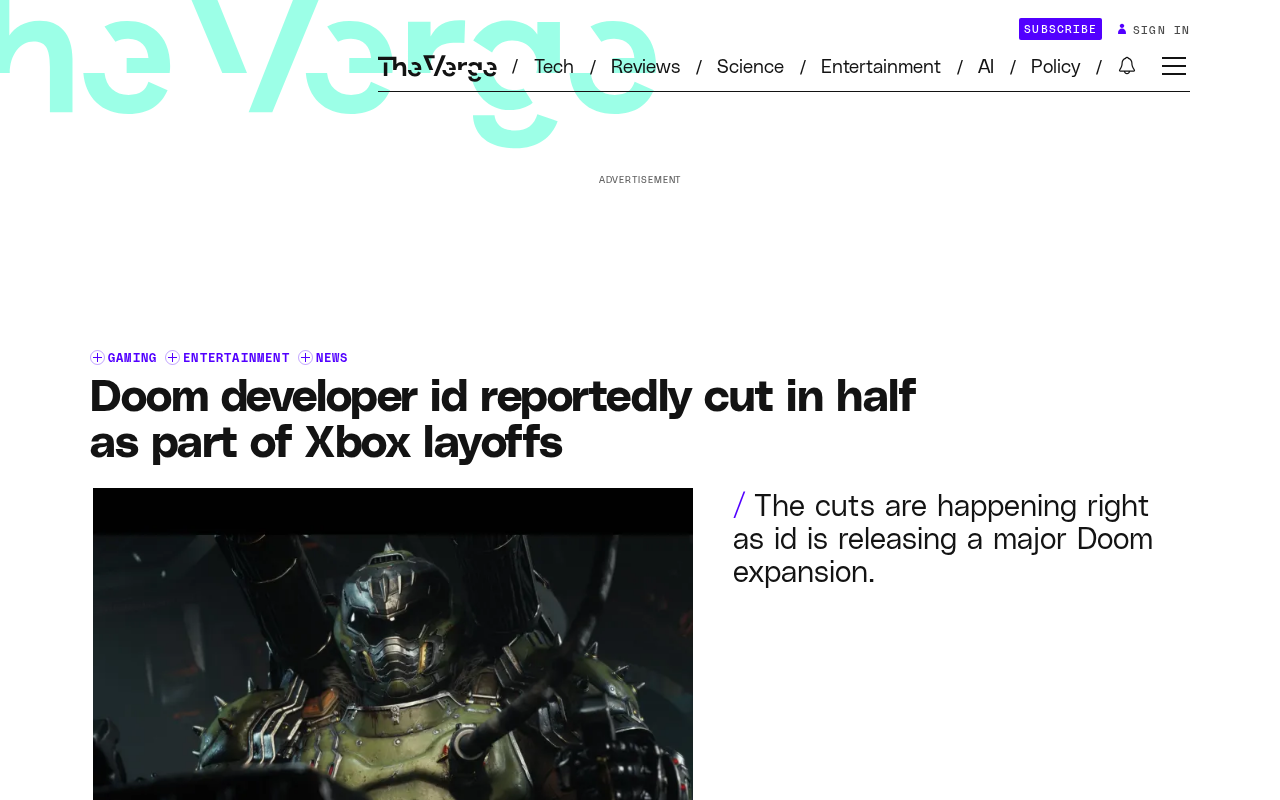
According to gaming industry outlet Game Developer, Microsoft has launched a large-scale round of layoffs across its Xbox division, dealing a heavy blow to id Software—the studio behind the classic shooter series Doom—with roughly 50% of its staff being cut. Sources reveal that the layoffs affected more than 90 positions, with the QA (Quality Assurance) department bearing the brunt of the impact.
This event is part of a recent series of large-scale organizational restructurings at Microsoft. As one of the most historically significant development studios in the gaming industry, id Software's plight has once again stirred deep concerns within the industry about the trajectory of gaming's future.
id Software's Place in History
For readers unfamiliar with this studio, id Software's importance in gaming history cannot be overstated. Founded in 1991, the company pioneered the first-person shooter (FPS) genre. Its signature works, Doom and Quake, not only defined a category but directly drove the evolution of 3D graphics technology, multiplayer online combat, and even modern GPU technology.
id Software's historical significance goes far beyond creating a few popular games. 1992's Wolfenstein 3D and 1993's original Doom redefined the possibilities of real-time 3D rendering at a technical level. The BSP tree (Binary Space Partitioning) technology pioneered by co-founder John Carmack—a data structure that recursively subdivides three-dimensional space into subsets of convex polygons—enabled engines to accomplish visibility determination at extremely low computational cost. This allowed for smooth pseudo-3D rendering within the processing limits of the 486 processors of the era—an algorithm still used today for collision detection and spatial queries in game AI. The Lightmap system that Carmack subsequently pioneered baked precomputed static lighting and shadows into textures, giving Quake dynamic lighting and shadow effects in 1996 that had never before been seen in real-time rendering. His active promotion of the OpenGL standard had an even more far-reaching impact—at a time when Microsoft was aggressively pushing its proprietary Direct3D interface, Carmack insisted on using OpenGL as Quake's rendering backend, forcing hardware vendors to elevate OpenGL driver optimization to parity with Direct3D. This directly accelerated the maturation of open graphics standards, and early 3D accelerator manufacturers like NVIDIA and 3dfx used Quake's rendering pipeline as a key benchmark when designing their chip architectures.
It's worth noting that Carmack's contributions to graphics went beyond engineering implementation. The Fast Inverse Square Root algorithm he introduced in Quake III Arena—a mysterious piece of code that approximates floating-point calculations through bit manipulation—achieved vector normalization at extremely low CPU cost. It was a classic technique for optimizing lighting calculations in the era before graphics shaders became widespread, and to this day it remains widely studied and cited as one of the most famous "hacks" in the history of computer science. This deep understanding and extreme exploitation of low-level hardware characteristics constitute the core DNA of id Software's technical culture.
id Software also pioneered the modding (Mod) ecosystem built around the .WAD file format—the WAD (Where's All the Data) format packaged levels, textures, sound effects, and other assets into a single replaceable file, allowing players to create custom content without ever touching the engine source code. This design philosophy gave rise to today's multi-billion-dollar game modding industry: Counter-Strike (CS) originated as a player mod for Half-Life, while the Half-Life engine itself was a deeply modified version of the Quake engine; Team Fortress likewise was born in Quake's mod community and later became a standalone commercial product under Valve. It's fair to say that the massive player-creation ecosystems represented today by Steam Workshop and the mod database Nexus Mods trace their genes directly to design decisions id Software made three decades ago.
It's also worth adding that id Software pioneered the practice of licensing game engines to third parties as standalone commercial products. Licensing fees for the Quake engine fueled the early businesses of studios like Valve and Raven Software—a business model that directly foreshadowed the rise of today's Engine-as-a-Service (EaaS) ecosystems like Unreal Engine and Unity. Epic Games alone generates over $1 billion in annual revenue from Unreal Engine licensing. From technical legacy to business model innovation, id Software's role in shaping the game industry runs throughout its history to this day.
After being brought under Microsoft's wing through the ZeniMax/Bethesda acquisition, id Software continued to deliver high-quality work, including the widely acclaimed Doom Eternal and several new titles in development. For a legendary studio carrying such deep gaming heritage, this round of layoffs is undoubtedly a heavy blow.
The Backdrop of Microsoft's Major Xbox Layoffs
id Software's layoffs are not an isolated event but rather a microcosm of the structural adjustments Microsoft is making across its entire Xbox gaming division. Ever since Microsoft completed its nearly $70 billion acquisition of Activision Blizzard, the pressure to integrate its gaming business and the need for cost control have continued to mount.
Notably, this $68.7 billion acquisition, completed in 2023, was one of the largest mergers in tech industry history. It endured a nearly two-year regulatory marathon—the U.S. Federal Trade Commission (FTC), the EU's Directorate-General for Competition (DG COMP), and the UK's Competition and Markets Authority (CMA) all successively intervened for review. The core controversy centered on whether Microsoft would make top-tier IPs like Call of Duty exclusive to the detriment of competitors' interests. Ultimately, Microsoft secured approval by committing to a series of behavioral remedies, including bringing Call of Duty to competing platforms (including Nintendo Switch and PlayStation) over the next decade—but this also meant Microsoft paid a price for the deal far exceeding the sticker figure. The transaction gave Microsoft top-tier IPs like Call of Duty, World of Warcraft, Diablo, and Overwatch in one stroke, bringing its total number of gaming studios to over 30 and expanding its workforce to around 23,000 employees.
From a strategic depth perspective, one of the core motivations behind Microsoft's acquisition of Activision Blizzard was to strengthen the content library of the Xbox Game Pass subscription service. Game Pass is essentially the gaming industry's "Netflix model"—trading a monthly subscription fee for access to a massive game library. Its business logic depends on a continuous supply of high-quality content to reduce user churn rate. Bringing top-tier IPs like Call of Duty and Diablo, which sell tens of millions of copies annually, into Game Pass significantly boosts the perceived value of the subscription service, thereby supporting Microsoft's long-term strategy of competing against Sony's PlayStation in the console market—especially against the backdrop of Xbox hardware sales lagging PS5 for a long time. A "platform-agnostic strategy" centered on software subscription services has become a key pillar of Microsoft's differentiated competition.
However, mega-scale mergers are often accompanied by a painful integration period: the consolidation and elimination of overlapping functional departments, the restructuring of management hierarchies, the unified migration of technical infrastructure (such as unifying the project management, code repositories, and publishing workflows of dozens of studios into Microsoft's Azure ecosystem), and the internal friction of bringing dozens of vastly different corporate cultures under a single management framework—all of these tend to erupt intensively within 12 to 36 months after the merger completes. There's a rule of thumb in the field of merger integration: "Half the price of a merger is paid at the negotiating table before closing day, and the other half is slowly consumed during the integration process afterward." id Software's layoffs occurred precisely within this classic window of merger integration pain, and their sheer scale reflects that Microsoft's current integration strategy has shifted from "preserving independence" to "unified management and cutting redundancy."
Over the past year and more, Microsoft has already carried out multiple rounds of layoffs across several of its well-known studios. Analysts believe this reflects several deep-seated tensions:
- The pain of acquisition integration: After large-scale mergers close, the elimination of redundant functions is nearly inevitable, and Microsoft needs to reallocate resources across its sprawling matrix of studios.
- Cost control pressure: AAA blockbuster development costs routinely reach hundreds of millions of dollars, and even a financially robust Microsoft is seeking a higher return on investment.
- Overall industry downturn: In recent years, the global gaming industry has experienced an unprecedented wave of layoffs, sparing no one from indie studios to industry giants.
Why the QA Department Bore the Brunt
The report specifically noted that id Software's QA department suffered significant impact—a phenomenon quite representative of gaming industry layoffs in recent years and worthy of deeper examination.
The QA (Quality Assurance) department is responsible for game testing, bug hunting, and quality control—the critical last line of defense determining the final product experience. However, at the corporate level, QA positions are often viewed as "optimizable" cost items. From an industry structure standpoint, game QA has long occupied the position with the worst treatment yet the greatest pressure in the entire development chain: testers are typically hired as contractors or temporary workers, with hourly wages in some parts of the U.S. even falling below the local minimum wage. During the "crunch period" before a game's release (the Gold Master phase), they must repeatedly execute test cases for as long as 12 to 16 hours a day; after release, they immediately face non-renewal of contracts, with neither unemployment insurance nor severance compensation. This structural vulnerability naturally makes the QA department a priority target during layoffs, because the relevant labor law protections are the weakest, and non-renewal of an expiring contract isn't even counted as a "layoff" on financial statements.
The organizing movement among game QA workers has accelerated significantly in recent years, reflecting deep-seated contradictions in labor relations across the entire industry. In 2021, QA employees at Activision Blizzard's Raven Software formed the first union at a major U.S. game studio—the Raven Software Quality Assurance Workers—joining the Communications Workers of America (CWA). The direct trigger was the company's sudden dismissal of 12 QA contractors. Following this, unionization efforts emerged at multiple studios including Blizzard Albany and Microsoft ZeniMax Studios. The CWA's "CODE-CWA" initiative specifically targets the gaming industry and has completed union certification votes at several studios. Ironically, however, the most heavily unionized QA departments were hit hardest in this round of Microsoft layoffs—drawing keen attention from labor rights advocates. Some analysts believe this is no coincidence but rather a strategic maneuver by management to evade collective bargaining obligations through structural restructuring, and the related controversy has already attracted the attention of the U.S. National Labor Relations Board (NLRB).
Meanwhile, AI automated testing tools based on large language models and computer vision are rapidly maturing: Microsoft's in-house Playwright framework supports cross-browser end-to-end automated testing; the game-specific AI testing platform modl.ai (already adopted by major publishers like Ubisoft and 505 Games) can train AI agents to autonomously explore game environments, automatically executing repetitive tasks like regression testing, edge-path traversal, physics collision detection, and crash reproduction; Epic Games has also integrated the automated testing framework Gauntlet into Unreal Engine 5.
From a technical principles standpoint, current game AI testing tools are primarily based on two approaches: first, autonomous exploration agents driven by reinforcement learning, which use reward functions to guide the AI in discovering physics-level bugs like geometry clipping and collision anomalies within game maps; second, anomaly detection based on computer vision, which identifies visual defects like screen tearing and texture errors by comparing rendered frames against baseline images. However, both methods face the "reward function design dilemma"—developers must define in advance what constitutes an "anomaly," yet the truly dangerous bugs are often edge cases the designers never anticipated. The more fundamental limitation is that AI cannot perceive "game feel"—this core dimension: whether the recoil feedback of firing a weapon is satisfying, whether the pacing of a level is appropriately balanced, whether the emotional turns of the narrative feel natural. These judgments require the embodied cognition of human players, which no current AI system can reliably quantify. This is precisely the fundamental reason why industry experts widely believe AI testing can only "assist" rather than "replace" human QA.
Many veteran developers in the industry hold a clear critical stance on this. They believe that cutting internal QA forces will likely directly lower the launch quality of games—the poor performance of several AAA blockbusters at launch in recent years (such as the console version crash issues when Cyberpunk 2077 launched in 2020, and the data corruption bug in Anthem) is directly linked to the compression of the testing phase.
The Far-Reaching Impact on the Gaming Industry
The id Software layoffs reflect the structural challenges currently facing the gaming industry. When a legendary studio with over thirty years of history, one that pioneered an entire game genre, needs to cut more than half its staff, this signal is enough to make the entire industry uneasy.
From a more macro perspective, between 2023 and 2024, the cumulative number of layoffs in the global gaming industry exceeded 30,000, affecting nearly every major publisher and developer including EA, Epic Games, Ubisoft, Sony, and Take-Two—dubbed within the industry as "The Great Games Industry Contraction." Its underlying causes are a compounding of multiple pressures:
First is the receding of the pandemic dividend. Between 2020 and 2021, lockdowns drove an irrational boom in global gaming consumption, with major publishers' monthly active users and revenue hitting record highs. Companies subsequently went on massive hiring sprees to meet the anticipated sustained growth. However, after the pandemic ended, user behavior returned to normal, and gaming consumption shrank noticeably in 2022–2023, leaving over-expanded headcounts as a heavy burden.
Second is the exponential swelling of AAA development costs. According to data from gaming industry research firms Newzoo and IDG, the average development cost of AAA games has tripled to quintupled over the past decade: in the early 2010s, a mainstream AAA title's budget was around $50 million to $100 million, whereas current top-tier AAA projects (such as Marvel's Spider-Man 2, reportedly costing over $300 million to develop, and GTA 6, whose budget is estimated at over $2 billion) rival the scale of Hollywood's top blockbuster films.
The micro-level mechanics of this cost inflation are worth examining closely. The most significant driver of soaring AAA game costs is the art asset production cost brought by the "graphics arms race": realistic games in the PS5/Xbox Series X era require each character's face to have tens of thousands of polygons, full-body skin shaders containing more than a dozen layers of physical parameters, and every rock in a scene to have hand-sculpted normal maps—this has swelled art teams from dozens of people in the PS3 era to hundreds or even over a thousand today. Naughty Dog's The Last of Us Part II development team peaked at over 2,000 people. At the same time, the swelling of game scale (players expecting main storylines exceeding 30 hours, open worlds measured in square kilometers) has directly lengthened development cycles, with the average AAA project development cycle extending from 2 to 3 years in the 2000s to the current 4 to 6 years. Some developers have begun to reflect on the sustainability of this model, and the revival of "AA games" (medium-scale productions between indie and AAA) is seen as one of the industry's explorations in seeking a rebalance between cost and quality.
Worth watching is that the introduction of generative AI tools is becoming a new variable in the industry's response to cost pressure. Image generation tools like Midjourney and Stable Diffusion are already used by some studios for the rapid prototyping stage of concept art; Microsoft's GitHub Copilot is used to assist in writing game scripts and toolchain code; and the Ghostwriter tool developed by Ubisoft La Forge can automatically generate draft NPC dialogue for scriptwriters to review and revise. However, these tools currently still primarily serve in assistive and acceleration roles rather than directly replacing core creative positions—their actual effectiveness in compressing overall development costs remains debated, and the legal risks involving the copyright ownership of training data (multiple class-action lawsuits against AI companies are currently pending) have made many studios cautious about large-scale adoption.
Third is the tightening of the capital environment. The rising interest rate cycle globally since 2022 has significantly compressed venture capital's tolerance for long-cycle, high-risk projects. Gaming investment has entered a winter, and large publicly traded companies also face direct pressure from institutional shareholders to "improve profitability." This wave of layoffs marks the gaming industry transitioning from a period of rapid expansion into a period of mature adjustment. Capital markets are demanding that game companies shift from "growth first" to "profit first," and the scissors gap between continuously rising development costs and slowing user growth is transmitting pressure to every link in the chain.
For practitioners, industry stability is declining; for players, the personnel turmoil at studios may affect the quality and release cadence of future titles. Whether id Software can continue to maintain the high standard of its work after such a significant staff reduction will be a focus of ongoing industry attention.
Conclusion
The news of id Software's layoffs is a microcosm of the current predicament facing Microsoft's Xbox division and indeed the entire gaming industry. It reminds us that even the most legendary studios are equally fragile in the face of capital logic and industry cycles.
As more details emerge, we hope Microsoft will provide a clearer explanation of this restructuring, and we hope the laid-off developers can find new opportunities as soon as possible. For players who love the Doom series, we can only hope that id Software can weather this difficult period and continue to bring the world those era-defining classics.
Key Takeaways
- id Software is the founder of the FPS genre, and its technical legacy (BSP trees, lightmaps, OpenGL promotion, the fast inverse square root algorithm, the modding ecosystem) profoundly influenced modern GPU architecture and the gaming industry ecosystem; its engine licensing business model directly gave rise to studios like Valve and foreshadowed today's Unreal Engine EaaS ecosystem
- These layoffs are a typical manifestation of the merger integration pain period following Microsoft's completion of the $68.7 billion Activision Blizzard acquisition, falling in the middle of the 12-to-36-month integration window; the strategic core of the acquisition was to strengthen the content competitiveness of the Xbox Game Pass subscription service through top-tier IPs, using a "platform-agnostic strategy" to counter PS5's hardware advantage
- The QA department, due to its structural vulnerability (predominantly contract workers, weak legal protection), has long been a priority target for layoffs; the rise of the game QA workers' unionization movement (represented by the Raven Software union) combined with this round of layoffs has sparked deep controversy at the labor rights level; the maturation of AI automated testing tools has accelerated this trend, but its technical limitations (inability to perceive subjective dimensions like "game feel") mean it cannot fully replace human judgment
- The underlying causes of the gaming industry's "Great Contraction" are the compounding of three pressures: the receding pandemic dividend, swelling AAA development costs (the "graphics arms race" driving dramatic increases in art team size and extending development cycles to 4–6 years), and the tightening capital environment; the introduction of generative AI tools is a new variable, but actual cost reduction effects coexist with copyright legal risks; the revival of "AA games" is a signal of the industry seeking a new balance
Related articles

Apple HomeView Hands-On Review: Is the $300 Smart Home Hub Worth It?
Apple HomeView hands-on: a $300 smart home hub with facial recognition for quick account switching, but no App Store or voice recognition. Is the wall-mounted version worth it? Should you buy the first generation?

Meta Muse Wonder Launch: What It Means for Meta's Return to the Frontier AI Race
Meta releases Muse Wonder and WonderFull, benchmarks reach the frontier, community feedback is polarized. An in-depth look at Meta's return to the frontier AI race, its personal agent strategy, and Zuckerberg's different path.

Apple Home Smart Home Lineup Leaked: LG and Schneider Team Up, UWB Door Lock on Board
Apple Home ecosystem gains new LG and Schneider devices: UWB smart lock with proximity unlock, 2.5K dual-camera doorbell, privacy indoor camera, and AirPods-like seamless pairing.