Microsoft Shuts Down Wunderlist: Why Do Good Apps Lose to Inferior Ones?

Microsoft is shutting down Wunderlist and pushing Microsoft To Do, but the latter falls short in features and experience, sparking user dissatisfaction and migration.
Microsoft announced it will shut down Wunderlist, the to-do app it acquired in 2015, and promote Microsoft To Do instead. Wunderlist was beloved for its clean interface, smooth syncing, and strong collaboration features, while To Do is lacking in sharing mechanisms and interface customization. The article reviews Microsoft's acquisition history that started high and ended low, noting that its product integration strategy often comes at the cost of sacrificing excellent acquired products, similar to what happened with Sunrise Calendar. Users are disappointed by the shutdown and are seeking alternatives such as Todoist and TickTick. Microsoft ecosystem integration is To Do's advantage, but whether it can make up for Wunderlist's absence remains to be seen.
Microsoft recently announced it will shut down its acquired to-do app Wunderlist and shift full focus to promoting its own Microsoft To Do. The news left many longtime users lamenting. After all, Wunderlist was once one of the most popular mobile to-do apps, and when Microsoft acquired it in 2015, rumors put the price as high as $200 million. At the time, fans worried Microsoft would strip its soul or bury it inside a complex enterprise subscription. But unexpectedly, Microsoft once played the role of a competent steward.
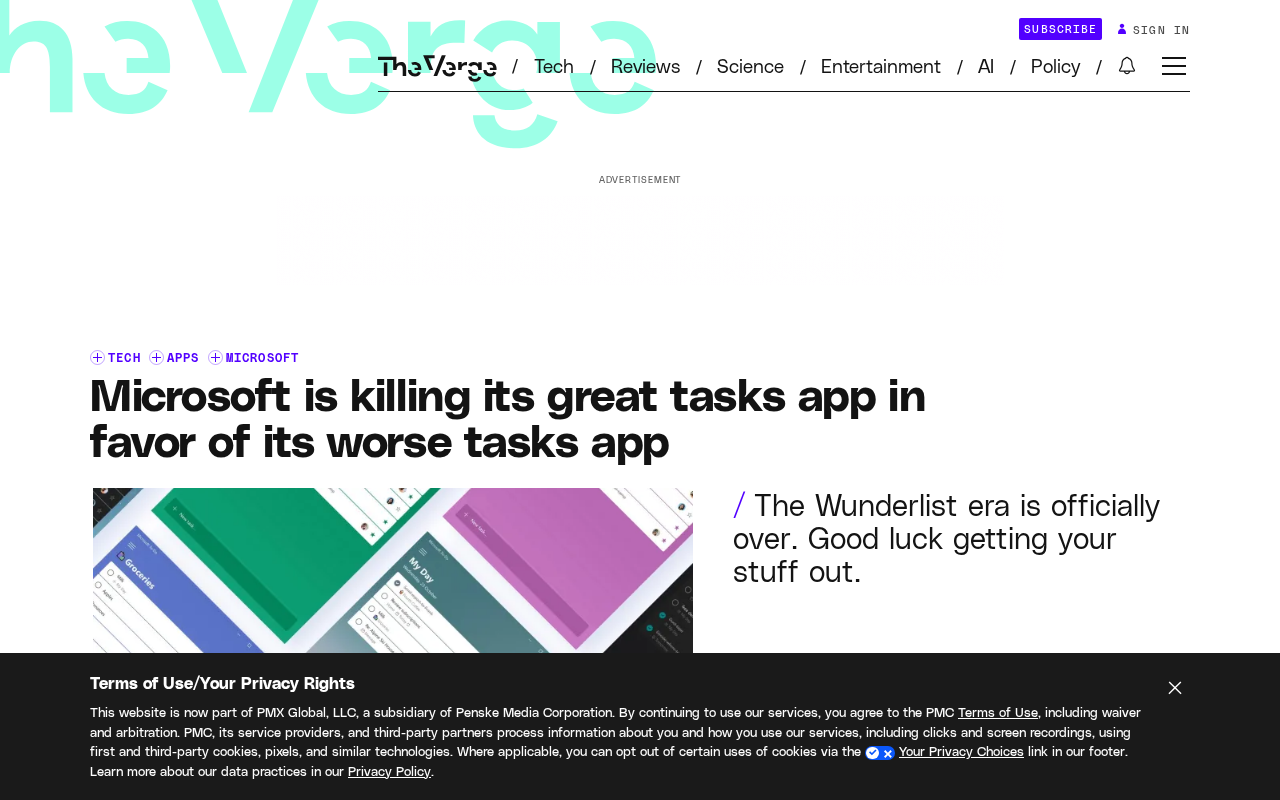
However, the good times didn't last. Microsoft ultimately decided to cut this well-regarded app, citing "resource consolidation." But the question is: can the replacement, Microsoft To Do, really carry the banner? Judging from user feedback and feature comparisons, the answer may be no.
From Wunderlist to Microsoft To Do: An Acquisition That Started High and Ended Low
In 2015, when Microsoft acquired Wunderlist, outsiders were generally optimistic. Wunderlist had won a large number of loyal users with its clean interface, smooth syncing, and cross-platform support. Initially, Microsoft did keep the app independent and even released some updates. But over time, Microsoft began gradually migrating Wunderlist's features to the new Microsoft To Do and eventually announced Wunderlist's shutdown.
According to RSS sources, Wunderlist fans had worried Microsoft would "ruin" the app, but Microsoft's initial behavior was a relief. Unfortunately, that "goodwill" did not last to the end. Microsoft ultimately chose to replace it with its own product, even though the latter was not as feature-rich or user-friendly as the former.
Wunderlist was developed by the German startup 6Wunderkinder and officially launched in 2011. It quickly rose to fame thanks to its clean interface, smooth cross-platform syncing, and collaboration features. By the time Microsoft acquired it in 2015, it had more than 13 million users worldwide. After the acquisition, the Wunderlist team was folded into Microsoft, but the app itself initially continued to receive independent updates. Microsoft launched Microsoft To Do in 2017 as a replacement for Wunderlist and gradually migrated Wunderlist's features to the new app. This transition period lasted several years until Microsoft officially announced Wunderlist's shutdown.
Feature Comparison: Why Was Wunderlist Superior?
Wunderlist was popular because it made to-do management extremely simple yet powerful. It supported multi-platform syncing, shared lists, task assignment, due-date reminders, subtasks, file attachments, and more. The interface was intuitive, the experience smooth, and there was almost no learning curve.
By contrast, although Microsoft To Do inherited some features, it falls short in the details. For example, Wunderlist's list sharing and collaboration features were more flexible, while To Do's sharing mechanism is relatively cumbersome. In addition, Wunderlist offered more interface customization options, while To Do's design feels more rigid. Many users complain on social media that To Do lacks Wunderlist's "light and breezy" feel.
Microsoft has not explained in detail the specific reasons for shutting down Wunderlist, but the industry generally sees it as part of Microsoft's effort to consolidate its product line and unify its brand strategy. However, this practice of "replacing good with inferior" inevitably raises questions about the logic of the decision.
The core features of to-do apps typically include task creation, categorized lists, due dates, reminders, subtasks, attachments, and collaborative sharing. On top of these, Wunderlist offered highly intuitive interaction design, such as quick task entry, natural-language date input, and flexible list grouping. Microsoft To Do integrates Outlook tasks and the Microsoft ecosystem and supports smart suggestions through "My Day," but it is more limited in shared-list permission management and interface customization. Both offer cross-platform syncing, but Wunderlist's syncing mechanism was known in its early days for stability and low latency, while To Do's syncing occasionally suffers from delays or conflicts.
Microsoft's Product Integration Strategy: Why Does Bad Money Always Drive Out Good?
Microsoft has many similar cases throughout its history. Excellent acquired products are ultimately replaced by weaker homegrown features or absorbed into larger platforms and lose their distinctiveness. For example, after Sunrise Calendar was integrated into Outlook, many advanced features disappeared; Wunderlist's fate is much the same.
Behind this strategy is Microsoft's consideration of ecosystem unification and commercial interests. Concentrating users on its core products can reduce maintenance costs and increase user stickiness, but it may also sacrifice product distinctiveness and user experience. For utility apps like Wunderlist, users care about efficiency and experience, not brand ownership. When replacements fail to meet their needs, user attrition is inevitable.
According to analysis from RSS sources, Microsoft may believe To Do is good enough, or at least able to meet most users' basic needs. But judging from the reactions of Wunderlist fans, "good enough" is clearly not enough.
Sunrise Calendar was a highly acclaimed cross-platform calendar app known for its elegant design and smart schedule integration, and Microsoft acquired it in 2015. After integrating some of its features into Outlook mobile and desktop, Microsoft discontinued Sunrise's standalone service in 2016. Similar cases include the Acompli email app Microsoft acquired (which later evolved into Outlook mobile) and the MileIQ mileage-tracking app (integrated into other services). These acquisitions are usually aimed at acquiring technology and talent rather than maintaining standalone products long term. Microsoft's integration strategy emphasizes concentrating users and data on its core product lines to reduce maintenance costs and strengthen ecosystem stickiness, but it often results in the simplification or removal of the original products' unique features.
What Should Users Do? Alternatives and Migration Advice
For loyal Wunderlist users, the shutdown means they need to find new tools. There are currently many excellent to-do apps on the market, such as Todoist, TickTick, and Things, which even surpass Wunderlist in functionality. Users can choose the right alternative based on their needs.
Microsoft officially says Wunderlist users can migrate their data to Microsoft To Do, but the migration process may not be perfect. Some users report that after migration, some task information is lost or formatting is disrupted. Therefore, it is wise to make a backup before migrating.
If you decide to stay in the Microsoft ecosystem, To Do remains a usable option, especially because it integrates closely with apps such as Outlook and Teams. But if you want a purer to-do experience, perhaps you should consider other options.
The to-do app market is already quite mature, and mainstream alternatives each have their own focus: Todoist is known for natural-language input and powerful filters, and supports cross-platform syncing and team collaboration; TickTick integrates a Pomodoro timer and calendar view, making it suitable for personal productivity management; Things focuses on the Apple ecosystem with elegant design but is limited to iOS and macOS. In addition, Google Tasks is deeply integrated with Gmail and suits light users; Any.do offers free basic features and an intuitive interface. When choosing, users need to consider platform compatibility, collaboration needs, data export capabilities, and whether they are willing to pay for premium features.
Conclusion: The Death of Good Products and Users' Choices
The shutdown of Wunderlist reminds us once again that under the dominance of business giants, excellent products do not necessarily meet a good end. Microsoft's decision may have its rationale, but for users, losing a handy tool is always regrettable. Fortunately, the market is open, and users can vote with their feet. In the future, whether Microsoft To Do can evolve enough to make up for Wunderlist's absence remains to be seen. But at least for now, it has not convinced everyone.
Related articles
Fear of AI Is Spreading: A Technologist's Confession
A Hacker News post 'I'm Scared of AI' sparks debate with 212 points and 247 comments, showing AI anxiety spreading from the public into the tech community itself.

Unkernel: Compiling the Linux Kernel to WebAssembly
The Unkernel project compiles a real Linux kernel to WebAssembly, making it possible to run a complete kernel in the browser. This article covers its technical principles, challenges, and prospects.
New Claude Sonnet Model Tested: Performance Approaches Opus with Less Thinking
Anthropic quietly tests a new Sonnet model in Claude Code—performance approaches Opus 5.5 with far fewer thinking tokens, plus Codex transfer optimization, xAI's low-level rewrite, Google Antigravity updates, and the AI science understanding gap.