Microsoft VS Code Tops GitHub: The Developer Ecosystem Behind 194,776 Stars
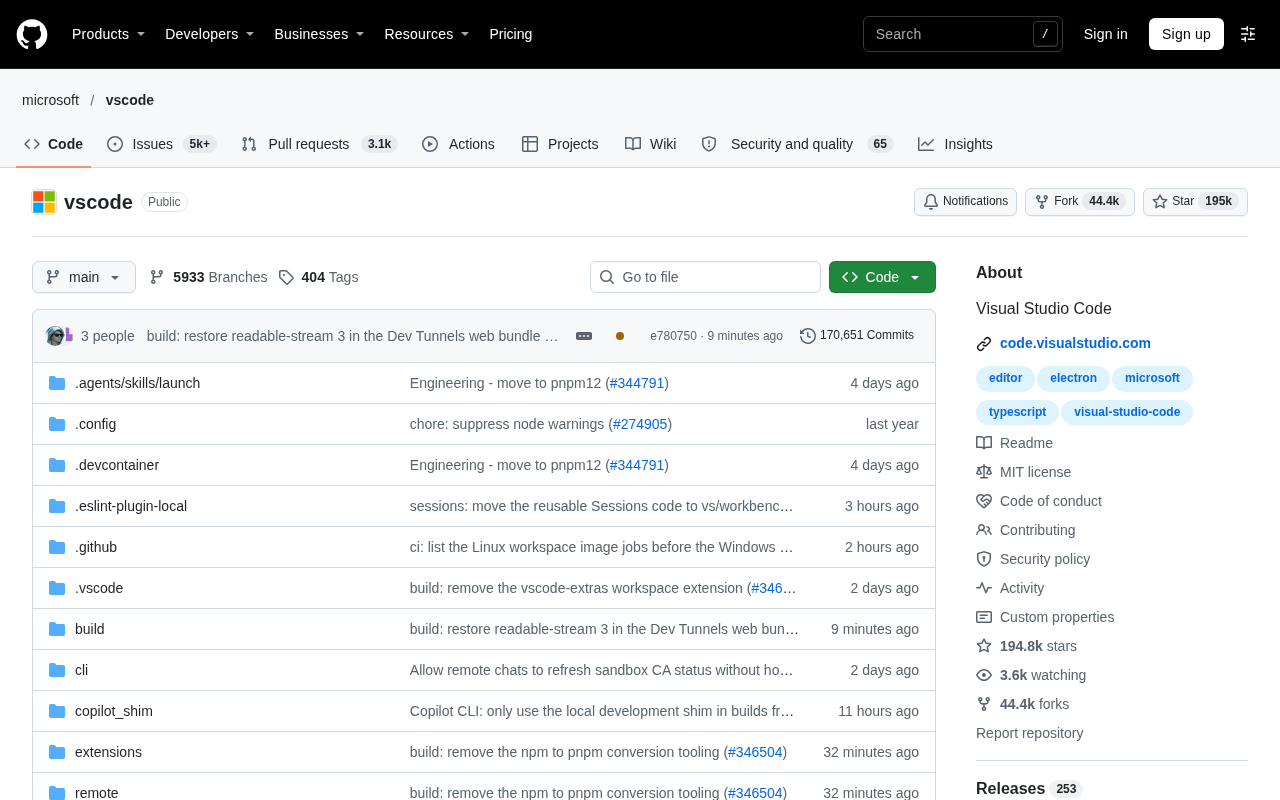
With nearly 200K stars and 44K forks, VS Code shows the open-source vitality of a TypeScript platform-based editor.
This article uses VS Code's rise on the GitHub trending list to examine its 194,776 stars, 44,403 forks, and 295 new stars in a single day, analyzing why an editor can attract such a large community. VS Code turns the "editor" into a "platform": TypeScript lowers the barrier for front-end developers, the open plugin system lets the community fill in language support and debuggers, and Electron enables cross-platform coverage. The 44,403 forks reflect hands-on customization, not just bookmarking. In the AI programming era, VS Code's open API makes it the main host for AI assistants, though feature evolution still needs tracking via releases and issues.
Title
Microsoft VS Code Tops GitHub: The Developer Ecosystem Behind 194,776 Stars
Meta Description
Microsoft's open-source Visual Studio Code has accumulated 194,776 stars and 44,403 forks on GitHub, with 295 new stars in a single day. This article analyzes why this project remains consistently active from the perspectives of its TypeScript tech stack, plugin ecosystem, and AI coding tool integration, and what reference value it offers developers.
Article Content
Visual Studio Code has once again appeared on the GitHub trending list. This code editor, open-sourced by Microsoft, has currently accumulated 194,776 stars and 44,403 forks, with 295 new stars in a single day, maintaining a long-term leading position among TypeScript projects. The fact that an editor can accumulate such a community scale itself demonstrates its position in developers' workflows.
Why an Editor Can Gather Nearly 200,000 Stars
GitHub star counts do not fully equate to technical level, but they roughly reflect a project's attention and sustained activity. VS Code's scale of nearly 200,000 stars is rare across the entire GitHub ecosystem.
What supports this number is its approach of turning an "editor" into a "platform." The core repository is written in TypeScript, meaning front-end developers can read the source code and submit PRs with a relatively low barrier to entry; the open plugin system allows capabilities such as language support, debuggers, themes, and linters to be filled in by the community rather than being handled solely by Microsoft.
From an engineering perspective, VS Code adopts the Electron architecture, bringing the web technology stack to the desktop. This choice sparked performance controversies in its early years, but precisely because of it, the editor can cover Windows, macOS, and Linux simultaneously and has spawned forms such as a web version.
Electron is an open-source framework led by GitHub that packages the Chromium rendering engine together with the Node.js runtime, allowing developers to build cross-platform desktop applications using HTML, CSS, and JavaScript. Well-known software such as VS Code, Atom, Slack, and Discord are all based on it.
Electron's advantage lies in running a single codebase on Windows, macOS, and Linux while reusing the vast web ecosystem and front-end talent pool. The cost is a relatively large application size, higher memory usage, and slower startup speeds compared to native solutions—which is precisely the root of VS Code's early performance controversies. In recent years, Electron has continued to improve its process model and rendering optimization, while VS Code has also alleviated these issues through measures such as lazy loading and extension process isolation.
The Exemplary Significance of the TypeScript Tech Stack
The original information shows that the project's primary language is TypeScript. For developers focused on AI programming and toolchains, this point deserves separate discussion.
TypeScript's static typing capability significantly reduces the collaboration cost of large front-end projects. VS Code itself is a massive TypeScript project, and its existence proves that this tech stack can support the long-term iteration of complex desktop applications. This also explains why a large number of AI coding assistants and Language Server Protocol (LSP) implementations prioritize the TypeScript ecosystem.
For developers who want to learn engineering practices, VS Code's repository structure, module division, and plugin API design are more direct reference samples than tutorials.
Language Server Protocol (LSP) is an open protocol proposed by Microsoft in 2016 to decouple the two ends of "editor" and "language intelligence." It abstracts capabilities such as autocompletion, go-to-definition, hover hints, and error diagnostics into a set of standard JSON-RPC-based messages, so that language providers only need to implement a language server to have it reused by any editor that supports LSP.
LSP's significance lies in breaking the M×N adaptation dilemma: in the past, M editors supporting N languages required M×N integrations; with LSP, only M clients and N servers are needed. VS Code was the first major implementer of LSP, and this protocol was later widely adopted by Neovim, Emacs, Sublime Text, and others, becoming an important channel for the TypeScript ecosystem to spread outward.
What 44,403 Forks Indicate
Fork counts are often overlooked, but they reflect the scale of "actual hands-on work" better than stars. 44,403 forks mean that a large number of developers are not just bookmarking but cloning, modifying, and attempting to build.
Among these forks, some are used for customized enterprise distributions, some for learning and research, and some become the foundation for third-party derivative projects. The true vitality of an open-source project often hides in these branches that are not in the main repository.
Combined with the growth of 295 stars in a single day, VS Code is still in a state of being continuously discovered, rather than a project that has already taken shape and is sustained only by its existing user base.
The Editor Battle in the Age of AI Programming
Currently, a large number of AI coding tools enter editors in the form of plugins, and VS Code is one of the most important hosts among them. Its open API allows various AI assistants to integrate as extensions without having to build their own editors.
This brings a two-way impact: on one hand, VS Code further consolidates its gateway position by hosting these AI capabilities; on the other hand, AI tools are also changing developers' expectations of editors, shifting from "text editing" to "equal emphasis on dialogue and autocompletion."
A quick note: this material only contains the repository's basic metrics and does not involve specific AI feature updates or version changes, so no judgment can be made about feature evolution. Readers interested in this direction are advised to directly follow the repository's release and issue updates.
VS Code's extension API is the key mechanism by which it moves from an editor to a platform. Extensions run in separate processes and register commands, menus, shortcuts, views, and language capabilities with the main program through a set of declarative contribution points, thereby achieving a balance between isolation and openness of capabilities.
For AI coding assistants, this API provides integration points such as in-editor chat, inline completion, and code actions, enabling tools like Copilot and Cline to be distributed as extensions without having to build their own editors or modify the host source code. Extensions run in a separate extension host process, so even if an AI extension lags or crashes, it will not directly bring down the editor's main interface—this is the engineering foundation that allows its ecosystem to carry a large number of third-party capabilities.
Practical Reference Value for Developers
If you are choosing an editor for long-term use, or want to participate in a mature open-source project, VS Code's metrics provide some signals: the project is active, the community is large, the tech stack is mainstream, and the plugin ecosystem is mature.
If you focus on AI application implementation, it is a sample for observing "how tools are reshaped by AI"; if you focus on open-source collaboration, it is a case study for researching the governance of large TypeScript projects.
Stars and forks are only the entry point; what is truly valuable is going into the repository and looking at those issues and PRs that are repeatedly discussed.
One-line Summary
With nearly 200,000 stars and 44,000 forks, VS Code demonstrates the open-source vitality of a TypeScript platform-based editor
Paragraph Summary
This article takes VS Code's appearance on the GitHub trending list as its starting point, outlining its basic metrics of 194,776 stars, 44,403 forks, and 295 new stars in a single day, and analyzing why an editor can accumulate such a scale of community attention. The article points out that VS Code's core idea is to turn an "editor" into a "platform": the TypeScript tech stack lowers the barrier for front-end developers to participate, the open plugin system allows capabilities such as language support and debuggers to be filled in by the community, and the Electron architecture enables cross-platform coverage. The 44,403 forks reflect the scale of actual hands-on customization rather than mere bookmarking. In the age of AI programming, VS Code has become the primary host for various AI assistants thanks to its open API, but its feature evolution still requires tracking release and issue updates.
Related articles
 Tech Frontiers
Stylome Bot Slammed as Useless Junk: Why Do AI Detection Tools Keep Failing?
Reddit users test the Stylome AI detection bot: Gemini-rewritten text judged human-written, consistently low confidence. An analysis of AI text detection's technical dilemmas, privacy concerns, and credibility crisis in community governance.
 Tech Frontiers
When AI Becomes a Productivity Divide: Clarity or "AI Psychosis"?
A civil engineer's deep use of agentic AI boosted efficiency but bred contempt for peers who refuse to learn. Is this clarity or AI psychosis? An analysis of the cognitive and psychological challenges behind the AI productivity divide.
 Tech Frontiers
Opus 5.5 Benchmark Scores Climb, Community Says Its "Weights Are Blessed"
Reddit community discusses Opus 5.5's rising scores on the Benchmaxxing Bench, with users describing its performance as "weights are blessed." This article interprets the community reaction and cautions against conflating benchmark scores with real capability.