Midjourney V8.2 Style Reference: A Practical Guide to Vintage Editorial Illustration Aesthetics
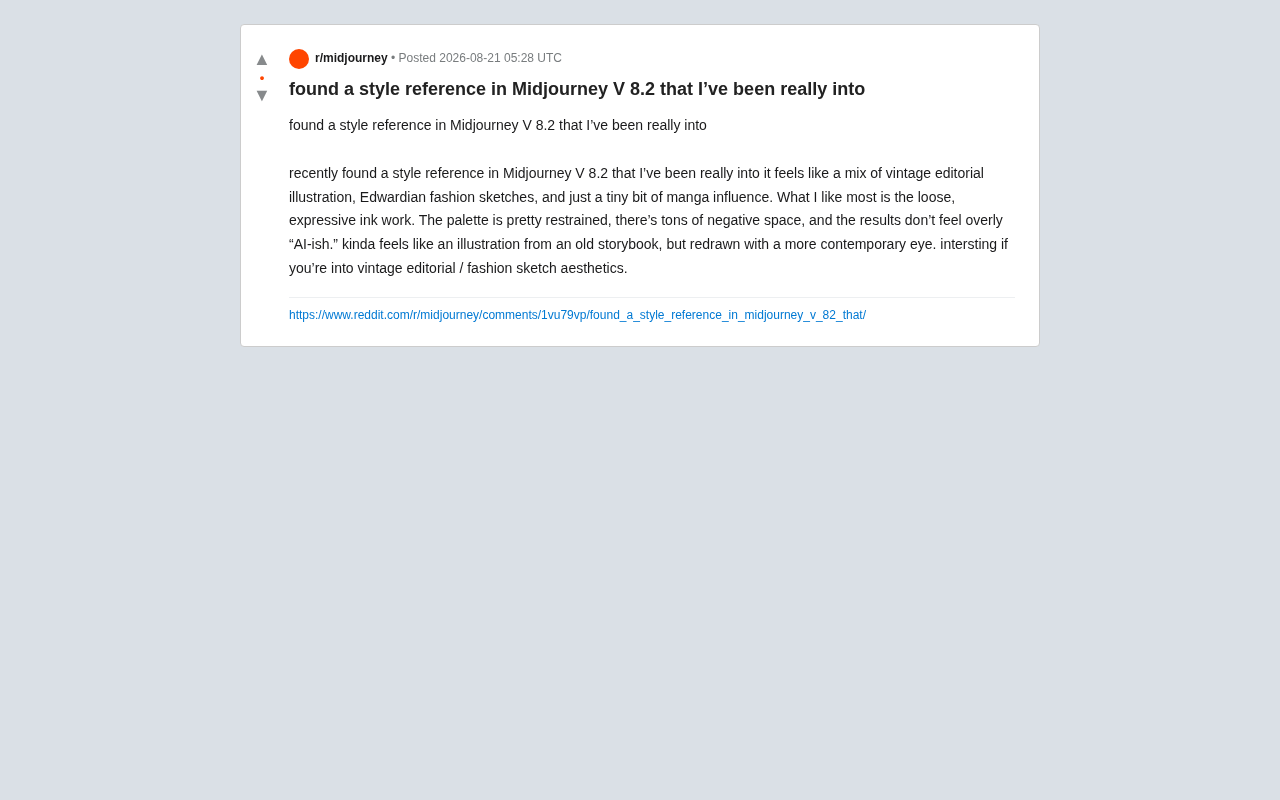
A guide to achieving vintage editorial illustration aesthetics in Midjourney V8.2 with less AI feel
Creators have discovered a distinctive vintage editorial illustration style reference in Midjourney V8.2 that blends Edwardian-era fashion sketches with loose, expressive ink work. The style's restrained color palette and abundant negative space successfully avoid typical AI rendering artifacts, creating outputs that feel hand-drawn rather than synthetically generated.
A Midjourney Style Reference Worth Noting
In the AI image generation space, Midjourney has consistently stood out for its artistic expressiveness. Founded by David Holz, Midjourney has undergone multiple major version updates since its public beta in 2022, evolving from relatively rough early outputs to a widely recognized high-quality artistic image generation tool. Recently, creators in the Reddit community shared a set of style references they discovered in Midjourney V8.2, sparking discussions about vintage editorial illustration aesthetics.
Style Reference (--sref) is a core feature Midjourney introduced after version 5.2, allowing users to provide one or more reference images so the model can extract visual DNA like color tones, brushstrokes, and compositional style, then apply these stylistic characteristics to newly generated images. Unlike traditional text prompt guidance, Style Reference essentially performs style vector transfer in latent space, capturing subtle aesthetic qualities that words struggle to describe precisely. This set of styles doesn't rely on exaggerated visual impact, but rather conveys a unique artistic temperament through restrained expression.
According to the creator, their first impression of this style was "a blend of vintage editorial illustration, Edwardian-era fashion sketches, plus a touch of comic influence." The Edwardian Era mentioned here typically refers to the period between 1901 and 1910 during King Edward VII's reign in Britain, and more broadly encompasses the period from the late 19th century to World War I. Fashion illustration from this era was characterized by elegant lines, elongated body proportions, and exquisite clothing details, serving as an important source for modern fashion illustration. Illustrators of the time, such as Charles Dana Gibson (famous for the "Gibson Girl" image), used pen and ink to create highly distinctive visual styles, emphasizing elegant poses and suggestions of fabric texture rather than photorealistic depiction. This fusion across multiple eras and genres is precisely the direction currently scarce in AI art creation—it doesn't pursue technical showmanship, but returns to illustration's narrative sense and emotional expression.
Core Characteristics of Vintage Editorial Illustration Style
Loose and Expressive Ink Work
What's most compelling about this style is its "loose, expressive ink work." Traditional AI-generated illustrations often feel "mechanical" due to overly neat lines and excessive detail accumulation, whereas this relaxed ink treatment brings the warmth of hand-drawing. The variation in line density and pressure all hint at the presence of a real artist.
For those familiar with illustration history, these brushstrokes recall the golden age of editorial illustration in the early 20th century—when magazine illustrators used pen and ink under limited printing conditions to create highly individualistic visual languages. This period, recognized as the golden age of editorial illustration, produced master-level figures like Norman Rockwell, J.C. Leyendecker, and Howard Pyle. Their works for renowned publications like The Saturday Evening Post, Collier's, and Harper's not only served commercial purposes but represented the highest artistic standards. The printing technology constraints of the time—such as limited color separation and halftone printing—actually gave birth to unique creative approaches: illustrators had to use refined lines and limited color blocks to convey rich information and emotion. This aesthetic language born from constraint still possesses powerful appeal today, and is precisely the essence this AI style reference attempts to capture.
Restrained Color Palette and Abundant Negative Space
Another significant feature of this style is its "restrained palette" and "abundant negative space." This point is especially critical. In a trend where AI-generated images generally pursue saturated colors and filled compositions, actively using negative space becomes an advanced aesthetic choice.
Negative space is a core concept in visual design, referring to the blank or background areas in an image not occupied by primary elements. This concept originates from the "figure-ground" relationship theory in Gestalt Psychology—the human visual system automatically divides an image into foreground subject and background space, and their relationship directly affects viewers' attention distribution and emotional response. In Eastern aesthetics, negative space is a core aesthetic philosophy; Chinese ink painting emphasizes "treating white as black," stressing that unpainted areas also carry meaning. In Western graphic design, masters like Paul Rand and Saul Bass also excelled at using negative space to enhance visual tension. The phenomenon of AI-generated images tending to fill compositions is essentially because diffusion models encounter more content-rich image data during training, while negative space, as a conscious design decision, requires higher-level aesthetic guidance.
Negative space not only gives the composition more breathing room but also strengthens the presence of the subject. This "less is more" approach is often an important marker distinguishing amateur work from professional illustration.
Why This Style Feels "Less AI"
The creator particularly emphasized that outputs from this style "don't feel overly AI-ish." This statement actually points to a core pain point in the current AI art field.
So-called "AI-ness" typically manifests as: overly smooth rendering, distorted detail accumulation, compositional symmetry lacking artistic intent, and that instantly recognizable "synthetic texture." These characteristics have clear technical causes. Current mainstream diffusion models generate images through repeated denoising processes, a mechanism that naturally tends toward generating statistically "reasonable" pixel distributions, resulting in overly smooth rendering. Additionally, training on massive datasets causes models to output "averaged" aesthetics—the greatest common denominator after synthesizing numerous image features, explaining why AI-generated images often display homogeneous characteristics like high saturation, symmetrical composition, and excessive detail accumulation. In character generation, overly smooth skin texture (like smoothing filters), overly bright eyes, and overly regular hair strands are typical manifestations of AI-ness. From a signal processing perspective, authentic hand-drawn works contain abundant "meaningful noise"—irregularity in brushstrokes, natural variation in pressure, accidental ink bleeding—these seemingly imperfect elements are precisely the key signals human brains use to recognize "authentic handmade traces."
This style successfully avoids these pitfalls through hand-drawn ink lines, restrained color palette, and negative space design, creating a unique impression of "illustration that seems pulled from an old storybook but redrawn with a more modern eye."
This "fusion of old and new" is exactly where its charm lies—it has both vintage nostalgic texture and contemporary design simplicity.
Practical Insights for AI Illustration Creators
The Value of Using Style Reference
Midjourney's Style Reference feature allows users to guide generation results' overall aesthetic style through reference images. From a technical lineage perspective, this feature traces back to a classic research direction in computer vision—style transfer. As early as 2015, Gatys et al. published groundbreaking neural style transfer research, using convolutional neural networks (CNN) to separate image content features from style features, then "transplanting" one image's style onto another's content. Midjourney's Style Reference can be seen as a highly engineered implementation of this technical approach within generative AI, but its underlying architecture far surpasses early solutions—within the diffusion model framework, it encodes reference image style information as conditional vectors guiding the generation process through conditioning mechanisms. This provides tremendous convenience for creators pursuing specific visual languages. Rather than repeatedly tweaking lengthy prompts, it's better to find a set of precise style anchors, letting the model stably output images meeting expectations.
This also suggests that in AI creation, aesthetic judgment is becoming more important than technical operation itself. Users' core competency has shifted from "how to write good prompts" to "how to select and combine style references," essentially elevating curatorial ability to the most differentiated competitive advantage in AI creation. The ability to identify and select quality style references often determines the final work's tone.
The Return of Vintage Aesthetics in AI Creation
From a more macro perspective, this style's popularity reflects the creative community's pursuit of "anti-AI" aesthetics. When technical barriers continuously lower and generated images trend toward homogeneity, styles with clear artistic heritage that emphasize handmade traces and emotional expression can better stand out.
For creators who love vintage editorial illustration or fashion sketch aesthetics, this is undoubtedly a direction worth deep exploration.
Conclusion
What makes this Midjourney V8.2 style reference resonate isn't some complex technical implementation, but rather how it reawakens thinking about illustration's essence—the expressiveness of lines, the restraint of negative space, and aesthetic fusion across eras.
As AI image technology matures, how to make work "not look AI-generated" may be the ongoing challenge every digital creator needs to master. And the answer often lies hidden in understanding and paying homage to classic artistic traditions.
Related articles

Frontend to AI Agent Development: A Frontline Architect Explains Career Paths and Opportunities
A frontline AI architect explains the industry changes and practical paths for frontend developers transitioning to AI Agent development: why pure frontend jobs are disappearing, why Agent + full-stack has become mainstream in hiring, and three transformation routes—Agent development engineer, FDE, and remote contracting—along with corresponding learning strategies.

How to Choose an AI Agent Development Course: Five Pitfall-Avoidance Guidelines
A mechanical-engineering career changer's two-year pitfall-tested checklist for screening AI Agent development courses: complete delivery pipeline, resume-worthy projects, real development perspective, update frequency, and coaching feedback—with concrete judgment methods and pitfall-avoidance tips.

Coze AI Agent Building for Beginners: A Zero-Code AI Agent Development Guide
Coze, ByteDance's one-stop AI application development platform, supports zero-code drag-and-drop AI agent building. This article outlines Coze's core concepts, three advantages, differences between the domestic and international versions, and the distinction between agents and apps, helping beginners quickly get started with AI Agent development.