MindEval2: Scoring Mental Health AI with a Clinical-Grade Evaluation Framework

MindEval2, with its MHQR clinical rubric and MindSim patient simulator, reveals guidance calibration as the biggest weakness in AI mental health support.
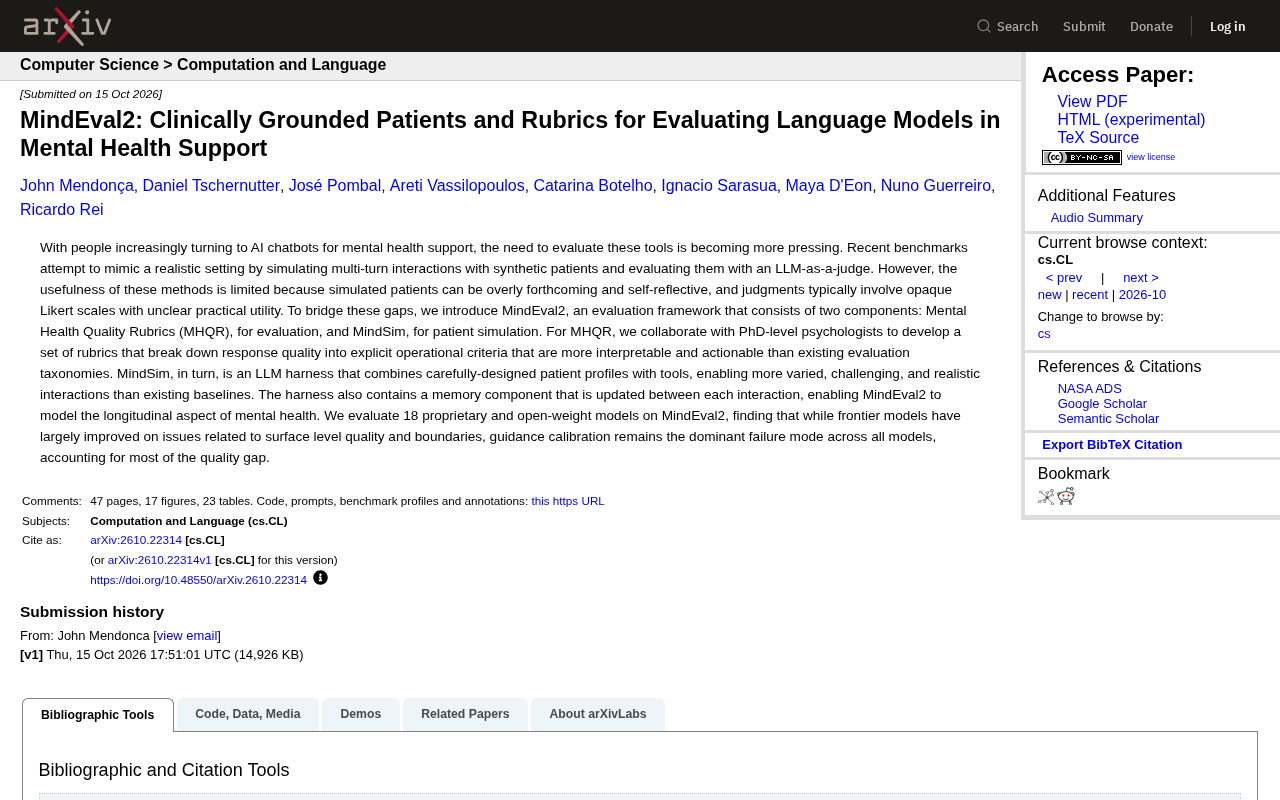
To address overly cooperative simulated patients and opaque judging criteria in existing mental health AI benchmarks, researchers introduced MindEval2, comprising the MHQR rubric and MindSim simulator. MHQR, co-designed with PhD psychologists, breaks response quality into explicit, actionable clinical items, replacing traditional Likert scales. MindSim uses patient profiles and inter-interaction memory updates to simulate more diverse, challenging multi-turn dialogues and support longitudinal evaluation. Testing 18 models shows frontier models improved in surface quality and boundaries, but guidance calibration is the top failure mode, driving most of the quality gap.
As more people turn to AI chatbots for mental health support, how to evaluate the performance of these tools has become an urgent question. Existing benchmarks typically have large models simulate patients for multi-turn conversations and then use another LLM as a judge to assign scores, but this approach has clear shortcomings: simulated patients are often too cooperative and overly self-analytical, while evaluation criteria frequently rely on opaque Likert scales, limiting their practical reference value.
To fill these gaps, the research team introduced MindEval2—an evaluation framework consisting of two parts: the "Mental Health Quality Rubrics" (MHQR) for evaluation, and "MindSim" for patient simulation.
Two Major Pain Points in Evaluation Methods
The core problem with existing mental health AI benchmarks is that "patients don't resemble real patients, and judges don't resemble real judges."
Real help-seekers typically don't clearly describe their emotional state right away, nor do they completely open up after just a few turns of conversation. They may be avoidant, ambivalent, express themselves vaguely, or even resist the AI's suggestions. Synthetic patients, however, are often set up too "ideally"—highly cooperative and strongly self-aware—which substantially weakens the real challenges models face.
The evaluation side has equally prominent problems. LLM-as-a-judge typically outputs a score from 1 to 5 or 1 to 7, but rarely explains what kind of response quality that score corresponds to. After receiving the score, developers find it difficult to improve the model based on it.
LLM-as-a-judge is one of the mainstream paradigms in current large model evaluation: using a more capable language model as a judge to score or rank the outputs of another model. Its advantages lie in low cost and strong scalability, enabling rapid coverage of large sample sizes without manual annotation. But in highly sensitive scenarios like mental health, this paradigm exposes clear limitations—the judge model itself may lack clinical knowledge, the basis for scoring is often untraceable, and it is easily influenced by surface features such as wording and length. More critically, there is a lack of clear mapping between scores and "why this response is good or bad," making it difficult for developers to pinpoint problems. MHQR specifically addresses this deficiency by shifting evaluation criteria from implicit model preferences to explicit clinical items.
MHQR: Breaking Down Response Quality into Actionable Clinical Standards
MindEval2's first component, MHQR, attempts to transform the question of "whether a mental health support response is good" into a set of explicit, actionable scoring rubrics.
The research team collaborated with PhD-level psychologists to decompose response quality into specific items. Compared to existing evaluation taxonomy systems, these scales place greater emphasis on interpretability and executability—that is, evaluation results can not only tell developers "what score was received," but also identify "which sentence or which response strategy went wrong."
This approach brings clinical judgment standards into the AI evaluation process. Psychologists' involvement in designing the scales means the evaluation dimensions are closer to key competencies in real counseling scenarios, rather than remaining at the surface level of language fluency or emotional expression.
The Likert Scale is a common psychometric tool that typically asks raters to indicate their level of agreement with a statement on a 1-to-5 or 1-to-7 scale. It is widely used in questionnaire research, but directly transferring it to AI response evaluation presents two problems: first, different raters may interpret the same level very differently, leading to unstable inter-rater reliability; second, a single number cannot carry information about "which aspects are good and which are poor." In contrast, MHQR adopts itemized scoring rubrics, where each item corresponds to a recognizable response behavior or strategy, and the scoring results are inherently diagnostic. This shift from "scoring" to "structured feedback" is a key step toward making mental health AI evaluation engineering-ready.
MindSim: Making Simulated Patients More Like Real Help-Seekers
MindEval2's second component, MindSim, is an LLM-driven simulation framework. It combines carefully designed patient profiles with tools to enable simulated help-seekers to produce more diverse and more challenging interactions.
MindSim also includes a memory component that updates between each interaction, enabling MindEval2 to model the longitudinal dimension of mental health issues. This is crucial: real psychological support often cannot be resolved in a single conversation, and the help-seeker's state changes over time and across multiple exchanges. An evaluation framework capable of tracking such changes is clearly closer to reality.
In the words of the original research, MindSim enables "more diverse, more challenging, and more realistic interactions than existing baselines."
Longitudinal evaluation in clinical psychology refers to repeated measurements of the same individual at multiple time points to observe trajectories of change. Introducing this concept into AI mental health evaluation means not only examining the quality of a single conversation, but also assessing whether the model can maintain coherence and adaptability over interaction spans of days, weeks, or even longer. MindSim's memory component is designed precisely for this: it updates the patient state after each interaction, allowing subsequent conversations to reflect changes brought about by previous exchanges. This is particularly important for identifying long-term failure modes such as "forgetting," "repeating suggestions," or "ignoring progress"—dimensions that existing static benchmarks struggle to cover.
Test Results from 18 Models: Guidance Calibration Is the Biggest Shortcoming
The research team evaluated 18 proprietary and open-weight models on MindEval2.
The results showed a clear pattern: frontier models have made significant improvements in surface quality and boundary issues—responses are more polite, safer, and less likely to cross professional boundaries. However, "guidance calibration" was the most prominent failure mode across all models, accounting for most of the quality gap.
This means models are increasingly good at "saying the right things" but not good at "saying appropriate things." Judgments about when to give advice, when to empathize first, and when to guide help-seekers toward offline professional help—these remain the weakest links in AI mental health support.
Why This Framework Deserves Attention
MindEval2's value lies not in providing a leaderboard, but in offering a set of evaluation language closer to clinical practice.
For developers, MHQR's actionable standards can directly guide the direction of model optimization. For researchers, MindSim's longitudinal memory mechanism opens a new dimension—mental health AI evaluation is no longer just static scoring of single turns or short conversations.
As AI increasingly intervenes in the highly sensitive field of mental health, the rigor of evaluation tools directly relates to whether products can truly help people rather than cause harm. MindEval2 has at least taken a step in this direction methodologically.
One-line Summary
MindEval2 uses the MHQR clinical rubric and the MindSim patient simulator to reveal that guidance calibration is the biggest shortcoming in AI mental health support.
Paragraph Summary
Addressing the problems of overly cooperative simulated patients and opaque evaluation criteria in existing mental health AI benchmarks, the research team introduced the MindEval2 evaluation framework, consisting of the MHQR rubric and the MindSim simulator. MHQR, developed in collaboration with PhD-level psychologists, breaks response quality into explicit, actionable clinical items, replacing traditional Likert scales; MindSim uses carefully designed patient profiles and inter-interaction memory updates to simulate more diverse and challenging multi-turn conversations, supporting longitudinal evaluation. Testing on 18 proprietary and open-source models shows that frontier models have improved in surface quality and boundary issues, but guidance calibration is the most prominent failure mode across all models, accounting for most of the quality gap.
Related articles

Uber Deploys ChatGPT Work Company-Wide: AI in the Workplace Enters the Scaled Implementation Phase
Uber deploys ChatGPT Work to 30,000+ employees, extending it from engineering to all roles. We analyze its expert-engineer pairing, end-to-end automation, and questions of AI control and power concentration—insights for scaling AI in the workplace.

Shift at Midnight Hands-On: When "ID Verification" Becomes Alien Hunting
Shift at Midnight blends ID verification with horror survival in a four-player co-op game. We break down its inspection mechanics and chaotic humor.

Zelensky Recounts the Outbreak of War: I Need Ammunition, Not a Ride
Zelensky recalls the first day of war in a YouTube interview: farewell to family, rejecting Biden's evacuation offer with "I need ammunition, not a ride," and how Bucha shaped his stance on compromise and peace talks.