MiniMax H3 Real-Time Interactive Avatar: Tested on Intel Arc Pro B70
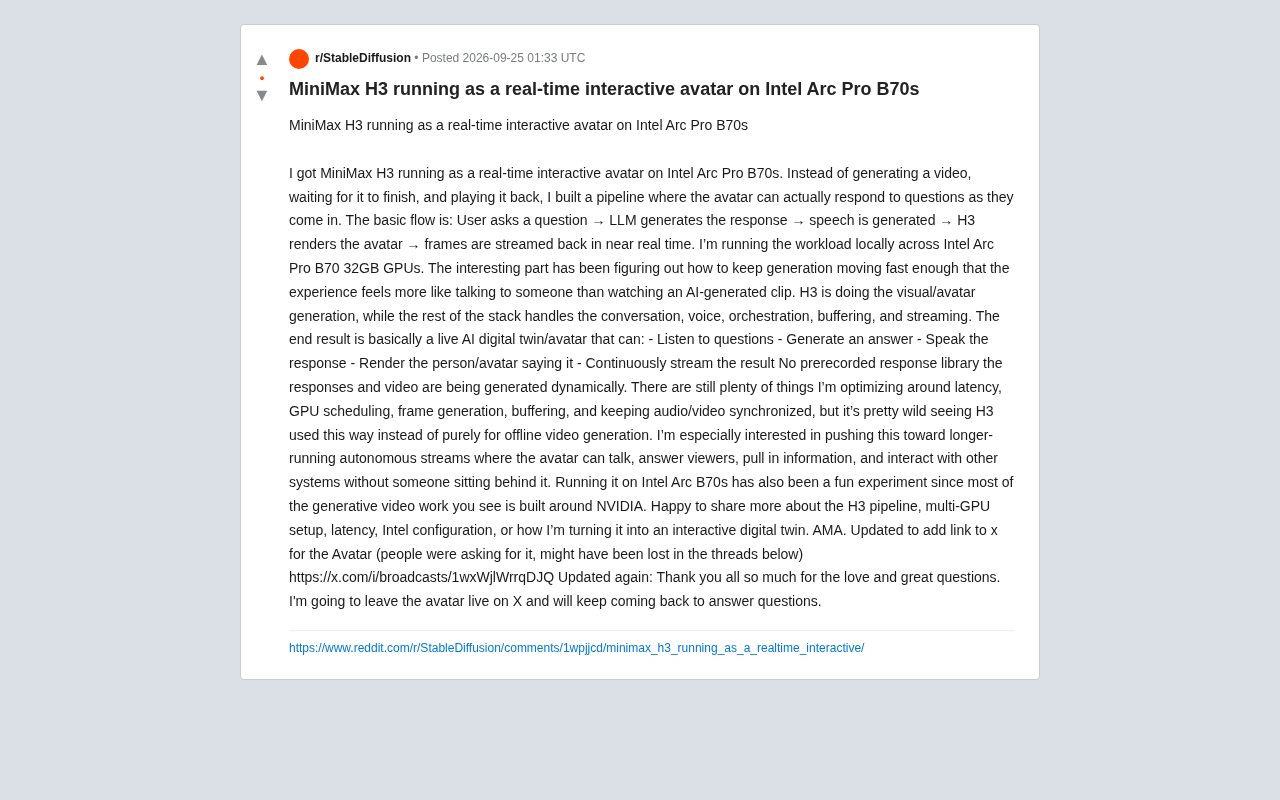
Developer turns MiniMax H3 into a real-time streaming avatar running on Intel Arc Pro B70 GPUs.
A developer transformed the offline video model MiniMax H3 into a real-time interactive avatar system, building a complete pipeline from user question to LLM response, TTS synthesis, H3 rendering, and streaming output — with all replies and video generated dynamically. The modular architecture isolates H3 to visuals only, enabling independent optimization of each stage. Notably, the entire system runs on Intel Arc Pro B70 32GB GPUs rather than NVIDIA hardware, validating non-CUDA generative video inference. The developer's next goal is autonomous long-duration AI live streaming, with a public demo already live on X.
A developer shared a genuinely groundbreaking experiment on Reddit: he transformed MiniMax H3 — a model originally designed for offline video generation — into a real-time interactive avatar, running the entire system on Intel Arc Pro B70 GPUs rather than NVIDIA hardware. The project is worth paying attention to because it challenges two prevailing assumptions: that H3 is only suitable for offline video, and that generative video necessarily requires NVIDIA.
From Offline Rendering to Real-Time Conversation
Traditional AI video generation works like this: provide a prompt, wait for the model to finish rendering, then play back the result. This process typically takes anywhere from seconds to minutes — the experience feels more like "watching an AI clip" than "having a conversation."
The pipeline this developer built completely changes that dynamic. His full workflow is: user asks a question → LLM generates a response → text-to-speech synthesis → H3 renders the avatar's visuals → frames are streamed back in near real time. The key distinction is the word "streaming" — frames aren't held back until fully generated and then played at once. Instead, they're pushed out as they're produced, spreading the latency thin enough to remain tolerable.
He emphasized that the system has no pre-recorded response library whatsoever. Every text reply and every frame of video is generated dynamically in real time. This means the avatar can theoretically answer any question rather than selecting clips from a fixed asset bank.
Streaming in this technical context means the model begins pushing frames to the client as soon as the first batch is ready, rather than waiting for the entire video segment to finish rendering before transmission. This parallels the philosophy behind HLS/RTMP streaming protocols in live video — the core goal is compressing "time-to-first-frame" to within what users find acceptable, generally considered below 500 milliseconds for interaction to feel natural.
For generative video models, streaming output is not a default capability. Most video diffusion models are architecturally designed to infer a complete sequence and then decode it in one pass. Enabling per-frame or per-segment output requires specialized modifications to inference scheduling. This explains why the developer listed "frame generation speed" and "buffering strategy" as areas of ongoing refinement — both directly determine whether the streaming pipeline can sustain a stable frame rate without stuttering.
H3 Handles Visuals; Everything Else Goes to the Orchestration Layer
It's worth unpacking how the responsibilities are divided in this architecture. MiniMax H3 handles only the visual/avatar generation component. Conversation logic, speech synthesis, task orchestration, buffering, and streaming are all managed by other parts of the stack.
This decoupled design is what makes a real-time avatar actually work. Separating "what to say" (LLM), "how to say it" (TTS), and "what it looks like" (H3) into independent modules means each component can be individually optimized and scheduled. The developer mentioned that the areas still being actively refined are: latency control, GPU scheduling, frame generation speed, buffering strategy, and audio-video synchronization.
Audio-video sync is especially tricky in real-time scenarios — if the speech has already moved on to a certain word while the mouth in the video hasn't caught up, the illusion immediately collapses. This is why he repeatedly highlighted the role "buffering" plays throughout the pipeline.
Audio-video synchronization (lip sync) in real-time avatar scenarios faces a dual challenge: on one hand, TTS and video generation are two independent asynchronous pipelines, each with unpredictable processing latency; on the other hand, video diffusion models don't natively generate frames conditioned on audio, requiring additional audio-driven talking head mechanisms to map audio features to facial motion.
Common industry approaches include running a dedicated lip-sync model (such as Wav2Lip or SadTalker) as a post-processing pass on H3's output frames, or embedding audio directly into the diffusion model's conditioning inputs during generation. The buffering layer's role is precisely here: by maintaining a short frame queue on the playback side, it absorbs jitter from variable upstream generation rates and ensures audio timestamps align with their corresponding video frames at playback time, rather than playing out in whatever order they happened to arrive.
Why Betting on Intel Arc Pro B70 Matters
The most counterintuitive aspect of this project is the hardware choice. The vast majority of generative video work today is built around NVIDIA's CUDA ecosystem, yet this developer chose to run the full workload on multiple local Intel Arc Pro B70 32GB GPUs.
He himself called it "an interesting experiment." Running multi-GPU generative video inference on Intel Arc inherently means dealing with a range of ecosystem compatibility issues — from drivers and framework support to VRAM management. His willingness in the post to share details on multi-GPU configuration and Intel environment setup signals that this hard-won experience has real value for the community.
For those watching AI hardware diversification, this is a meaningful signal: non-NVIDIA GPUs are progressively proving their viability for generative AI inference workloads, and specifications like 32GB of VRAM are particularly well-suited for local deployment.
Intel Arc Pro B70 is a professional-grade discrete GPU launched by Intel in 2024–2025, based on the Battlemage architecture, with 32GB GDDR6 VRAM per card — a competitive specification among professional cards at its price point. Unlike the consumer Arc series, Arc Pro targets workstation and professional inference scenarios, offering better driver stability and sustained performance under long workloads.
On the AI inference ecosystem side, Intel provides the oneAPI and OpenVINO toolchains for adapting mainstream deep learning frameworks. However, compared to NVIDIA's CUDA ecosystem, the community base and framework compatibility still lag noticeably — many models ship with CUDA-only optimization paths by default, and porting to Intel GPUs requires additional adaptation work. This is the main source of the "rough edges" the developer mentioned. The 32GB VRAM advantage matters because it allows loading larger models locally without requiring quantization or precision reduction, which is especially critical for memory-intensive tasks like video generation.
Next Goal: Long-Running Autonomous Live Streaming
The developer revealed a more ambitious target: pushing this avatar toward long-duration autonomous live broadcasting. The envisioned form would have the avatar continuously speaking, answering viewer questions, proactively pulling in information, and interacting with other systems — all without a human operator running things in the background.
This essentially sketches the outline of an "AI digital twin broadcaster." If latency and stability issues are resolved, systems like this have clear deployment potential in virtual streaming, customer service, and educational demonstration scenarios.
He has already put the avatar live on X for public demonstration (the original post included a broadcast link), and has committed to returning to answer community questions — openly inviting an AMA covering H3 pipelines, multi-GPU setups, latency optimization, and Intel configuration details.
Why This Case Is Worth Watching
This project is still in the optimization phase, and the developer openly acknowledges that latency, scheduling, and synchronization all need further work. But its significance as a proof of concept rests on three points: the engineering approach of transforming an offline video model into a real-time interactive system; the modular, decoupled architectural design; and the validation of generative AI viability on non-mainstream hardware.
For developers looking to reproduce something similar, the core challenge isn't any single model — it's getting the entire pipeline to flow: ensuring every frame, every piece of audio, and every response connects promptly to the next, ultimately approaching the natural feel of a real human conversation. That's the threshold that real-time generative AI must cross to move from "technically possible" to "actually usable."
Related articles

Free Unlimited Claude Code Solution: Agnes AI + CC Switch Setup Guide
No paid subscription needed — pair the free AI platform Agnes AI with the open-source tool CC Switch to provide a backend for Claude Code, enabling unlimited free calls to text, image, and video models. This guide covers the full setup, test results, and usage boundaries.

A Complete Zero-Cost Guide to Getting Started with Claude Code for Beginners in China
A beginner's guide to Claude Code for users in China: two installation methods (command line and IDE plugin), full configuration steps for replacing the official API with the free domestic LongCat model, and a hands-on demo of building a small tool with natural language, plus tips.

When the NSA Gets Involved: The AI Supply Chain Crisis Behind Open-Source CVEs and API Key Hijacking
Multiple open-source projects disclosed severe CVEs in one day, PHP flaws alarmed the FBI, and Railway and OpenCode were breached with API keys stolen. This article breaks down the vulnerability window, AI-accelerated exploitation, and the AI supply chain crisis behind the API key black market, with a developer defense checklist.