MiniMax H3 Revives Classic 'Dungeons & Dragons' Cartoon, Sparking a Nostalgia Wave on Reddit
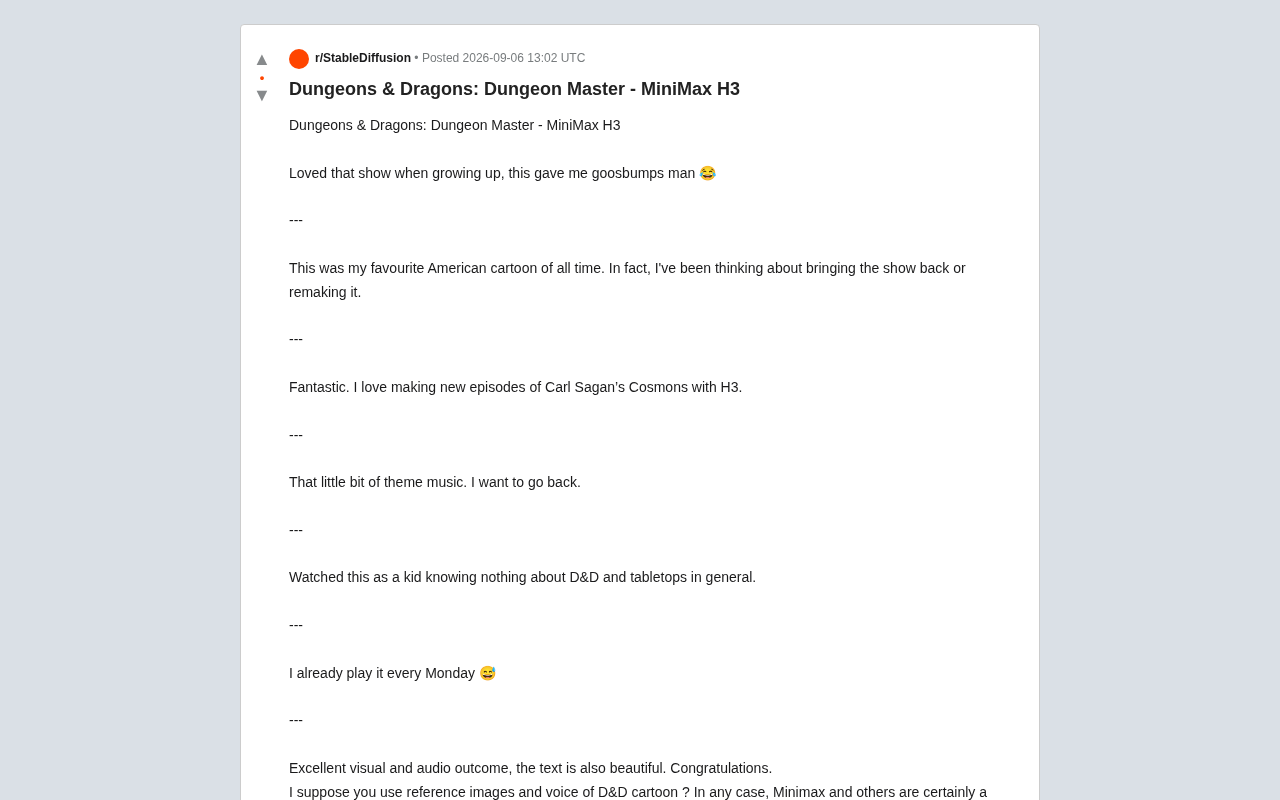
MiniMax H3 recreates the classic D&D cartoon, igniting Reddit nostalgia and dreams of an AI-finished finale.
A Dungeons & Dragons animated clip generated by MiniMax H3 has gone viral on Reddit, with fans praising its faithful recreation of the 80s cartoon's art style and iconic theme music. The community rallied around the idea of using AI to finally produce the show's never-aired finale episode "Requiem," highlighting AI video generation's unique potential for reviving and completing classic works.
An AI-generated clip of the classic Dungeons & Dragons cartoon, created using MiniMax's H3 video model, has sparked a massive wave of nostalgia across the Reddit community. The return of this beloved 80s American animated series not only showcases the latest advances in AI video generation but has also stirred up childhood memories for countless viewers.
MiniMax H3 Recreates a Classic — Visual and Audio Quality Win High Praise
The Dungeons & Dragons: Dungeon Master clip generated by MiniMax H3 achieved impressive results across visual presentation, audio reproduction, and text generation. One commenter in the thread specifically noted: "Great visual and audio, the text is fine as well." This level of polish makes it hard to believe the content was automatically generated by an AI model.
MiniMax H3 is a video generation large model developed by the Chinese AI company MiniMax (稀宇科技). Founded in 2021 by Yan Junjie, former VP of SenseTime, MiniMax is one of China's earliest companies to invest in multimodal large models. The H3 model represents the latest iteration of their video generation product line, supporting multiple generation modes including Text-to-Video and Image-to-Video. It can produce fluid animation sequences while maintaining visual consistency. The model's standout performance in character consistency, motion coherence, and style reproduction is precisely the technical foundation that enabled it to successfully recreate the classic Dungeons & Dragons animation style.
From a technical standpoint, the creator likely used reference images from the original animation and character voice recordings as input materials. In the field of AI video generation, this approach — known as Reference-guided Generation — is a key technical paradigm. Creators provide the model with character reference images, style samples, or keyframes; the model then uses a visual encoder to extract style features, character appearances, and color schemes from these materials, combining them with text prompts to generate new video content that meets the specified requirements. Unlike traditional Style Transfer, modern multimodal models can understand the semantic meaning of reference materials rather than merely mimicking surface-level colors and textures. This reference-based approach to AI video generation is becoming the mainstream method for AI animation creation — preserving the essence of the original work while enabling entirely new storylines. Interestingly, the generated clip even reproduced the show's iconic theme music. One user exclaimed: "That little bit of the theme song makes me want to go back."
Nostalgia Ignites Community Discussion: Can AI Finish the Story That Never Ended?
The response to this AI-generated video on Reddit went far beyond technical discussion. Multiple users expressed strong emotional resonance, with one stating outright, "This gives me goosebumps," while another said it was "my favorite American cartoon, in fact I've been considering bringing the show back or remaking it."
To understand the depth of this emotion, you need to know the show's unique history. The Dungeons & Dragons animated series aired on CBS from 1983 to 1985, running three seasons and 27 episodes, co-produced by Marvel Productions and TSR. The show followed six teenagers who are transported through a theme park roller coaster into the fantasy world of Dungeons & Dragons, embarking on adventures guided by the mysterious Dungeon Master as they search for a way home. Despite achieving considerable ratings at the time, the show was canceled after its third season due to protests from parent groups over violent content and rising production costs. Writer Michael Reaves had penned a finale script titled Requiem, in which the characters finally find their way home — but this episode was never produced or aired, leaving an enduring void in the hearts of an entire generation of viewers.
The most striking aspect of the community response was the focus on this "unfinished story." One user issued a direct call to action: "Dude, you have one mission now: turn that unproduced final episode script into a real episode. Do it!" This proposal received widespread support, highlighting the unique value of AI video technology in "continuing classics" — the finale Requiem, which has a complete script but was never brought to screen, now finally has a technological path to realization.
From Nostalgia to Creation: AI Video Generation Opens a New Paradigm for Content Revival
Beyond Dungeons & Dragons, the comment section also mentioned AI remake attempts of other classic content. One user shared their experience using the MiniMax H3 model to create new episodes of Carl Sagan's Cosmos. Cosmos: A Personal Voyage was a 13-episode science documentary hosted by the renowned astronomer Carl Sagan in 1980, widely regarded as one of the greatest science programs in television history. It aired in over 60 countries and was watched by more than 500 million people. The show made extensive use of the most advanced special effects technology of its era to depict the grandeur of the universe, with Sagan's poetic narration making complex scientific knowledge accessible to general audiences. The user's attempt to generate new episodes of the show using AI demonstrates the vast potential of AI technology in science communication and the continuation of classic content, indicating that AI video generation is being applied to an increasingly broad range of classic content revival.
The emergence of MiniMax and other AI video models offers entirely new approaches to film and television content creation:
- Completing unfinished works: Many classic series that were cut short for commercial or technical reasons can now be continued through AI technology
- Low-cost animation remakes: Without needing to reassemble large production teams, individual creators can reproduce classic art styles
- Empowering fan creation: Fans who love classic works now have the ability to create their own sequels or spin-offs
Interestingly, one commenter in the thread also noted, "I'm already playing this every Monday," hinting that they were continuing the world through tabletop gaming. Dungeons & Dragons (D&D) has been the world's most influential tabletop role-playing game (TTRPG) since its creation by Gary Gygax and Dave Arneson in 1974. The game's core mechanic revolves around "collaborative storytelling" — players improvise narratives under the guidance of a Dungeon Master. This narrative model naturally complements screen adaptations. In recent years, D&D has experienced a significant cultural resurgence through the 2023 film Dungeons & Dragons: Honor Among Thieves and Twitch shows like Critical Role. The addition of AI video technology now makes it possible for ordinary tabletop players to visualize their game campaigns as animated content, breaking down the barrier that previously limited screen adaptations to professional production teams and creating a cross-media creative ecosystem.
Where Technology Meets Nostalgia: How AI Captures the Spirit of Classic Animation
What MiniMax H3 demonstrated in this case goes beyond a mere stacking of technical parameters — more importantly, it captured and reproduced the original work's "spirit" — from character designs and art style texture to that theme song that instantly transports viewers back to childhood. This ability to precisely understand and recreate the style of classic works is the fundamental difference between current AI video models and earlier technology. Early AI video generation tools could only produce blurry, flickering short clips lacking stylistic consistency. The new generation of models, represented by MiniMax H3, can now simultaneously achieve watchable quality across three dimensions: style fidelity, temporal coherence, and multimodal coordination (visual + audio + text). This leap has taken "recreating classics with AI" from concept to practice.
For the generation that grew up watching this cartoon without any knowledge of the tabletop game, AI technology offers an opportunity to revisit and extend childhood memories. For content creators, this technology opens a door to "digital archaeology" — artistic works left unfinished due to the limitations of their era can now be rediscovered and continued. From the unaired Dungeons & Dragons finale to new chapters of Carl Sagan's Cosmos, AI video generation is blurring the lines between "original" and "sequel," between "professional production" and "fan creation," giving rise to an entirely new model of cultural production.
Key Takeaways
Related articles
Free Claude Code: One Proxy Connecting 50 Providers and 9 Coding Assistants
Free Claude Code (FCC) is an MIT open-source local proxy integrating 50 Providers and 9 Coding Agents with auto-Failover, domestic model fallbacks, and local GGUF support.
Vibe Coding: An Essential Hands-On Skills Guide for Product Managers
A deep dive into the three core Vibe Coding skills product managers need: requirements clarification, engineering execution mindset, and technical judgment for shipping MVPs with AI.
Multimodal Collaborative Agents: A Complete Methodology from Vague Intent to Precise Recommendations
Deep dive into Google DeepMind's multimodal collaborative agent methodology: three-stage framework (Discovery, Research, Response) solving user articulation gaps, with design principles and evaluation systems.