MIRA: Mutual Information-Guided Calibration for More Reliable Test-Time Adaptation

MIRA uses last-layer Gaussian perturbations and mutual information calibration to make test-time adaptation more reliable.
The article introduces MIRA, a test-time adaptation method that addresses the overconfidence trap of entropy minimization by probing prediction reliability with lightweight last-layer Gaussian perturbations. It dynamically selects perturbation scales per batch using mutual information and prediction consistency, then applies a confidence-weighted entropy loss to downweight fragile samples. Experiments show improved accuracy, calibration, and NLL without source data, retraining, or ensembles, though limitations remain for complex shifts and small batches.
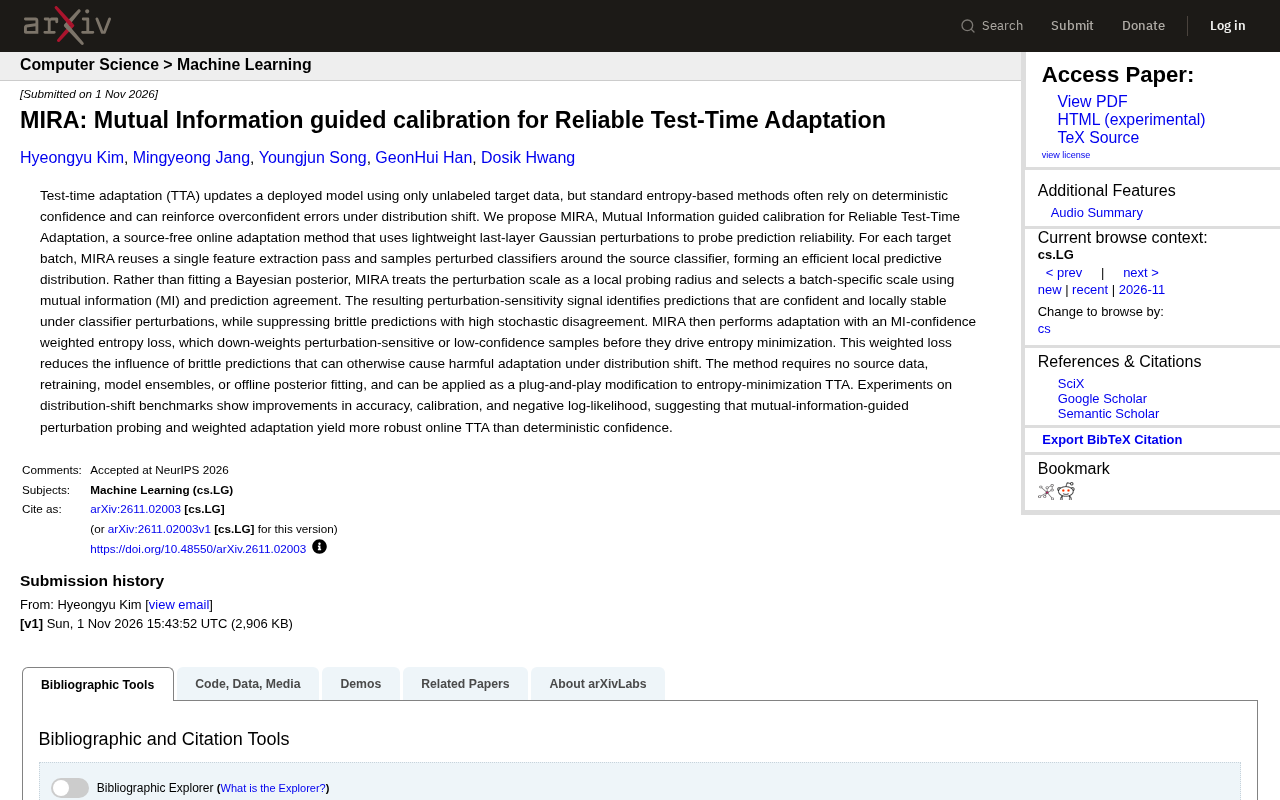
Test-time adaptation (TTA) can update deployed models using only unlabeled target data, but mainstream entropy-based methods often rely on deterministic confidence, which under distribution shift may actually reinforce overconfident errors. To address this problem, researchers propose MIRA (Mutual Information guided calibration for Reliable Test-Time Adaptation)—an online adaptation method that requires no source data and probes prediction reliability through lightweight last-layer Gaussian perturbations, offering a new approach to TTA robustness.
The Hidden Concern of Entropy Minimization: The Trap of Deterministic Confidence
Standard TTA methods typically aim at entropy minimization, encouraging the model to produce low-entropy (high-confidence) predictions on target data. However, this deterministic confidence is not always reliable: when distribution shift causes the model to become overconfident, entropy minimization amplifies these errors and drives the model further in the wrong direction. The authors of MIRA point out that the root of the problem lies in "equating confidence with reliability," while ignoring the stability of predictions under perturbation.
Entropy minimization is one of the most commonly used unsupervised objectives in test-time adaptation. Its intuition is that if the model produces low-entropy predictions for samples in the target domain, the decision boundary is relatively "certain" for those samples, so these high-confidence predictions can be used as pseudo-labels to drive adaptation. The usual approach is to minimize the Shannon entropy of each sample's predicted distribution (-\sum_c p_c \log p_c), pushing predictions toward one-hot. The problem is that entropy only characterizes the "sharpness" of the model's own output distribution and does not test whether this sharp prediction is correct. When distribution shift causes the model to make systematic errors, incorrect predictions can also be low-entropy; in this case, minimizing entropy amounts to repeatedly reinforcing the model with wrong pseudo-labels, creating a self-amplifying "confirmation bias." In addition, entropy is sensitive to temperature scaling and logit scale, and the model may reduce entropy by globally magnifying logit magnitudes rather than genuinely improving feature representations. Therefore, subsequent research emphasizes the need to introduce reliability signals that do not depend on a single deterministic output—such as stability, consistency, or uncertainty decomposition of predictions under input or parameter perturbations—in order to judge whether low-entropy predictions are trustworthy.
The Core of MIRA: Perturbation Probing and Mutual Information Calibration
MIRA's design philosophy is to assess the local stability of each prediction at extremely low computational cost without making major changes to the model architecture. Specifically, for each target batch, MIRA reuses the feature extraction process only once and then samples multiple perturbed classifiers around the source classifier to form an efficient local prediction distribution.
Unlike Bayesian methods, MIRA does not fit a posterior distribution. Instead, it treats the perturbation scale as a local probing radius and uses mutual information (MI) and prediction consistency to select a specific scale for each batch. The resulting "perturbation sensitivity" signal can identify predictions that are both confident and locally stable under classifier perturbations, while suppressing fragile predictions with large random disagreement.
How Mutual Information Works
Here, mutual information measures the degree of dependence between the prediction and the perturbed classifiers. If a sample's prediction changes drastically across multiple perturbations, the model's decision for that sample is unstable, and mutual information captures this uncertainty. MIRA combines prediction consistency to dynamically adjust the probing radius, making reliability assessment better fit the data distribution of the current batch.
Mutual information (MI) measures the degree of statistical dependence between two random variables and can be understood as "how much uncertainty about one variable is reduced by knowing the other." In MIRA's setting, one variable is the sample's class prediction, and the other is the prediction given by the perturbed classifier; if the two are highly dependent, the prediction remains consistent under perturbation and MI is large; if perturbation causes the prediction to jump randomly, MI is small. This complements plain predictive entropy: entropy only looks at the sharpness of a single distribution, whereas MI examines the reproducibility of the prediction distribution under parameter perturbations. In practice, MI can be estimated as predictive entropy minus conditional entropy (i.e., the average entropy of predictions given the perturbed classifier), or empirically from prediction distributions across multiple samples. Note that Monte Carlo estimates of MI have high variance when the sample size is small or the number of classes is large, which is exactly why the paper mentions that scale selection may be unstable in small-batch scenarios.
Weighted Entropy Loss: Letting Fragile Samples Speak Less
After obtaining the perturbation sensitivity signal, MIRA performs adaptation using an entropy loss weighted by mutual information confidence. This loss function downweights samples that are sensitive to perturbation or low-confidence, preventing them from dominating the entropy minimization process. In other words, those "fragile" predictions are marginalized during adaptation, thereby reducing harmful model updates.
This weighting mechanism is key to MIRA's plug-and-play nature: it does not require modifying the structure of the original TTA pipeline. It only needs to introduce weights during loss computation, allowing integration with existing entropy-minimization TTA methods.
Experimental Validation: Comprehensive Improvements in Accuracy, Calibration, and NLL
Experiments on distribution shift benchmarks show that MIRA improves accuracy, calibration, and negative log-likelihood (NLL). This supports the authors' core argument: mutual information-guided perturbation probing and weighted adaptation lead to more robust online TTA than deterministic confidence. You may not have noticed that MIRA requires no source data, retraining, model ensembles, or offline posterior fitting, making it attractive for practical deployment.
Calibration describes whether the confidence scores a model provides match its actual accuracy: if about 90% of samples predicted with 0.9 confidence are indeed correct, the model is considered well calibrated. Common metrics include expected calibration error (ECE) and reliability diagrams, while negative log-likelihood (NLL) penalizes both incorrect predictions and overconfidence, making it particularly sensitive to calibration. A model can have poor NLL due to overconfidence even if its accuracy remains unchanged. This is especially critical for TTA: entropy minimization tends to push confidence to extremes, potentially improving accuracy while harming calibration and causing the model to output misleading confidence scores in deployment. Therefore, reporting accuracy, calibration error, and NLL together provides a more comprehensive picture of whether an adaptation method is truly "reliable," not merely "more accurate."
Significance and Limitations
MIRA provides a lightweight and effective approach to the reliability problem in TTA. It reveals the shortcomings of deterministic confidence and introduces a finer-grained reliability measure through perturbation probing. However, the method is currently still based on last-layer Gaussian perturbations, and its generalization ability to more complex distribution shifts or non-classification tasks remains to be further verified. In addition, the choice of perturbation scale depends on mutual information estimation, which may face estimation variance issues when batches are small or the number of classes is extremely large.
Overall, MIRA is a valuable exploration in the TTA field, offering a new perspective for building more reliable online adaptation methods.
One-line Summary
MIRA uses last-layer Gaussian perturbations and mutual information calibration to make test-time adaptation more reliable.
Paragraph Summary
The article introduces the test-time adaptation (TTA) method MIRA. To address the problem that mainstream entropy-minimization methods rely on deterministic confidence and may reinforce overconfident errors under distribution shift, it proposes using lightweight last-layer Gaussian perturbations to probe prediction reliability. MIRA reuses feature extraction only once per target batch, samples multiple perturbed classifiers around the source classifier to form a local prediction distribution, and uses mutual information and prediction consistency to dynamically select the perturbation scale for each batch, thereby identifying predictions that are both confident and stable under perturbation. It then uses an entropy loss weighted by mutual information confidence to reduce the weight of fragile samples in the adaptation process. Experiments show that the method simultaneously improves accuracy, calibration, and NLL on distribution shift benchmarks, and it requires no source data, retraining, or model ensembles, allowing it to serve as a plug-and-play module. The article also points out its limitations in generalization and estimation variance for complex shifts, non-classification tasks, and small batches.
Related articles

9 AI Subscription Plans Compared: The Real Cost Per 100M Tokens Revealed
Bilibili creator tests 9 AI subscription plans from Volcano, Alibaba, Tencent, Baidu, Zhipu, Xiaomi, MiniMax and more, converting them all to real cost per 100M tokens, breaking down fixed-quota vs. three-tier coefficient billing and how caching, time-of-day discounts, and window limits affect actual quota.

Vibe Coding for Beginners: Expressing Intent Instead of Handwriting Code
What is Vibe Coding? A 137-episode Bilibili course defines it: the core is expressing intent, not writing code. This article analyzes Vibe Coding's productivity logic, target audience, and entry expectations to help beginners decide if it's worth learning.

LangChain Beginner's Guide: An Agent Development Roadmap from LangGraph to Deep Agents
Clarify the encapsulation relationship among LangChain, LangGraph, and Deep Agents, and master the learning path and selection logic for agent development frameworks—suitable for beginners in large model development.