Mistral Large 4 Open-Weights Release: 1 Trillion Parameters, 4.9 Billion Active

Mistral Large 4 opens trillion-parameter weights, with self-deployment and security risks coexisting.
Mistral released its flagship model Mistral Large 4 and made the weights public: ~1T total parameters, only ~4.9B activated per inference, text-image input, and ~1M token context. Open weights let enterprises deploy on their own servers with data staying internal, but the company admits downloaded copies cannot be recalled and later security upgrades only cover the API and new versions. Vendor self-tests show 47% less compute for coding, 41% terminal coding score, and 51% cybersecurity index, all unverified. The modified permissive license allows self-use, modification, and commercial use, but external model services require a separate commercial license, and deployment needs data-center-grade hardware. Open weights hand both the choice and deployment responsibility to users.
French AI company Mistral recently released its flagship model Mistral Large 4 and made a key decision: to publish the model weights. This means enterprises and institutions can deploy this roughly 1-trillion-parameter model on their own servers without handing over code and data to a third party. Tech Brief Issue 11 covered this, and below is further analysis based on public information.
Model Specs: A Trillion Parameters with Sparse Activation
Mistral Large 4 has a total parameter count of roughly 1 trillion, but only about 4.9 billion parameters are activated per inference. This sparse activation design continues the current trend of large models pursuing "large capacity, low inference cost"—total parameters determine the model's knowledge capacity, while activated parameters affect the resource consumption of a single computation.
The model supports both text and image input, with a context window of about 1 million tokens. A million-token context means it can process large volumes of documents or long conversation histories in one go, which has direct value for applications that require deep retrieval augmentation.
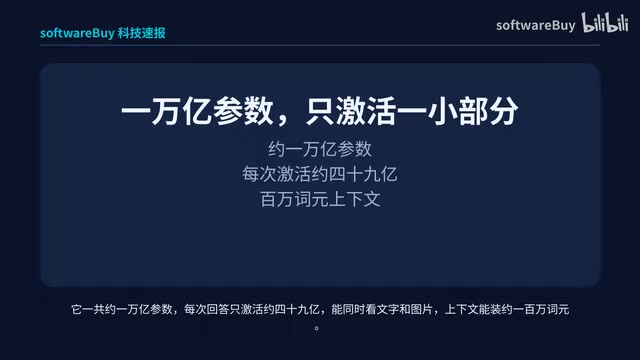
The typical implementation of sparse activation is the Mixture-of-Experts (MoE) architecture: the model contains multiple parallel "expert" subnetworks and a gating network responsible for routing. During each forward pass, the gating network dynamically selects a small number of experts to participate in computation based on the input, while the rest remain silent. This allows the total parameter count to be very large to carry richer knowledge, while the actual computational load depends only on the number of activated experts. Mistral Large 4's configuration of about 1 trillion total parameters with only about 4.9 billion activated means that each inference calls less than 0.5% of the total parameter count. This also explains the underlying logic behind the official claim of "47% less compute per coding task"—sparse activation is the key means of reducing per-inference cost, rather than relying solely on model compression.
A "token" is the basic unit of text processed by a language model, roughly understood as a word or a fragment of a word. A 1-million-token context window is roughly equivalent to hundreds of thousands of Chinese characters or over a hundred pages of documents by common conversion. Traditional models are limited to windows of tens of thousands of tokens, so long documents must be chunked and fed in batches; a million-token window allows an entire contract, an entire code repository, or a long conversation history to be input at once, letting the model establish associations globally. This is especially important for retrieval-augmented generation (RAG): when the window is large enough, candidate materials can be placed directly into the context as a whole, reducing the information fragmentation caused by retrieval chunking, but it also places higher demands on VRAM and inference scheduling.
Open Weights: Self-Deployment and the Irreversible Risk
The core change in this release is not the model's capabilities themselves, but the delivery method. In the past, when enterprises called closed-source model APIs, data had to pass through third-party servers; with open weights, institutions can complete inference on their own infrastructure, and data never leaves the internal network.
But Mistral itself acknowledges the other side of the risk in its official documentation: downloaded weight versions cannot be recalled. Subsequent security hardening upgrades will only appear in the API and new versions, and will not automatically update downloaded copies. This is a structural problem that open-weight models cannot avoid—release means loss of control, and security governance can only take effect going forward.
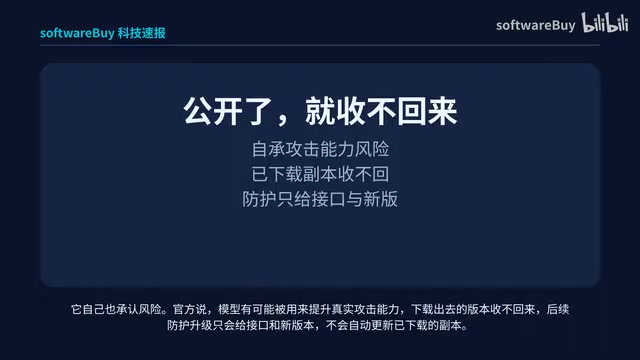
"Open weights" is not entirely equivalent to open source in the strict sense. Open-source software usually means the source code is obtainable, modifiable, and redistributable; model weights, however, are parameter files obtained after training. Publishing the weights lets users complete inference or even fine-tuning locally, but the training data, training code, and complete training pipeline are often not disclosed, so the industry more often calls this "open weights." This distinction determines that what users gain is the freedom to deploy and build upon the model, not the freedom to fully reproduce or audit the model's capabilities. Mistral Large 4 uses a modified permissive license, which precisely reflects the common practice under the open-weights model of "capabilities accessible, terms with constraints."
Vendor Self-Test Data: Coding and Cybersecurity Performance
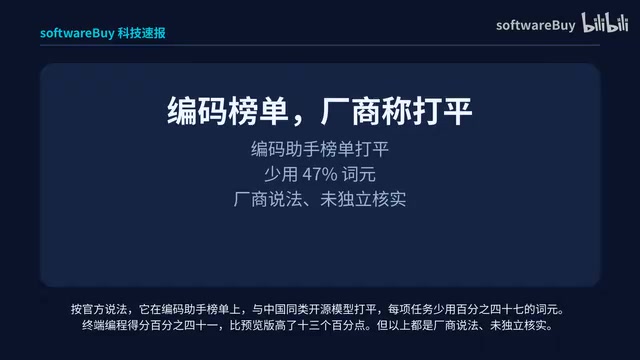
According to the official statement, Mistral Large 4 ties with comparable Chinese open-source models on the coding assistant leaderboard, using 47% less compute resources per task. It scores 41% on terminal coding, 13 percentage points higher than the preview version.
Cybersecurity is the main direction emphasized by the official release, with a cybersecurity index score of 51%. It should be made clear that the above data are all vendor self-tests and have not yet been independently verified. The official release also acknowledges that the model could potentially be used to enhance real attack capabilities—this is two sides of the same coin as the improvement in cybersecurity capabilities.
Two Practical Barriers: Licensing and Hardware
The first barrier is licensing. Mistral Large 4 uses a modified permissive license: you can use it yourself, modify it, and use it commercially, but if you use it to provide model services externally, you need to purchase a separate commercial license. This effectively draws a line—internal use is free, reselling inference capacity is charged.
The second barrier is hardware. A model with about 1 trillion parameters requires data-center-grade hardware to run; ordinary computers cannot handle it. Open weights reduce the risk of data leakage, but they do not lower the economic barrier to deployment.
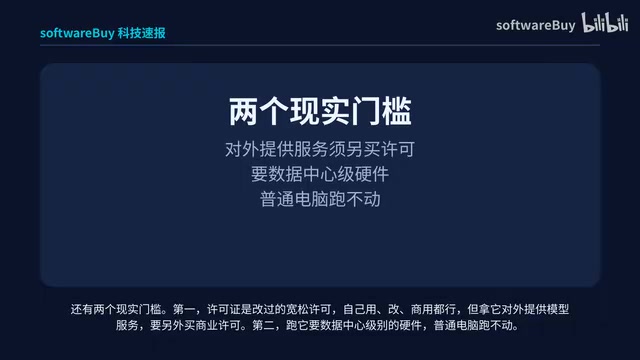
Even with sparse activation, a model with about 1 trillion parameters still needs all weights loaded into VRAM or high-speed storage during deployment. Estimated at common precision, the weight volume can reach hundreds of GB or even the terabyte scale, far exceeding the capacity of a single consumer-grade GPU. It typically requires a multi-machine, multi-GPU high-speed interconnect cluster, along with a specialized inference framework for expert parallelism and request scheduling. This means the actual deployment cost is concentrated in GPU clusters, VRAM bandwidth, data center cooling, and operations manpower, which is fundamentally different from the pay-as-you-go model of calling cloud APIs. Open weights solve the problems of data sovereignty and controllability, but the capital expenditure on hardware and operations still has to be borne by the user.
What Open Weights Mean
For enterprises with compliance requirements or sensitive data, a flagship model that can be self-deployed is an attractive option. But what needs to be weighed is: vendor self-test data remains to be verified, security risks cannot be fixed in already-distributed copies through subsequent updates, commercial resale requires additional authorization, and the hardware investment is not small.
Open weights hand the choice to users, while also transferring deployment responsibility and risk along with it. For Mistral, this is a strategy of trading openness for an ecosystem position; for users, whether it is worth taking on depends on their own data boundaries and operational capabilities.
One-line Summary
Mistral Large 4 opens up trillion-parameter weights, with self-deployment and security risks coexisting.
Paragraph Summary
Mistral released its flagship model Mistral Large 4 and made the model weights public. It has about 1 trillion total parameters, activates only about 4.9 billion per inference, and supports text and image input with a context of about 1 million tokens. Open weights allow enterprises and institutions to deploy on their own servers without data leaving the internal network, but the company acknowledges that downloaded copies cannot be recalled, and subsequent security upgrades will only cover the API and new versions. Vendor self-tests show 47% less compute for coding tasks, a 41% terminal coding score, and a 51% cybersecurity index, none independently verified. The modified permissive license allows self-use, modification, and commercial use, but providing model services externally requires a separate commercial license, and deployment requires data-center-grade hardware. Open weights hand both the choice and deployment responsibility to users.
Related articles

Gemini 4 Neon Review: Benchmark Scores Rival Carbon, API Pricing and Quota Breakdown
Google Gemini 4 Neon is now live, benchmark scores closely tracking Carbon, API pricing 3/15 at twice Hydrogen's rate. This article compiles Bilibili creator testing: Neon can replace 90% of Carbon scenarios, AntiGravity quota consumption is only one-third of Carbon, plus subscription channel restrictions and 2API ban risks.

Gemini 4 Helium Coming Soon? Signals of Google Loosening Subscription Restrictions
Google team member hints releases will continue; community speculates Gemini 4 Helium (Flash Lite) may be next. Subscription ban controversy gets a response as product lead says "Soon," suggesting restrictions may be lifted. This article covers Gemini developments, OpenAI Coding Agent and risk management, Doubao real-time audio-video API, and compute business dynamics.

AI-Assisted React Development in Practice: Optimizing a Video App and Handling Errors
A 14-year veteran developer demonstrates AI-assisted React video app optimization: compressing video from 80MB to 5MB (~94%) via ImageKit, plus reliable error handling and retry mechanisms. Includes planning, code understanding, and verification methods for working with AI.