MIT Lecture: Legal Scholar on Using AI to Save and Transcend Democracy

At MIT, Minow argued democracy needs AI to enhance its operation and must transcend and constrain it with democratic values.
This article reports on Martha Minow's MIT Compton Lecture. She warned that mismanaged AI could cause a "loss of the Enlightenment" by eroding reason and public deliberation. She noted AI can lower participation barriers but design choices determine its effect. Democracy's deliberation and accountability cannot be outsourced to algorithms; judicial, press, educational, and civic infrastructures must be strengthened. She urged early guardrails given the temporal asymmetry between AI and institutional change.
MIT Lecture: Legal Scholar on Using AI to Save and Transcend Democracy
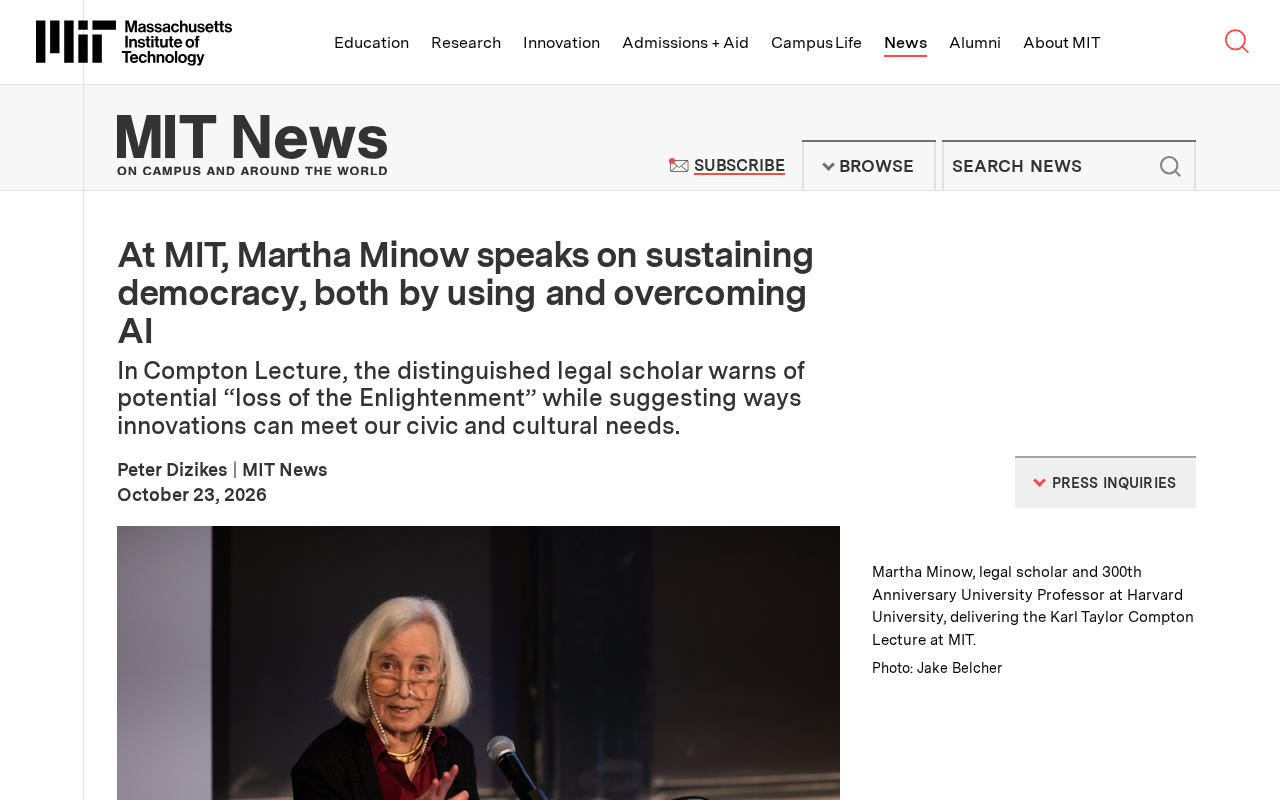
As artificial intelligence gradually permeates elections, the judiciary, public opinion, and public governance, is it a boon or a threat to democracy? At a recent Compton Lecture at MIT, the renowned legal scholar Martha Minow offered a rather tension-filled answer: democracy both needs AI to sustain itself and must learn to transcend AI.
A Warning About the "Loss of the Enlightenment"
Minow is the former dean of Harvard Law School and an authority on international law and human rights. In her lecture, she made a jarring assertion: if society mismanages AI, it may face a "loss of the Enlightenment." This phrase is not rhetorical exaggeration but points to a structural risk—when the information ecosystem is manipulated by algorithms, public reason is eroded by deepfakes, and decision-making power quietly shifts from citizens into opaque systems, the foundations of reason, public discussion, and individual judgment established during the Enlightenment are weakened.
According to MIT News, Minow's core concern is that the pace of technological innovation far outstrips the pace of institutional response, while the resilience of democratic institutions depends precisely on sustained public deliberation and accountable power structures. If AI is merely embedded into governance as an efficiency tool without accompanying rights protections and transparency mechanisms, it may inadvertently hollow out the substance of democracy.
Behind the phrase "loss of the Enlightenment" lies the core legacy of the Enlightenment: the exercise of public reason, fact-based public discussion, and the status of citizens as autonomous judges. In "What Is Enlightenment?" Kant defined enlightenment as "man's emergence from his self-imposed immaturity," premised on the public use of reason. When algorithmic recommendation replaces the public agenda, deepfakes blur the boundary between fact and fiction, and decision-making logic is encapsulated in unauditable models, the informational foundations and cognitive conditions on which citizens rely for rational judgment are systematically weakened. Minow's warning is therefore not a rejection of technological progress but a point that democracy's epistemological foundations—shared facts, debatable reasons, accountable decisions—may be technologically eroded, with consequences deeper than mere privacy breaches or job displacement.
Sustaining Democracy with AI: Possibilities at the Tool Level
Minow did not stop at criticism. She also noted that AI can serve as a practical tool to support democratic functioning. For example, in scenarios such as voter information access, organizing public records, comparing legislative texts, and accessible participation, AI can lower the threshold for citizen participation and enhance the accessibility of public services.
The logic here is that the daily operation of democracy requires a great deal of information processing and communication work, which is exactly what AI excels at. The key lies in the design orientation—whether AI is used to expand participation and enhance transparency, or to optimize manipulation and concentrate power. Minow reminds us that technology itself does not presuppose a direction; institutional choices determine the outcome.
Transcending AI: Democracy Cannot Be Outsourced to Algorithms
The "overcoming AI" part of the lecture title is even more intriguing. Minow emphasizes that the core elements of democracy—deliberation, compromise, empathy, and questioning power—cannot be outsourced to any algorithmic system. Even if AI far surpasses humans in information processing, it cannot replace mutual persuasion and shared responsibility among citizens.
She suggests that, in the face of the challenges posed by AI, society needs to reaffirm and strengthen those non-technological democratic infrastructures: an independent judiciary, a free press, public education, and civic spaces capable of accommodating disagreement. These mechanisms are themselves checks on technological abuse and constitute the concrete meaning of "transcending AI"—not rejecting technology, but not letting technology define the boundaries of democracy.
"Deliberative democracy" is the key theoretical background for understanding this section. This tradition (traceable to Habermas, Rawls, and more recently scholars such as Fishkin) argues that the legitimacy of democracy comes not only from the aggregation of votes but also from citizens' reason-based mutual persuasion and responsiveness in public spaces. Deliberation requires participants to be moved by reasons, to revise preferences, and to bear the obligation of justification to others. Algorithmic systems structurally lack these capacities: they can optimize preference matching but cannot participate in the exchange of reasons; they can predict behavior but cannot bear political responsibility. This is precisely the normative basis for Minow's emphasis on "non-outsourceability"—democracy is not a set of processes that can be automatically optimized but a relational activity requiring continuous practice by citizens.
The Urgency of Institutional Design
Minow's argument implies a sense of urgency in the temporal dimension: the evolution of AI capabilities is continuous and accelerating, while the updating of laws and institutions is often intermittent and lagging. This asymmetry means that if guardrails are not established early—including algorithmic transparency requirements, disclosure obligations for deepfakes, and accountability mechanisms for AI use in the public sector—the cost of later remediation will rise sharply.
Her position is not technological pessimism but closer to institutional realism: acknowledging the transformative power of AI while insisting that democratic societies must actively shape the boundaries of technology use rather than passively adapt.
The "temporal asymmetry" is often called the "pacing problem" in technology governance research: technology evolves exponentially or at least continuously, while legislation and regulation update cyclically and intermittently, and the rate differential between the two creates governance vacuums. Specific institutional tools around AI include: algorithmic impact assessments (requiring public sectors to assess rights risks before deployment), explainability requirements (making decision reasons understandable to those affected), labeling and disclosure obligations for synthetic deepfake content, and accountability chain design in procurement and outsourcing. Early intervention is crucial because technological paths have lock-in effects—once system architectures, data infrastructures, and organizational routines take shape, the marginal cost of later correction rises significantly.
Conclusion
Minow's lecture at MIT provides a clear framework for thinking: the relationship between AI and democracy is not either-or but dual-track—using AI to enhance democracy's operational capacity while constraining AI's expansion with democratic values. The real risk lies not in technology itself but in whether society is willing to make conscious choices between innovation and accountability.
One-line Summary
In her MIT lecture, Minow proposed that democracy both needs AI to enhance its operation and must transcend and constrain AI with democratic values.
Paragraph Summary
This article reports on a speech by Martha Minow, former dean of Harvard Law School, at the MIT Compton Lecture. Minow warned that if AI is mismanaged, society may face a "loss of the Enlightenment"—algorithmic manipulation of the information ecosystem, deepfakes eroding public reason, and decision-making power shifting to opaque systems will weaken the foundations of reason and public deliberation on which democracy depends. She also noted that AI can lower the threshold for citizen participation and enhance the accessibility of public services, but design orientation determines whether it strengthens or weakens democracy. Democracy's deliberation, empathy, and accountability cannot be outsourced to algorithms, and non-technological infrastructures such as the judiciary, press, education, and civic spaces need strengthening. She emphasized the temporal asymmetry between AI evolution and institutional updating, and the need to establish guardrails early, including algorithmic transparency, deepfake disclosure, and public-sector accountability.
Related articles

LLaMA-Factory in Practice: A Complete No-Code Guide to Fine-Tuning Large Models
An introduction to LLaMA-Factory, the open-source fine-tuning tool: its 60.1K-star background, supported models and algorithms, local vs. cloud deployment, and CUDA setup steps.

Zeng Ming's Deep Retrospective: Why OpenAI May Not Be the Ultimate Winner — and Why the Corporate System Will Disappear
Zeng Ming's deep retrospective on the AI endgame: model companies are just infrastructure, OpenAI and Anthropic won't be the final winners; the next battle is the Agent entry point standard; the corporate system will disappear as AI restructures collaboration, and only mission-driven companies can survive the cycle.

OpenHands v1.28.0: OpenCode and PI Added as Built-in Agents, API Keys Requestable In-Conversation
OpenHands ships 5 releases in 21 days: v1.27.0 adds OpenCode and PI as built-in agents, v1.28.0 enables in-chat key requests. ACP integration, credential reuse, model list changes, and upgrade advice.