ML System Map: A Free Interactive Tool for Visualizing and Learning Machine Learning System Design

A free interactive tool that visualizes ML system design through animated flows and component exploration.
ML System Map is a free interactive learning tool built on real production systems that helps data scientists develop ML system design intuition. It addresses the gap between reading about system architecture and truly understanding it by offering animated flow demonstrations, clickable component explanations, and build order guidance—shifting learning from passive reading to active visual exploration.
From Reading to Practice: The Learning Gap in ML System Design
As machine learning becomes increasingly prevalent in production environments, more and more data scientists are expected to own the entire model lifecycle end-to-end—from training and deployment to monitoring. However, a data science practitioner with 8+ years of experience pointed out a common problem on Reddit: many junior engineers dive headfirst into learning MLOps tools like Docker and Kubernetes while skipping the most critical foundation—ML system design.
Docker is a containerization technology that packages applications and their dependencies into standardized container images, ensuring consistent execution across any environment. Kubernetes (K8s) is a container orchestration platform responsible for automating deployment, scaling, and management of containerized applications. In ML scenarios, Docker encapsulates the model serving environment, while Kubernetes automatically scales inference service instances based on traffic. MLOps (Machine Learning Operations) applies DevOps principles to machine learning systems, covering model version management, continuous training, automated deployment, monitoring, and more. Common MLOps tool stacks also include MLflow (experiment tracking), Kubeflow (ML workflow orchestration), and Airflow (task scheduling). Understanding the role of each tool is important, but without awareness of the overall system architecture, tool selection and configuration often lacks coherence.
This "tools over architecture" learning path means many people can cobble together a pipeline but lack intuitive understanding of how the system operates as a whole. They know "how to do it" but not "why it's done this way," leaving them helpless when the system encounters issues or needs to scale.
Why Books Struggle to Build ML System Design Intuition
The author admits having studied multiple classic resources, including Chip Huyen's Designing Machine Learning Systems—a widely recognized authoritative text in the industry. But he found that reading books or staring at static architecture diagrams alone makes it very difficult to truly master the essence of system design.
Chip Huyen is the instructor for Stanford's CS 329S (Machine Learning Systems Design) course and has worked at NVIDIA and Snorkel AI. Her 2022 book systematically covers core ML system topics: data engineering, feature engineering, model development, deployment patterns, data distribution shift, continual learning, and more. The book is considered authoritative because it goes beyond the algorithm level to examine ML's full lifecycle from a systems engineering perspective, emphasizing reliability, maintainability, and adaptability. However, as the author points out, books are limited by their print medium and can only use static diagrams and text to describe dynamic system behavior.
The Limitations of Static Diagrams
Machine learning systems are fundamentally dynamic, living entities: training pipelines, online serving, batch processing jobs, monitoring alerts... these components collaborate in different ways at different times. Static architecture diagrams can only show "connections" but cannot illustrate how data flows or how components are triggered and respond over time.
In the author's words: "You only really get that intuition when you can see how the pieces actually connect and work." This is precisely the pain point of traditional learning approaches—lacking perception of the system in its "alive" state.
ML System Map: An Interactive Learning Tool Based on Real Systems
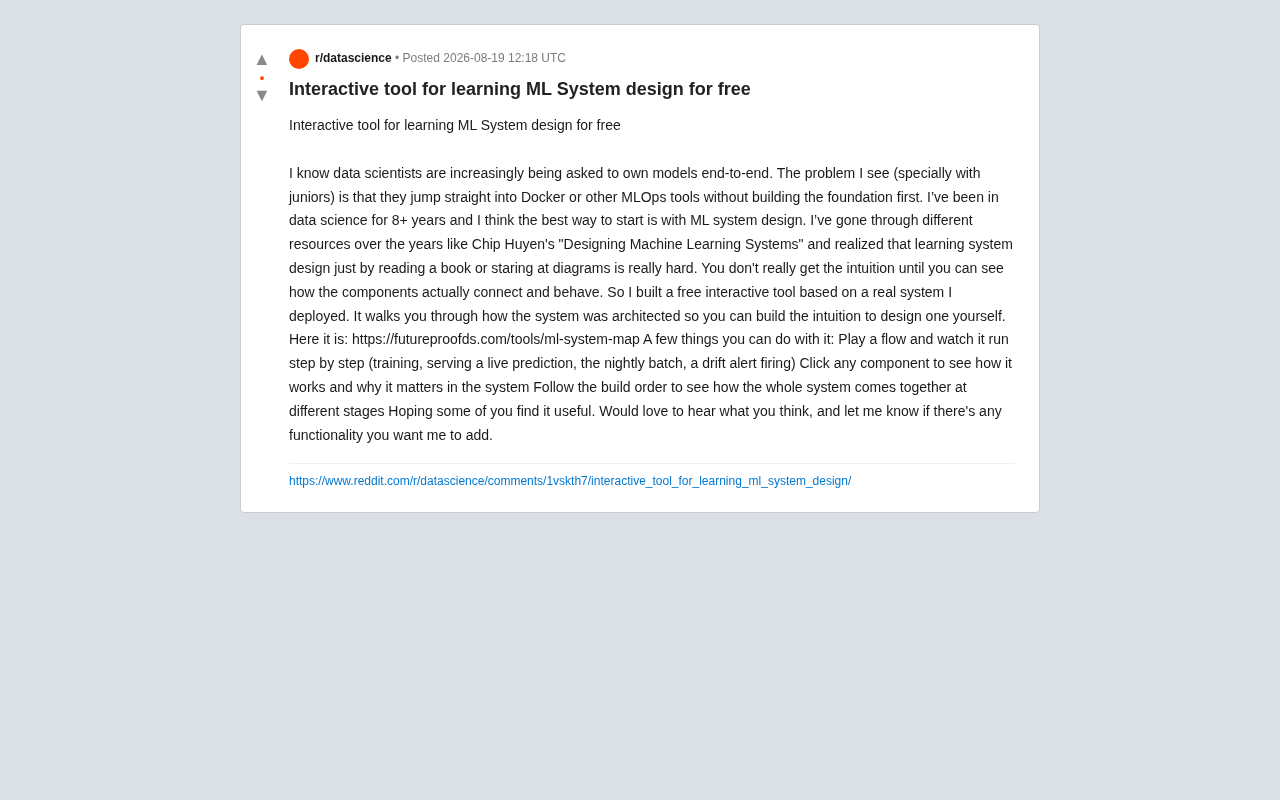
To address this problem, the author built a free interactive learning tool called ML System Map (https://futureproofds.com/tools/ml-system-map), based on real systems he has actually deployed. Its core philosophy is: through visualization and interaction, learners can "see" how a system is architected, thereby developing the ability to independently design systems.
Core Feature 1: Animated Flow Demonstrations
The tool's standout feature is the ability to "play" a flow and watch it execute step by step. Users can observe the complete execution of several typical scenarios:
- Model training
- Serving a live prediction
- Nightly batch processing
- Drift alert firing
This dynamic demonstration makes abstract system behavior intuitive and tangible, allowing learners to clearly understand the role each step plays within the overall system.
Online real-time prediction serving and batch processing represent two fundamental architectural patterns for ML inference. Online serving requires low latency (typically milliseconds) and is suited for real-time user interaction scenarios like search ranking, recommendation systems, and fraud detection; architecturally, it typically uses REST API or gRPC interfaces with model serving frameworks like TensorFlow Serving or Triton Inference Server. Batch processing performs predictions on large volumes of data within fixed time windows (e.g., nightly) and is suited for scenarios that don't require real-time responses, such as email marketing scoring and user segmentation; architecturally, it commonly uses Spark or distributed computing frameworks. Many mature ML systems maintain both paths simultaneously—this is known as Lambda architecture or nearline serving architecture, and its complexity is a key consideration in system design.
Drift alerts are a core mechanism in ML system monitoring. Data drift refers to changes in the statistical distribution of input data in production relative to training data; concept drift refers to changes in the relationship between inputs and target variables. For example, a consumer behavior prediction model trained on pre-pandemic data would experience severe concept drift during the pandemic. Common detection methods include statistical approaches like KL divergence, PSI (Population Stability Index), and KS tests. Once significant drift is detected, the system needs to trigger alerts and potentially automatically initiate model retraining. This is one of the key operational challenges that distinguishes ML systems from traditional software systems.
Core Feature 2: Deep Component Explanations
Users can click on any component to see how it works and "why it matters in the system." This design not only tells you what a component is but emphasizes the significance of each component and its relationship to the overall architecture—which is precisely the key to developing systems thinking.
Core Feature 3: Build Order Guidance
The tool also provides a "build order" view showing how the entire system is constructed incrementally across different stages. This is extremely valuable for understanding system evolution paths: a mature ML system isn't built overnight but is progressively refined as requirements grow. Learners can use this to understand which parts should be prioritized at different stages of development.
Implications for Data Science Learning Paths
The emergence of this tool reflects an important trend in current AI engineering education: shifting from passive reading to active interactive learning. For domains like system design that heavily depend on intuition and experience, interactive visualization can genuinely compensate for the shortcomings of traditional text and diagrams.
From a pedagogical perspective, the effectiveness of interactive learning tools has solid theoretical support. Constructivist learning theory holds that knowledge is not passively received but actively constructed by learners through interaction with their environment. Cognitive load theory suggests that dynamic visualization can decompose complex systems into manageable information units, reducing learners' extraneous cognitive load. In software engineering education, similar interactive approaches have been widely validated—tools that visualize algorithm execution (like VisuAlgo) have significantly improved students' depth of understanding. ML system design, as a complex domain involving multi-component coordination, is particularly well-suited to this "observable and manipulable" learning approach.
Advice for MLOps Beginners
Combining the author's perspective, a more reasonable learning path for data scientists new to MLOps should be:
- Understand the big picture first: Grasp how training, serving, monitoring, and other modules collaborate to build overall architectural intuition.
- Then dive into specific tools: After understanding the "why," learning the "how" of Docker, Kubernetes, and other tools becomes much more meaningful.
- Validate through hands-on practice: Convert abstract concepts into actionable experience through interactive tools or real projects.
You might not have noticed, but the author is also actively soliciting community feedback, hoping to continuously expand features based on user needs. This approach of building on real systems and iterating openly itself embodies good engineering practice.
Conclusion
For practitioners looking to deepen their expertise in machine learning engineering, system design ability is the dividing line between "knowing how to use tools" and "being able to design architecture." Free interactive tools like ML System Map offer a new approach to bridging this learning gap. Whether you're a data scientist just entering the field or a senior engineer looking to systematically organize your knowledge, it's worth experiencing this "visible and clickable" way of learning firsthand—it might bring unexpected insights.
Related articles

Apple HomeView Hands-On Review: Is the $300 Smart Home Hub Worth It?
Apple HomeView hands-on: a $300 smart home hub with facial recognition for quick account switching, but no App Store or voice recognition. Is the wall-mounted version worth it? Should you buy the first generation?

Meta Muse Wonder Launch: What It Means for Meta's Return to the Frontier AI Race
Meta releases Muse Wonder and WonderFull, benchmarks reach the frontier, community feedback is polarized. An in-depth look at Meta's return to the frontier AI race, its personal agent strategy, and Zuckerberg's different path.

Apple Home Smart Home Lineup Leaked: LG and Schneider Team Up, UWB Door Lock on Board
Apple Home ecosystem gains new LG and Schneider devices: UWB smart lock with proximity unlock, 2.5K dual-camera doorbell, privacy indoor camera, and AirPods-like seamless pairing.