MMEnterprise-Bench: How Can Enterprise Agents Cope with Evolving Multimodal Records?

MMEnterprise-Bench evaluates enterprise agents' conflict resolution and evidence reasoning using evolving multimodal records.
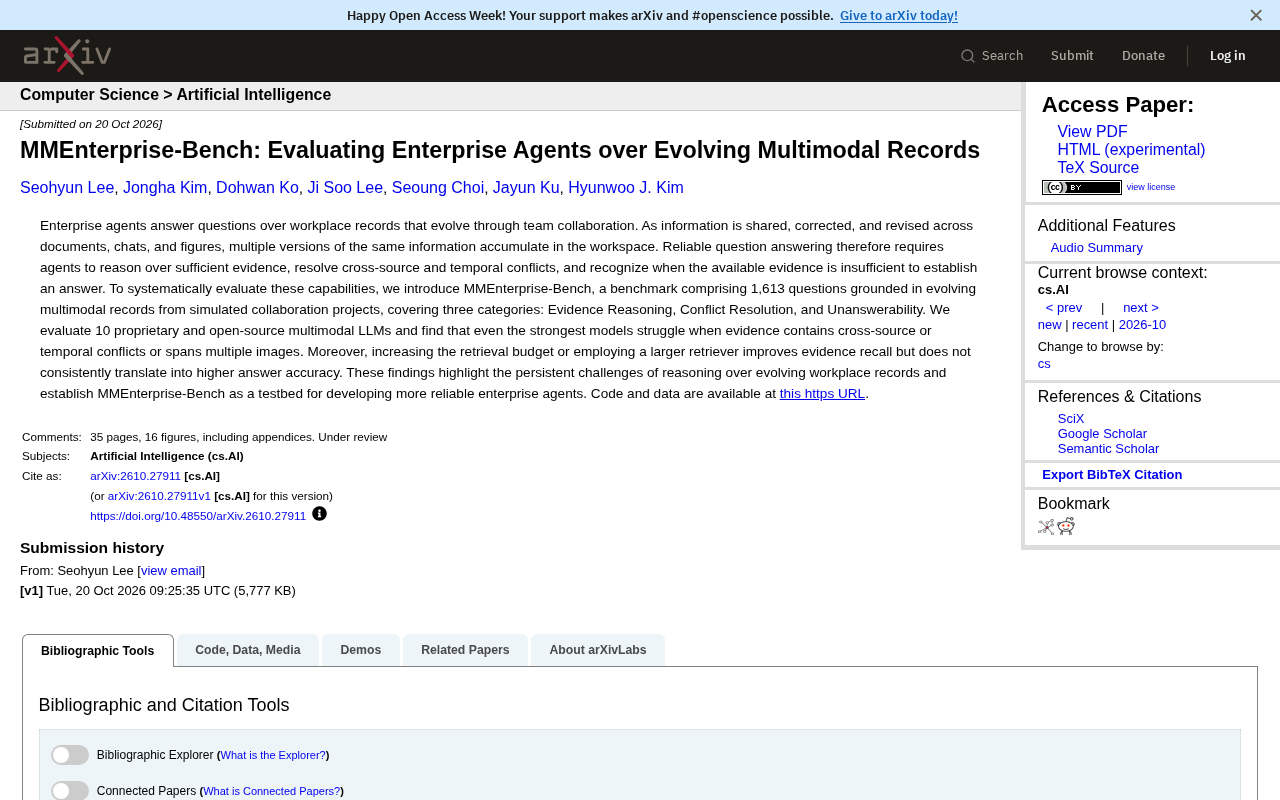
MMEnterprise-Bench is a new benchmark for enterprise agents built on simulated collaborative projects, with 1,613 questions covering evidence reasoning, conflict resolution, and unanswerability identification. It treats the dynamic evolution of office records—version updates and cross-source contradictions—as the object of evaluation rather than assuming static, singular information. After evaluating 10 multimodal large models, the research team found that increasing retrieval budget improves evidence recall but does not reliably translate into higher answer accuracy; the strongest models still struggle with cross-source or temporal conflicts and multi-image evidence. The article argues that enterprise agents need a dedicated evidence verification layer—preserving version metadata, detecting conflicts, and assessing evidence sufficiency—rather than relying only on stronger base models or larger vector databases.
Title
MMEnterprise-Bench: How Can Enterprise Agents Cope with Evolving Multimodal Records?
Meta Description
MMEnterprise-Bench is a multimodal benchmark for enterprise agents with 1,613 questions covering evidence reasoning, conflict resolution, and unanswerability. Experiments show that even the strongest models still struggle with cross-source and temporal conflicts, and increasing retrieval budget does not reliably improve answer accuracy.
Article Content
Enterprise agents are moving from demo scenarios into real office environments, but office records are rarely static. The same piece of information is shared, corrected, and rewritten across documents, chats, and charts, with versions continuously accumulating. A reliable agent must not only find evidence but also determine which piece of evidence is newer, which version is trustworthy, and whether it should refrain from answering when evidence is insufficient. MMEnterprise-Bench is a benchmark proposed to address exactly this pain point, using multimodal records from simulated collaborative projects to systematically test agents' reasoning capabilities.
Why Enterprise Agents Need a New Benchmark
Most existing benchmarks assume that information is static and singular: one question corresponds to a fixed passage of text or a single image. Real work scenarios, however, are full of dynamism—a colleague corrects an error in a document in a group chat, a chart is updated after a meeting, and an old PDF version remains on the shared drive. If an agent performs only similarity-based retrieval, it can easily recall outdated conclusions that have already been overturned.
The core design philosophy of MMEnterprise-Bench is to make "evolution" the object of evaluation. It builds 1,613 questions based on simulated collaborative projects, covering three types of tasks: evidence reasoning, conflict resolution, and unanswerability identification. This means the benchmark tests not only whether an agent can find information, but also whether it can make correct judgments amid cross-source and cross-temporal contradictions, and whether it can honestly say "I don't know" when evidence is genuinely insufficient.
Multimodal records refer to information carriers in enterprise collaboration that simultaneously contain multiple forms such as text, images, and chat logs. In the MMEnterprise-Bench setting, the same project may produce heterogeneous materials such as documents (PDF/Word), instant-message screenshots, and data charts, each carrying part of the facts. Agents need to align semantics across modalities—for example, linking a correction in a chat to an updated value in a chart—rather than treating each modality as an isolated retrieval source. The difficulty of multimodal integration lies in the fact that timestamps and update rhythms often differ across modalities, and models must explicitly track sources and versions; otherwise, they may easily mistake outdated screenshots for the latest evidence.
Breaking Down the Three Task Types: From Finding Evidence to Recognizing "No Solution"
Evidence reasoning requires agents to integrate fragments scattered across documents, chats, and images to assemble a complete answer. Such questions often require locating clues across multiple files rather than through single-point retrieval.
Conflict resolution is the most difficult part. The same fact may exist in multiple versions, and sources may even contradict one another; the agent needs to judge temporal order and source credibility. Experiments in the paper show that even the strongest models struggle in the face of cross-source or temporal conflicts, indicating that current models lack a stable mechanism for version reasoning.
Unanswerability tests the agent's "restraint." When the evidence chain is broken or the information is insufficient to support a conclusion, the model should refuse to fabricate. This category directly targets the most dangerous risk in enterprise deployment—answers that appear fluent but are actually wrong.
Evidence sufficiency assessment is the meta-reasoning ability to judge whether the currently retrieved information is sufficient to support a definite answer. It differs from traditional question-answering accuracy: the model must not only generate an answer but also proactively output "unable to answer" when the evidence chain is broken, sources contradict one another, or key information is missing. In enterprise scenarios, lacking this ability leads models to fill gaps with seemingly reasonable speculation, producing high-confidence erroneous conclusions. MMEnterprise-Bench sets unanswerability questions as a separate category precisely to turn this "restraint" into a quantifiable evaluation dimension rather than relying on post hoc manual review.
Experimental Findings: Increasing Retrieval Budget Does Not Equal More Accurate Answers
The research team evaluated 10 closed-source and open-source multimodal large models and reached a counterintuitive conclusion: increasing the retrieval budget or switching to a larger retriever does improve evidence recall, but it does not reliably translate into higher answer accuracy.
This finding deserves the attention of enterprise architects. It shows that the bottleneck is not "whether enough is found" but "whether correct reasoning can be performed after finding it." Engineering measures such as piling on retrieval volume and expanding context windows cannot solve the problems of conflict judgment and evidence sufficiency assessment. When evidence spans multiple images, models' integration ability also declines noticeably.
From an engineering perspective, this means enterprise agents need a dedicated evidence verification layer: compare timestamps for multiple-version records of the same fact, perform consistency checks on cross-source information, and set a clear "insufficient evidence" exit. Relying solely on a stronger base model or a larger vector database is not enough to build a reliable enterprise question-answering system.
Retrieval budget usually refers to the number of documents allowed to be retrieved in one question-answering session, the upper limit of recalled snippets, or the token capacity of the context window. Expanding the budget can increase the probability that relevant evidence is recalled, but experiments in MMEnterprise-Bench show that improved recall does not automatically translate into answer correctness, because the bottleneck shifts to the subsequent stages of conflict judgment and evidence integration. For engineering teams, this means that when evaluating systems, they should not look only at retrieval metrics such as recall@k, but should treat end-to-end answer accuracy, conflict-resolution correctness, and reasonableness of refusal as core monitoring metrics; otherwise, they may easily overinvest in the retrieval layer while neglecting verification design in the reasoning layer.
Implications for Building Enterprise Agents
The value of MMEnterprise-Bench lies in shifting the evaluation focus from "retrieval hits" to "reasoning reliability." For teams currently deploying enterprise knowledge-base question answering, this benchmark offers several actionable directions: preserve version and update-time metadata in the data pipeline; add a conflict detection step to the agent workflow; and enforce evidence sufficiency assessment at the output stage.
The benchmark's code and data are publicly available, and teams can use them to identify weaknesses in their own systems regarding conflict resolution and unanswerability. As office records continue to become more multimodal and versioned, this kind of evaluation will become necessary infrastructure for enterprise agents to move from usable to trustworthy.
For more details, visit the project page: https://mlvlab.github.io/MMEnterprise-Bench/
One-line Summary
MMEnterprise-Bench evaluates enterprise agents' conflict resolution and evidence reasoning abilities using evolving multimodal records.
Paragraph Summary
MMEnterprise-Bench is a new benchmark for enterprise agents, built on simulated collaborative projects with 1,613 questions covering evidence reasoning, conflict resolution, and unanswerability identification. It treats the dynamic evolution of office records—version updates and cross-source contradictions—as the object of evaluation rather than assuming information is static and singular. After evaluating 10 multimodal large models, the research team found that increasing retrieval budget improves evidence recall but does not reliably translate into higher answer accuracy; the strongest models still struggle with cross-source or temporal conflicts and multi-image evidence. The article accordingly points out that enterprise agents need a dedicated evidence verification layer, including preservation of version metadata, conflict detection, and evidence sufficiency assessment, rather than relying only on stronger base models or larger vector databases.
Related articles

GPT-Next Leak, Gemini 4 Argon Imminent: AI News Roundup
GPT-Next leak suggests extreme efficiency; OpenAI's 28-day shipping pledge boosts speed 50%; Gemini 4 Argon nears release; Anthropic subscription value report sparks debate.

GPT-Next Leaked, Gemini 4 Argon Speeds Up, Fable 5.5 May Launch Today
OpenAI's GPT-Next model leaks, expected to be extremely low-cost and possibly part of the 28-day release plan; Gemini 4 Argon internal testing accelerates, NanoBanana 2.1 is live; Semi Analysis tests show Claude Max's equivalent API value is about 5 times that of ChatGPT Pro; Fable 5.5 may launch today.

Gemini 4 Argon Launches Globally: Key Highlights from the AI Daily Brief
Google opens Gemini 4 Argon globally across Pro and Ultra subscriptions and the API, and demonstrates robot control. This article rounds up open-source models, Agent infrastructure, cost transparency, and safety governance updates.