MOSS Image Acceleration LoRA Tested: How Big Is the Gap Between 4 Steps and 8 Steps?
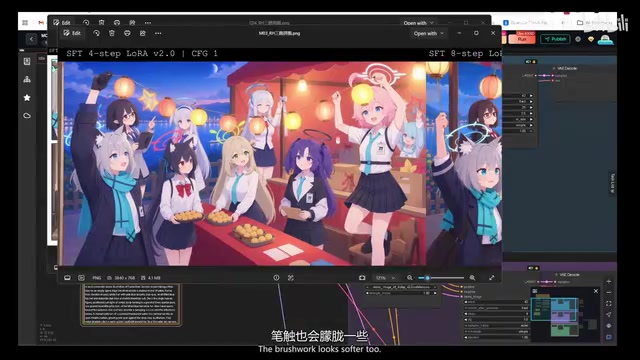
Bilibili creator tests MOSS Image acceleration LoRA: 4-step stabilizes composition, 8-step has better detail but prone to misalignment, native 25-step has the richest detail.
A Bilibili creator systematically tested MOSS Image's 4-step and 8-step acceleration LoRAs against native 25-step generation, covering anime, multi-person, tattoo, and comic scenarios. The test used a three-image comparison workflow with uniform CFG=1 and Euler simple sampler, and reminds users to choose SFT for 8-step and 2.0 for 4-step. Results show: 4-step LoRA outperforms native 25-step in multi-person and composition stability but is hazy in detail and more 2D in style; 8-step detail falls between the two but has obvious composition misalignment in some scenarios; native 25-step has the richest detail and preserves artist brushstrokes but is error-prone in multi-person backgrounds. Acceleration LoRA is essentially a trade-off of detail for speed, and selection should be weighed by scenario.
A Bilibili creator conducted a systematic comparison test of two acceleration LoRAs for MOSS Image (4-step and 8-step versions), using native 25-step generation as a horizontal reference. The test covered various scenarios including anime, multi-person images, tattoo images, and comics. The conclusion: the 4-step version strikes a good balance between stability and speed, while the 8-step version gets closer to native in detail in some scenarios, but composition issues cannot be ignored.
Test Method and Workflow
The test used a three-image comparison workflow, running native 25-step, 4-step LoRA, and 8-step LoRA versions simultaneously. Operationally, you just need to load the corresponding LoRA after the model, change CFG to 1, set steps to 4 or 8, use Euler simple uniformly as the sampler (the creator pronounced it "Youla simple"), and keep all other parameters consistent. The workflow supports toggling the output of the other two versions via Ctrl+B checkbox, and you can run it by uploading the resolution and prompt.
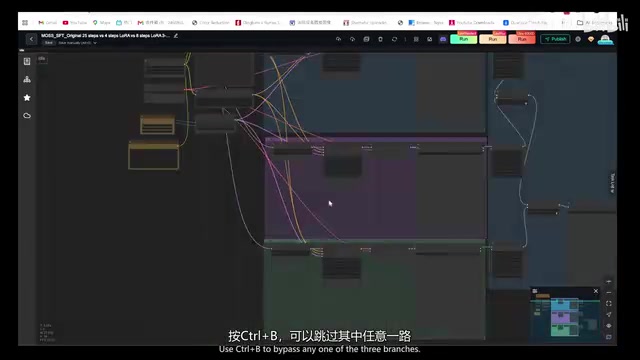
Regarding LoRA version selection, the creator specifically reminds: the 8-step LoRA has two versions, SFT and Base, and for daily use you should choose SFT (the version continuously trained on the base model); for the 4-step LoRA, use the 2.0 version directly, and be careful not to download the old 1.0 version. These are pitfalls that are easy to fall into in practice.
LoRA (Low-Rank Adaptation) is a parameter-efficient fine-tuning technique: it freezes the base model weights and injects low-rank matrices into the attention layers as a bypass, using a small number of parameters to learn a specific style or capability (such as "4-step generation"). The essence of acceleration LoRA is distillation—training the LoRA on a large number of "native multi-step generation" results so that it learns to reproduce the multi-step sampling trajectory in very few steps. Therefore, it is not simply compressing the model, but reallocating attention: shifting computational resources from redundant steps to key feature reconstruction. This explains why acceleration LoRA has trade-offs in detail, yet can outperform native multi-step in dimensions such as composition stability.
CFG (Classifier-Free Guidance) is a parameter that controls the strength of alignment between the generated result and the prompt, typically ranging from 5 to 9. Acceleration LoRA requires CFG=1 because the model has already internalized the guidance signal during distillation; if a high CFG is still used, it will instead break the step-compression mapping learned by the LoRA, leading to oversaturation or structural collapse. The same applies to setting steps to 4 or 8—they must strictly match the step setting used during LoRA training, otherwise the sampling trajectory deviates and quality drops sharply.
Anime and Multi-Person Images: Improved Stability, Trade-Offs in Detail
In anime scenarios, the differences between 4-step, 8-step, and native are mainly reflected in the art style, especially in multi-person images. Native 25-step showed obvious errors in the background area of multi-person images, while the 4-step version was actually more stable. However, images generated by 4-step generally have a "hazy feel" with some loss of detail; 8-step showed background misalignment issues, with an art style between native and 4-step.
In terms of detail richness, native 25-step has very rich brushstrokes—MOSS Image itself has a 3D and realistic tendency, with obvious detail layers; the 4-step version presents a more 2D hazy texture. This is actually a typical characteristic of acceleration LoRA trading detail for speed, not a quality issue but a trade-off.
SFT (Supervised Fine-Tuning) and Base are two stages of model fine-tuning: Base refers to the version obtained by directly training on the original pre-trained weights, retaining broader priors but potentially unstable; SFT is further trained on Base with high-quality instruction-response pairs, aligned with human preferences, producing more controllable outputs that better meet daily use expectations. For acceleration LoRA, the SFT version is usually filtered and corrected, making composition and details after step compression more reliable; the Base version may retain more original noise, suitable for secondary development rather than direct image generation. Therefore, the creator emphasizes "choose SFT for daily use" precisely to avoid the instability amplified by the Base version at low step counts.
Artist Style and Comic Scenarios: Limited Impact
For scenarios that need to preserve artist brushstrokes, such as tattoo images, native 25-step can retain more of the artist's effect, while 4-step weakens this stylistic feel. But for comic-type content, the impact of four steps is almost negligible, with overall differences being small apart from slightly less detail.
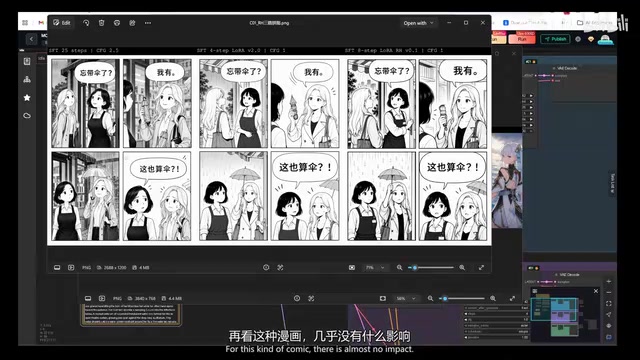
For color comics, the native version has slightly more detail, while the 4-step version leans slightly toward a chibi style. The 8-step performance in this scenario falls between the two, and the creator thinks the 8-step actually looks a bit better—though this also depends on the specific image and aesthetic preference.
Composition Comparison: 4-Step Wins on Stability
After testing with another image, the conclusion reversed: the 4-step version had better composition and higher stability; native 25-step had rich detail but slightly inferior composition; 8-step composition was clearly not good.
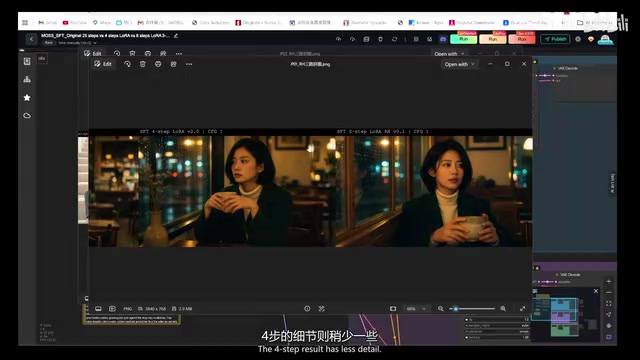
This result shows that the performance of acceleration LoRA is strongly correlated with specific image content, and there is no linear relationship of "fewer steps means worse." The advantage of 4-step in composition stability even surpasses native 25-step in some scenarios.
Euler simple is a commonly used sampler in ComfyUI (Euler is a numerical integration method, simple refers to the step size scheduling strategy). It has low computational cost and fast speed, and performs stably at low step counts, thus becoming the unified sampler for acceleration LoRA testing. Different samplers vary greatly in sensitivity to step count: Euler simple can better balance speed and quality at 4-8 steps, while multi-step samplers like DPM++ tend to produce artifacts at extremely low step counts. A unified sampler is key to controlling variables—if samplers are mixed, the step comparison conclusions will lose meaning.
Additional Finding: MOSS Image Edits
The creator also mentioned MOSS Image's Edits feature—similar to the previous Krea2 image editing node, currently usable through ComfyUI's (pronounced "Austria") edits node, but the node is not yet available on RH (RunningHub). Users who want to try it can watch for future updates. The comparison workflow can be downloaded directly from RH or obtained from cloud storage.
Purchase Advice
Based on the comprehensive test results: for speed, choose the 4-step 2.0 version, which is sufficient for daily image generation; switch back to native 25-step when extreme detail is needed; 8-step suits specific aesthetic scenarios but be aware of composition risks. For version selection, go for SFT rather than Base, and avoid the old 1.0 version for 4-step LoRA. Acceleration LoRA is not simply quality reduction, but reallocating the model's attention across different dimensions—understanding this is key to choosing the right tool.
Related articles
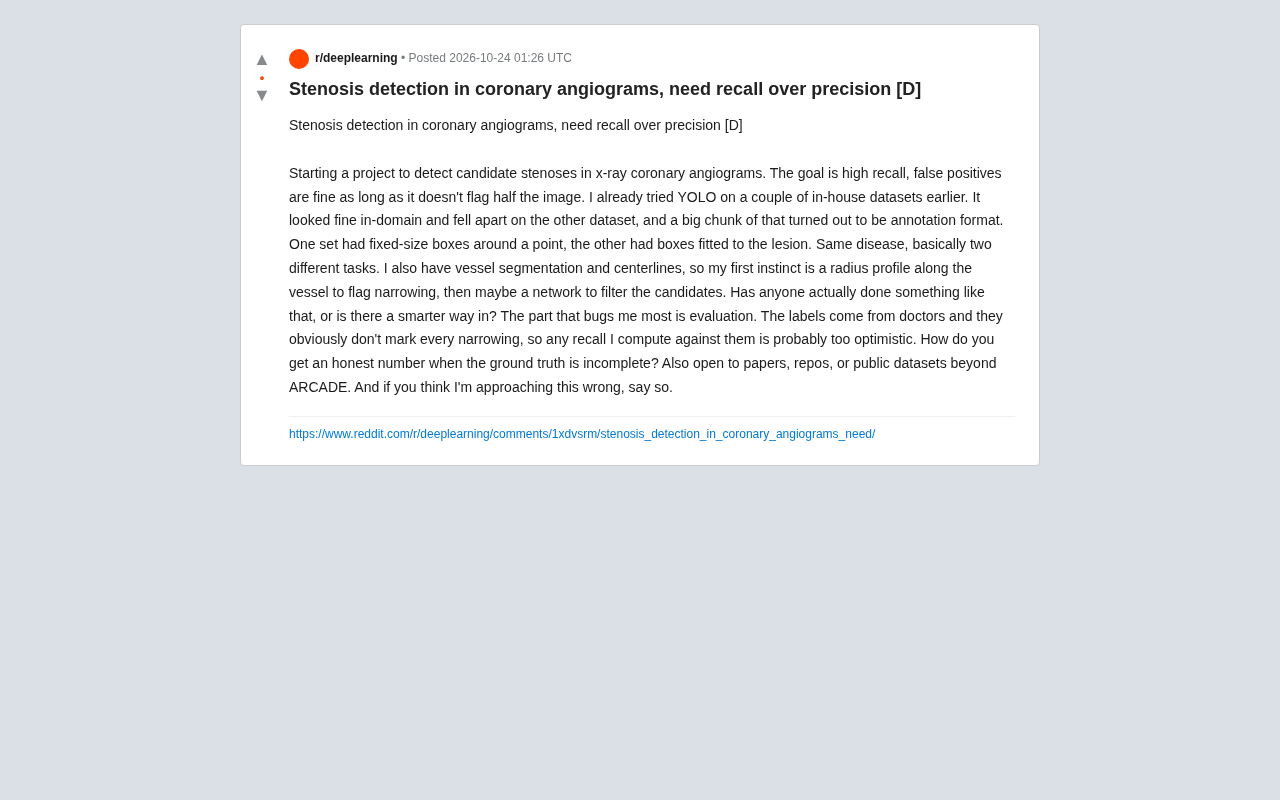
Coronary Angiography Stenosis Detection: A Practical High-Recall-First Approach
Exploring a high-recall-first technical approach for coronary angiography stenosis detection, analyzing annotation format issues behind YOLO cross-domain failure, discussing vessel radius profile candidate generation, and the evaluation dilemma under incomplete gold standards.

Perplexity Hybrid Compute Tested: Privacy Data Never Leaves the Mac
Perplexity Hybrid Compute tested: how PrivacyGate intercepts sensitive data, how local and cloud models divide work, model differences on 16GB vs 32GB Macs, and privacy protection in real scenarios like bank statements and medical records.

Big Fat Fish Roasts Mainstream LLMs at Home and Abroad: Doubao Takes the Crown, DeepSeek Tied for First
Bilibili creator Big Fat Fish roasts mainstream LLMs: Doubao tops for emotional value, DeepSeek ties first for open-source value, with ERNIE, Hailuo, Yuanbao, Kimi, Qwen, Kling, Claude, Gemini, and Grok each branded with a distinct persona.