MOSS-Image Team AMA Reveals: Anime Model and Editing Tool in Development, Committed to Apache 2.0 Open Source

MOSS-Image team revealed in a Reddit AMA the roadmap for an anime model, an editing model, and keeping Apache 2.0 for the next generation.
In a Reddit AMA, the MOSS-Image team disclosed its roadmap: developing an anime-specific model with alpha channel support and multi-character reference for transparent backgrounds and consistency; an image editing model also in progress; and most critically, the next-gen model planned to stay under Apache 2.0, with the qualifier 'if all goes as planned.' The article analyzes that Apache 2.0 allows commercial use, modification, and redistribution without requiring derivative works to be open-sourced, offering practical value for developers. Overall, open-source image model competition is shifting from pure quality to differentiated dimensions like vertical styles, editing, and workflow integration.
The MOSS-Image team recently held an AMA (Ask Me Anything) event on the Reddit community, disclosing the project's follow-up roadmap in a concentrated manner for the first time. For developers and creators following open-source image generation models, this AMA revealed quite a lot: an anime-style model, an image editing model, alpha channel support, multi-character reference, and most critically—the next-generation model is planned to continue using the Apache 2.0 license.
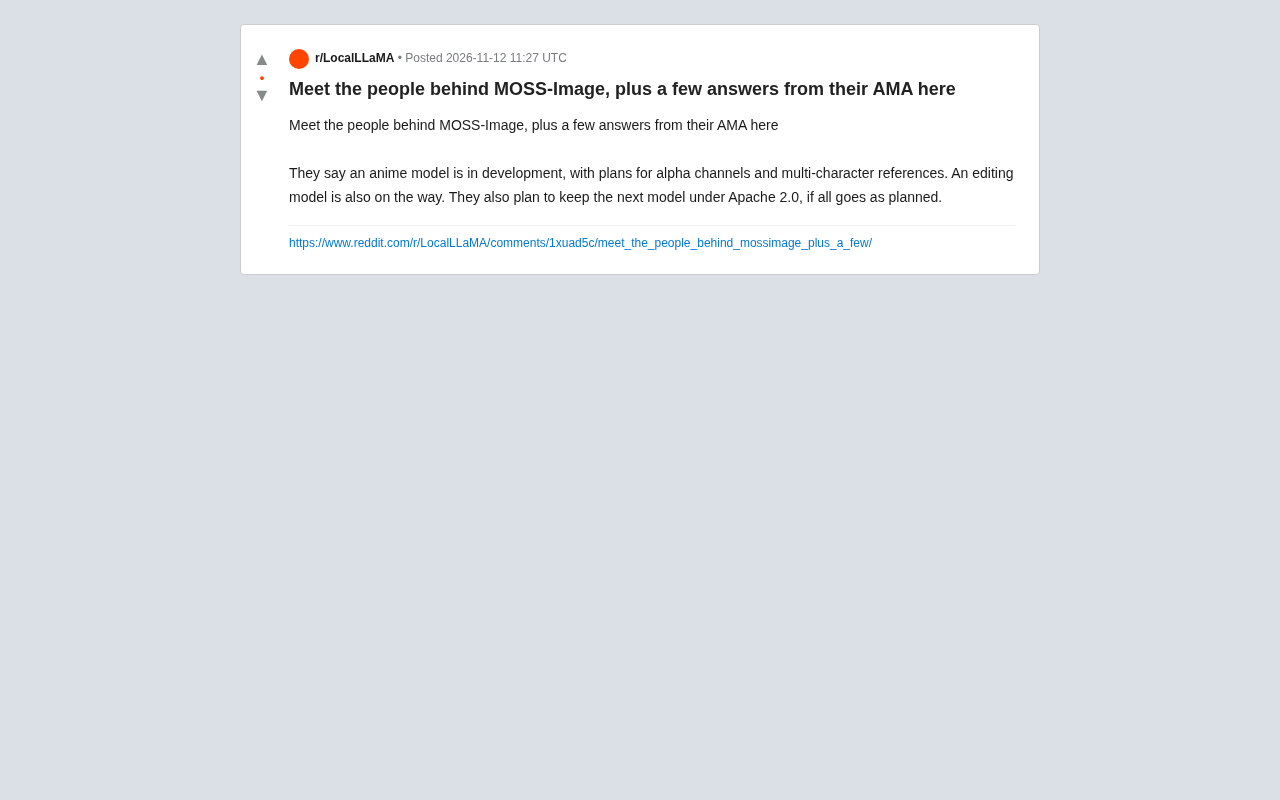
Three Things on the Roadmap: Anime Model, Editing Model, Apache 2.0
According to the team's answers in the AMA, MOSS-Image's subsequent development revolves around at least three directions.
The first is an anime-style model. The team explicitly stated they are developing an anime-specific model, and this model is not just about swapping in a different training dataset—they plan to add alpha channel support and multi-character reference capabilities. Combined, these two features point to a fairly specific creative scenario: anime character illustrations requiring transparent background assets, and the ability to stably present multiple different characters in the same image. For developers working on ACG content, game character art, or fan creations, this is more practically valuable than mere style fine-tuning.
The second is an image editing model. The AMA mentioned the team is also advancing an editing model, but the original information did not provide more technical details. Judging from the current pace of open-source image model development, editing capabilities (local inpainting, instruction-based modification, etc.) have become a key dividing line for model practicality. The team including it in the roadmap shows they recognize that the second leg beyond generation is equally important.
The third is a license commitment. The team stated that if everything goes as planned, the next-generation model will continue to remain under Apache 2.0. This point was mentioned separately in the AMA's brief answer, and its weight deserves separate discussion.
What Apache 2.0 Means
In the open-source model space, licenses often determine a project's actual influence more than benchmark scores. Apache 2.0 allows commercial use, modification, and redistribution, and does not require derivative works to be open-sourced. For an image generation model, this means enterprises can integrate it into commercial products without worrying about license contamination, research teams can freely do secondary training on top of it, and individual developers can confidently use it for freelance work and creation.
The MOSS-Image team proactively reaffirming this commitment in the AMA is effectively sending a signal to the community: the project's open strategy will not tighten in the next generation. Considering that many open-source models shift to stricter license terms after iterations, this statement has practical reference value for developers wanting to bet on this tech stack long-term.
It's worth noting that the team used qualifiers like "if all goes as planned," indicating the license strategy is still tied to development progress and is not an unconditional commitment. This is a common phrasing in AMA contexts; readers need not over-interpret it, but should also not treat it as an already-finalized term.
Common Types of Model Licenses and Their Trade-offs
Licenses common in the open-source model space can be roughly divided into three categories: fully permissive (such as Apache 2.0, MIT), copyleft with viral effects (such as the GPL family, requiring derivative works to be open-sourced under the same terms), and community-type licenses in between (such as OpenRAIL, allowing commercial use but with additional use-case restrictions). In addition, many models use custom licenses with extra terms on commercial scale, redistribution, or output content.
For image generation models, license differences directly affect the downstream ecosystem: Apache 2.0 does not require derivative models to be open-sourced and does not restrict commercial integration, making it most friendly to startups and closed-source products; copyleft licenses force works fine-tuned or retrained on the model to also be open-sourced, raising the barrier for commercial adoption. This is why models with the same architecture under different licenses can differ dramatically in community activity and commercial adoption speed.
Multi-Character Reference and Alpha Channel: Why These Two Features Matter
If you look at the two additional capabilities of the anime model together, you'll find they address two sides of the same problem.
Multi-character reference targets the consistency problem. With existing models, keeping more than two characters with their own appearance features in the same image without contaminating each other has always been a challenge in prompt engineering. If the model natively supports multi-character reference, creators can save a lot of repetitive debugging effort.
Alpha channel targets the workflow integration problem. Transparent background output means generated results can go directly into downstream steps like layout, compositing, and UI design without manual cutout. For users who treat image models as production tools rather than toys, such "engineering-oriented" features often take priority over a few percentage points of image quality improvement.
Combining the two features, it's clear that the team is targeting actual production workflows when designing the next-generation anime model, rather than pure benchmark competition.
Technical Challenges of Multi-Character Consistency
In diffusion models or similar generative architectures, keeping multiple characters in the same image each with stable appearance is essentially a problem of identity feature disentanglement and binding. Common approaches inject identity information via reference images (such as IP-Adapter, ReferenceNet-type mechanisms), but when multiple references are input simultaneously, features of different characters tend to cross-talk in attention layers, causing attributes like hair color, clothing, and face shape to blend.
More tricky is spatial attribution: the model needs to know which feature belongs to which position in the image, otherwise characters will swap appearances. Native multi-character reference typically requires additional regional constraints or identity routing mechanisms, which is why this capability is an order of magnitude harder than single-character reference—not just a matter of feeding in a few more images.
Alpha Channel and Transparent Background Generation
The alpha channel is the data channel in an image that records the transparency of each pixel, forming RGBA images together with the common RGB three channels. PNG or WebP with an alpha channel can be overlaid on any background without white edges, and is the standard format for UI assets, game textures, character art, and compositing workflows.
Mainstream image generation models typically train and output in RGB space, and transparent backgrounds require post-processing via cutout or segmentation, where edge details (such as hair strands and semi-transparent materials) are easily lost. Making a model natively output alpha channels requires preserving transparency information in training data and adjusting the output layer and loss function. This is why alpha support is viewed as an engineering-oriented capability rather than a simple format option.
Competitive Focus of Open-Source Image Models as Seen from the AMA
Although brief, this AMA reflects a trend in the current open-source image model race: the stage of pure competition over generation quality is passing, and differentiated capabilities—specific styles, editing, workflow integration—are becoming new competitive dimensions.
The MOSS-Image team's choice to double down on the anime vertical, fill in editing capabilities, and stick with a permissive license has a clear intent: in a context where general-purpose models are already strong enough, win over the creator community with deep features for vertical scenarios. Whether these plans can be delivered on schedule—the AMA itself gave no timeline—remains to be seen, and subsequent progress is worth following.
One-line Summary
MOSS-Image team revealed in a Reddit AMA the roadmap for an anime model, an editing model, and keeping Apache 2.0 for the next generation.
Paragraph Summary
In a Reddit AMA, the MOSS-Image team disclosed its roadmap for the first time, focusing on three directions: an anime-specific model in development with alpha channel support and multi-character reference capabilities, targeting transparent background assets and multi-character consistency in real production; an image editing model also in progress but without technical details; and most critically, the next-generation model planned to continue using the Apache 2.0 license, albeit with the qualifier "if all goes as planned." The article analyzes that Apache 2.0 allows commercial use, modification, and redistribution without requiring derivative works to be open-sourced—a statement with practical reference value for developers betting on this tech stack long-term. Overall, competition in open-source image models is shifting from pure generation quality to differentiated dimensions like vertical styles, editing capabilities, and workflow integration, with the team choosing to double down on the anime vertical and win over the creator community with a permissive license.
Related articles

Zed Editor Releases v1.29.2: Observations on a Routine Version Iteration
Zed editor releases patch v1.29.2, version bump by @JosephTLyons, commit verified via GitHub signature. This article covers the release's basic info, what a patch version means, and practical upgrade advice for users.

Anthropic IPO Questioned: Hacker News Debates Timing of Going Public
A Hacker News post titled "Just say no to Anthropic's IPO" sparks debate on the timing of Anthropic's public listing and AI capitalization, touching on valuation bubbles and mission independence.

Hands-On with the Genie 4 World Model: Directing Worlds in Real Time Like a Puppeteer
Google DeepMind's Genie 4 world model in depth: Special Guest X's hands-on demo of real-time scene direction via prompts, custom interactive apps in Project Genie, and prompts-as-seeds reproducibility.