MOTHER: A Native macOS Terminal App Built Specifically for Claude Code

MOTHER is a native macOS terminal app purpose-built to enhance the Claude Code developer experience.
MOTHER is a native macOS terminal application specifically designed for Claude Code users. It features one-click session resume, a project launcher for quick switching between codebases, and menu-bar smart alerts for when Claude needs input. Priced at $9.99 one-time purchase, it reflects the growing trend of specialized tools emerging around AI programming assistants as their ecosystems mature.
A Terminal Born for AI Programming
As AI programming assistants like Claude Code increasingly integrate into developers' daily workflows, a supporting ecosystem around these tools is rapidly emerging. MOTHER, which recently launched on Product Hunt, is exactly this kind of product—a native macOS terminal application tailor-made for Claude Code. It reached #16 on the daily leaderboard with 73 upvotes, categorized under Mac, Productivity Tools, and Developer Tools.
Claude Code is a command-line AI programming assistant from Anthropic that runs directly in the terminal environment, allowing developers to write, debug, and refactor code through natural language interaction. Unlike IDE-embedded AI tools such as Cursor or GitHub Copilot, Claude Code adopts a terminal-native interaction model. This means it inherits the flexibility of command-line tools but also faces the inherent limitations of terminal environments when it comes to graphical experience. Claude Code supports long-context conversations, can understand an entire project's code structure, and directly performs read/write operations on files—it's precisely this deep terminal interaction pattern that has given rise to specialized terminal tools like MOTHER.
Unlike general-purpose terminals, MOTHER doesn't attempt to replace feature-rich terminal emulators like iTerm2 or Warp. Instead, it focuses on a more vertical scenario: making developer collaboration with Claude Code smoother. iTerm2 is the most popular open-source terminal emulator on macOS, known for its high customizability and rich feature set; Warp is a next-generation terminal that has raised significant funding in recent years, having rewritten its rendering engine in Rust with built-in AI command completion. These general-purpose terminals are designed to cover all command-line use cases, from system administration to remote connections to development debugging. MOTHER's choice to abandon this comprehensiveness and focus solely on AI programming assistant interaction represents a classic "do less" product strategy. This "specialized tool" positioning reflects the trend of AI programming evolving from "add-on features" to an "independent ecosystem."
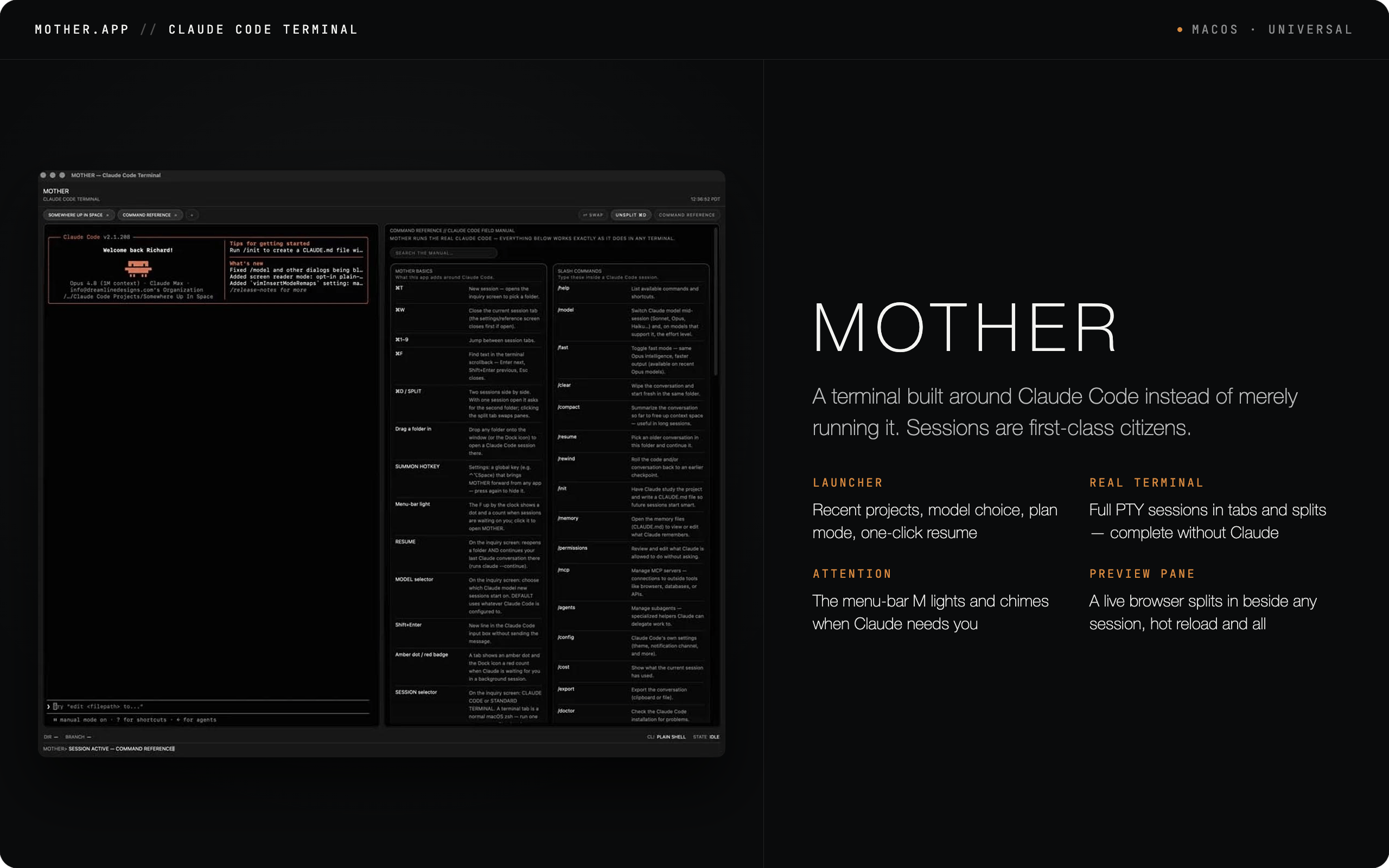
Core Features: Making Claude Code Better to Use
Based on the official introduction, MOTHER has designed several key features around Claude Code's pain points.
One-Click Session Resume
MOTHER's most prominent selling point is "one-click session resume." Developers who have used AI programming tools know that once a long conversation context is interrupted, re-establishing the working environment often requires tedious operations.
To understand the value of this feature, you need to understand the concept of "context" in AI programming. When using an AI programming assistant, context refers to the AI's complete understanding of the current task—including previous conversation content, code files that have been read, modification records, and more. Large language models have physical limitations on their context window (Claude's context window is 200K tokens, roughly equivalent to the information content of a medium-length novel). When a session is interrupted or tokens are exhausted, the AI "forgets" its previous working state. Rebuilding context requires not only reloading relevant files but potentially re-explaining the project architecture and current task objectives.
MOTHER enables users to quickly return to previous Claude Code sessions through native integration, without manually rebuilding context or searching through history. It essentially solves the memory persistence problem of large models at the application layer. For developers who frequently switch between multiple projects, this significantly reduces cognitive load.
Project Launcher
MOTHER includes a built-in project launcher that allows developers to quickly switch between different code projects and launch Claude Code sessions. This feature compresses the multi-step operation of "open terminal → navigate to directory → start Claude" into a more direct entry point, further reducing friction in the workflow. For developers maintaining multiple code repositories simultaneously, this project-level quick switching eliminates the time wasted navigating the file system repeatedly.
Menu-Bar Smart Alerts
Another thoughtful design is the menu-bar alert. When Claude Code needs user intervention—such as waiting for confirmation or input—MOTHER sends a notification through the macOS menu bar. This solves an often-overlooked problem in AI programming: developers tend to get distracted doing other things while waiting for AI to execute tasks, and fail to notice promptly when the task is complete or confirmation is needed.
This scenario is extremely common in practice. When Claude Code performs complex code refactoring or file operations, it may take tens of seconds or even minutes. Developers naturally switch to a browser or other applications, and when Claude completes the task and waits for the next instruction, without a notification mechanism, this "idle time" is simply wasted. MOTHER's proactive alert mechanism makes human-AI collaboration better aligned with actual work rhythms, transforming asynchronous waiting into efficient event-driven interaction.
Positioning Analysis: Market Opportunities for Vertical Tools
MOTHER's emergence is fundamentally a signal that the AI programming tool ecosystem is maturing. When tools like Claude Code reach a certain user scale, third-party tools that optimize the usage experience find room to exist.
You might not have noticed, but MOTHER uses a $9.99 one-time payment pricing model rather than the currently popular subscription model. This pay-once approach is more welcomed by developers for utility applications and lowers the psychological barrier to trying it out. As a product built by independent developer Richard Rogers, this pricing strategy reflects both a lightweight business logic and aligns with market norms for small tool applications.
From a product philosophy perspective, MOTHER's choice of "native macOS" over a cross-platform approach means it can better leverage system-level capabilities (such as menu bar integration) to deliver a more platform-appropriate experience. The background context here is that many desktop applications today are built on the Electron framework—developed by GitHub, Electron essentially packages the Chromium browser engine into an application, enabling web technologies to build cross-platform desktop software. Well-known apps like VS Code, Slack, and Discord are all built on it. However, the tradeoff is higher memory usage (typically starting at several hundred MB) and relatively sluggish responsiveness. Native macOS applications written in Swift or Objective-C can directly call system APIs, offering significant advantages in memory management, animation smoothness, and system-level feature integration (such as Notification Center, menu bar, and Spotlight). For tools like terminals that require high-frequency interaction and low-latency response, the experience advantages of native development are particularly pronounced. MOTHER's choice of a native approach contrasts with many bloated Electron-based terminals and forms part of its competitive differentiation.
Noteworthy AI Programming Industry Trends
Although MOTHER is a niche tool, it reflects several industry developments worth paying attention to.
First, AI programming assistants are spawning dedicated tool chains. In the past, developers could meet their needs with general-purpose terminals. Now, optimized products targeting specific AI tools are emerging, indicating that AI programming has developed sufficiently complex and high-frequency use cases. This is similar to the early mobile internet era—when smartphone user numbers reached a tipping point, vertical applications rapidly emerged. It was no longer about one browser solving all problems, but rather having specialized tools for each high-frequency scenario.
Second, the experience details of human-AI collaboration are receiving attention. Features like session resume and smart alerts may seem minor, but they directly address real pain points in AI programming—context management and attention coordination. Whoever can nail these details can build experience-based moats. This is also why we see more and more products competing not on the AI model's capabilities themselves, but focusing on optimizing the interaction layer of "how humans can use AI more efficiently."
Finally, independent developers can still find opportunities in the AI wave. The "long-tail demands" within the AI tool ecosystem create unique market spaces for indie developers—large companies typically focus on platform-level products and have no bandwidth for optimizing specific tool experiences. This is similar to the early iOS ecosystem, where numerous independent developers found success by building enhancement apps for system functions. In the AI programming space, similar opportunities include: prompt management tools, AI conversation history analyzers, multi-model switchers, and more. MOTHER isn't trying to compete head-on with big companies; rather, it has found a pocket of insufficiently met demand within the Claude Code ecosystem. This reminds us that product innovation in the AI era doesn't always need to be a grand narrative—precisely solving specific problems holds equal value.
Summary
MOTHER is a product with clear objectives: providing Claude Code users with a more ergonomic terminal experience. Through three features—one-click session resume, project launcher, and menu-bar alerts—it addresses several specific pain points in AI programming. The $9.99 one-time pricing and native macOS technical choices both demonstrate a clear understanding of the target user.
For macOS developers who heavily use Claude Code, MOTHER may be an efficiency tool worth trying. For industry observers, it's a microcosm of the AI programming ecosystem reaching maturity—when a tool becomes widespread enough, optimization needs around it will naturally emerge.
Related articles

Apple HomeView Hands-On Review: Is the $300 Smart Home Hub Worth It?
Apple HomeView hands-on: a $300 smart home hub with facial recognition for quick account switching, but no App Store or voice recognition. Is the wall-mounted version worth it? Should you buy the first generation?

Meta Muse Wonder Launch: What It Means for Meta's Return to the Frontier AI Race
Meta releases Muse Wonder and WonderFull, benchmarks reach the frontier, community feedback is polarized. An in-depth look at Meta's return to the frontier AI race, its personal agent strategy, and Zuckerberg's different path.

Apple Home Smart Home Lineup Leaked: LG and Schneider Team Up, UWB Door Lock on Board
Apple Home ecosystem gains new LG and Schneider devices: UWB smart lock with proximity unlock, 2.5K dual-camera doorbell, privacy indoor camera, and AirPods-like seamless pairing.