MotoGP Misano Sprint Race: How Marquez's Tire Strategy Won the Day

Marquez wins Misano sprint by going medium tires and leading from Turn 1 all the way home.
At the MotoGP Misano sprint, Marquez used a medium tire strategy to pass Bezzecchi at Turn 1 and control the race from the front. Bezzecchi's soft rear briefly closed the gap to 0.6 seconds mid-race, but the mediums' durability advantage allowed Marquez to pull away to a 1.1-second winning margin. In the midfield, Fermin dropped from third to eighth amid contact and position battles, while Martin used a classic late-braking move to take third. Around two-thirds of riders collected track limit warnings. Marquez's fastest lap of 1:30.763 was the only sub-1:31 of the race, and the result trimmed the Martin–Marquez championship gap to 14 points.
The MotoGP San Marino Grand Prix sprint race at Misano delivered a compelling battle of strategy and technique. On a circuit defined by a series of tight, low-speed corners linked by short straights, Marc Marquez emerged victorious, with Bezzecchi and Martin taking second and third. This 13-lap sprint packed in multiple storylines around tire selection, launch tactics, and overtaking lines.
Turn One Sets the Tone
The moment the lights went out, the front runners all got off the line cleanly. Starting from second, Marquez went on the attack before even reaching Turn 1, passing Bezzecchi in the braking zone to take the lead. This was no accident — Marquez had opted for medium compound tires front and rear, and his entire plan hinged on opening up a gap from the very first corner and then controlling the race from the front.
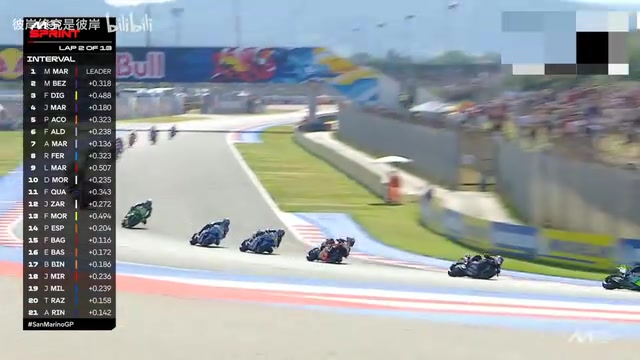
Marquez's relaxed demeanor after qualifying was telling. Despite only lining up second, he was visibly at ease — even cracking a joke in Italian. In hindsight, he knew he had the pace to threaten the lap record; the qualifying result was simply a matter of setup, not raw speed. His confidence in his own race pace was exactly why he went with mediums for the sprint.
The Core Tire Strategy Battle
The most technically fascinating element of this race was the head-to-head between the medium tire strategy of Marquez and Martin versus Bezzecchi's soft rear tire gamble.
Soft tires can deliver peak grip levels close to 100 out of 100 in the opening laps, while mediums top out at around 80. But as the race wears on, softs degrade much faster — by the final five laps, Bezzecchi's soft rear might have had only around 40% of its original peak grip remaining, while the mediums could still offer 60–70%.
Marquez's strategy was to complete his key overtake before Bezzecchi's soft tire even hit its optimal window. By pulling clear at Turn 1 and opening a gap immediately, he neutralized the soft tire advantage before it could be used — a calculation that proved entirely correct as the race unfolded.
MotoGP tires are exclusively supplied by Michelin. Each race weekend, teams select front and rear compound hardness from a defined set of specifications — typically Soft, Medium, and Hard. Soft tires use a more pliable rubber compound that reaches its ideal operating temperature window more quickly, delivering higher peak grip — a clear advantage in qualifying and the early race phase. However, their softer molecular structure means they wear faster, and on high-friction circuits or over longer distances, they can suffer from sudden "drop-off," where grip falls sharply. Medium tires strike a balance between peak grip and durability, making them well-suited to strategies that require consistent pace over a full stint. Even across a short 13-lap sprint, soft tire degradation becomes visible in the final five laps — which is why the timing of overtakes and tire temperature management are just as critical as raw pace. A leader on mediums often needs to establish both a psychological and physical advantage before a soft-shod rival reaches their optimal working window.
Mid-Race: Managing the Gap
Through the middle stint, Marquez steadily extended his lead. His fastest race lap of 1:30.936 was already pushing close to his qualifying time, reinforcing the view that his Saturday result had been held back by the bike setup rather than a lack of pace.
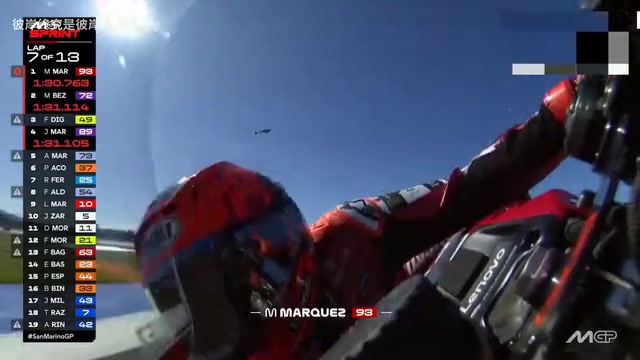
Marquez ultimately became the only rider to lap in the 1:30s, posting a best lap of 1:30.763, while everyone else remained in the 1:31s. It's worth noting that sprint race lap times don't count toward official circuit records — with roughly half the laps of a grand prix, the pace context is different. Bezzecchi's existing circuit record was set during qualifying.
Mid-race, Bezzecchi did use the soft tire's residual grip to close in, trimming time in Sectors 1 and 2 and reducing the gap to 0.592 seconds at its tightest. But Marquez responded in the closing stages, stretching the lead back out to 1.108 seconds — the durability advantage of the medium compound fully asserting itself.
The Midfield Battle and the Art of the Overtake
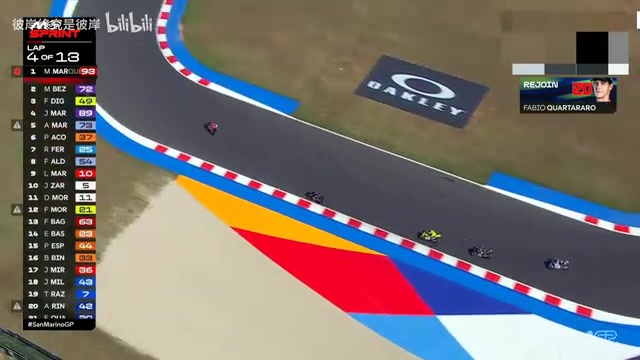
The mid-pack fight was equally intense. Fermin started third but dropped to eighth within just three laps, caught up in a series of position battles. His repeated position swaps and crossed lines with Diggia ("the little shark"), followed by a subsequent contact with Oller, completely destroyed his rhythm.
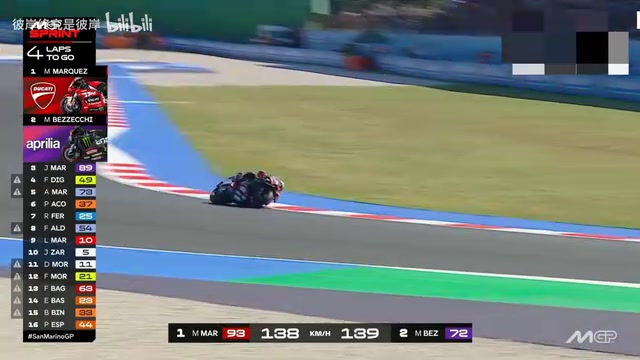
Martin, meanwhile, showcased the classic Misano overtaking technique. His pass on Diggia used the short straight following a series of corners — a hard late-braking move from behind. From 303 km/h to 82 km/h in 5.7 seconds, at a 60-degree lean angle: this kind of aggressive late-braking attack is the most common and effective approach at Misano, precisely because the overtaking windows through the tight, low-speed corners are so narrow that any misjudgment risks contact.
On outright top speed, Binder's KTM RC16 led the field at 301 km/h, reflecting KTM's traditional strength in raw straight-line pace — though its cornering pace through the flowing sections still trails the Ducati.
Misano World Circuit Marco Simoncelli stretches 4.226 km and is named after the late rider Marco Simoncelli. The layout is dominated by a sequence of medium-to-low-speed corners with short, infrequent straights — making it one of the most technically demanding circuits on the MotoGP calendar. With corners tightly packed and overtaking opportunities rare, braking point selection and brake distance control are often the deciding factors in any pass attempt. The most typical overtaking zone is the short straight following the exit of the second sector, where riders can use the corner exit acceleration to close the gap before committing to an extremely late braking point. This "late-braking attack" places extreme demands on rider physicality and trust in the braking system — carbon fiber brake discs can reach hundreds of degrees Celsius during a hard stop from high speed, and riders must precisely sense the bite point to avoid locking up or running wide.
Track Limit Warnings Widespread
Misano's layout makes it easy to exceed track limits, and roughly two-thirds of riders picked up warnings for touching the green run-off areas. Riders receive alerts on their dashboards, and teams reinforce the message via pit boards or signal lights. After his own warning, Fermin visibly adopted a more conservative line — while the top three ran with consistent precision throughout, never touching the green zones. That discipline was a meaningful contributor to their ability to control the race.
Results and Championship Impact
Marquez secured the sprint victory, flashing a thumbs-up as he crossed the line through Turn 16. Bezzecchi finished second, Martin third. In championship terms, with Martin holding third and Marquez winning, the gap between the two closed to 14 points. Beyond the tactical showcase, this sprint race also planted important seeds for the strategy battle in Sunday's main event.
Related articles

M&M's Spent Millions Replacing Artificial Blue Dye — Why Is It So Hard?
Mars spent millions trying to replace artificial blue dye in M&M's with spirulina, but thick material clogs pipes and residue risks mold, forcing a full production-line rebuild. Here's the engineering behind the reformulation.
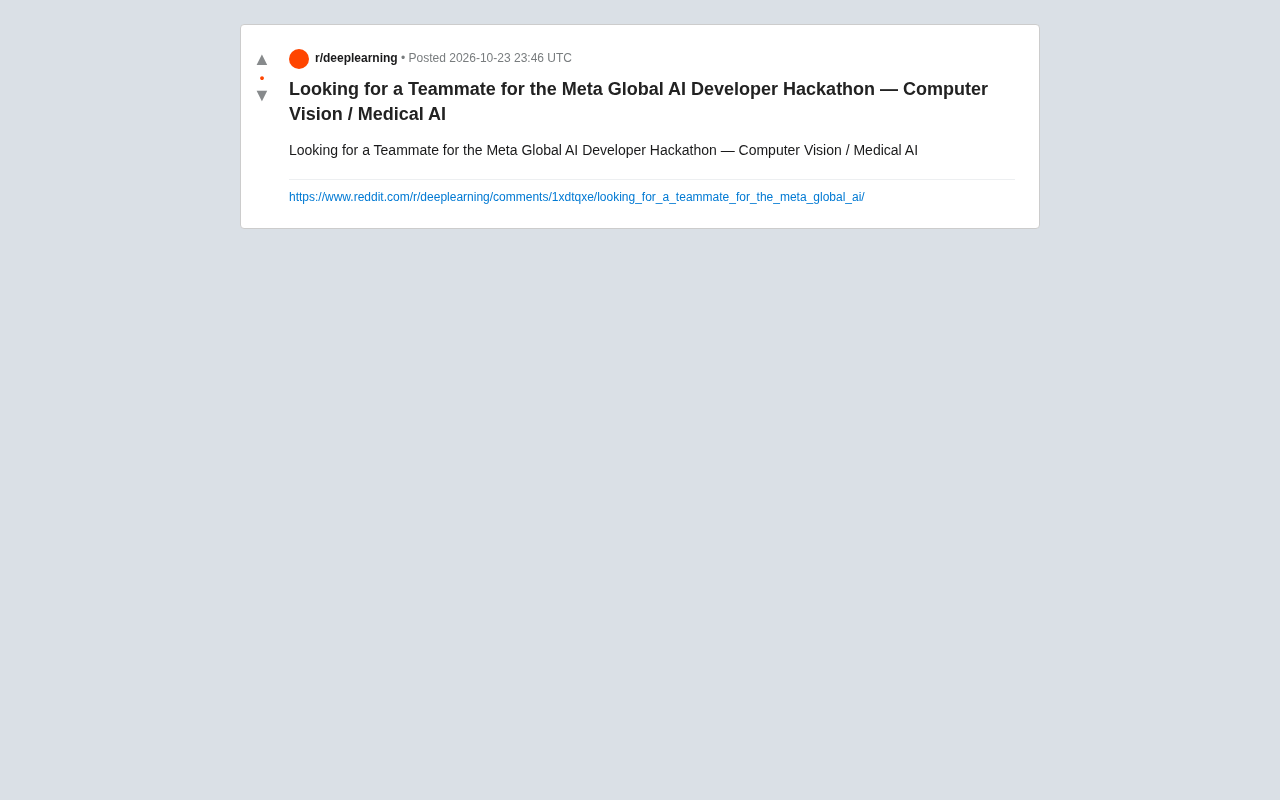
Teammate Wanted for Meta Global AI Developer Hackathon: Computer Vision & Medical AI
A Reddit developer seeks teammates for the Meta Global AI Developer Hackathon, focusing on computer vision and medical AI. This article analyzes the track logic, skills-complementarity needs, and topic selection strategy behind this teaming signal.
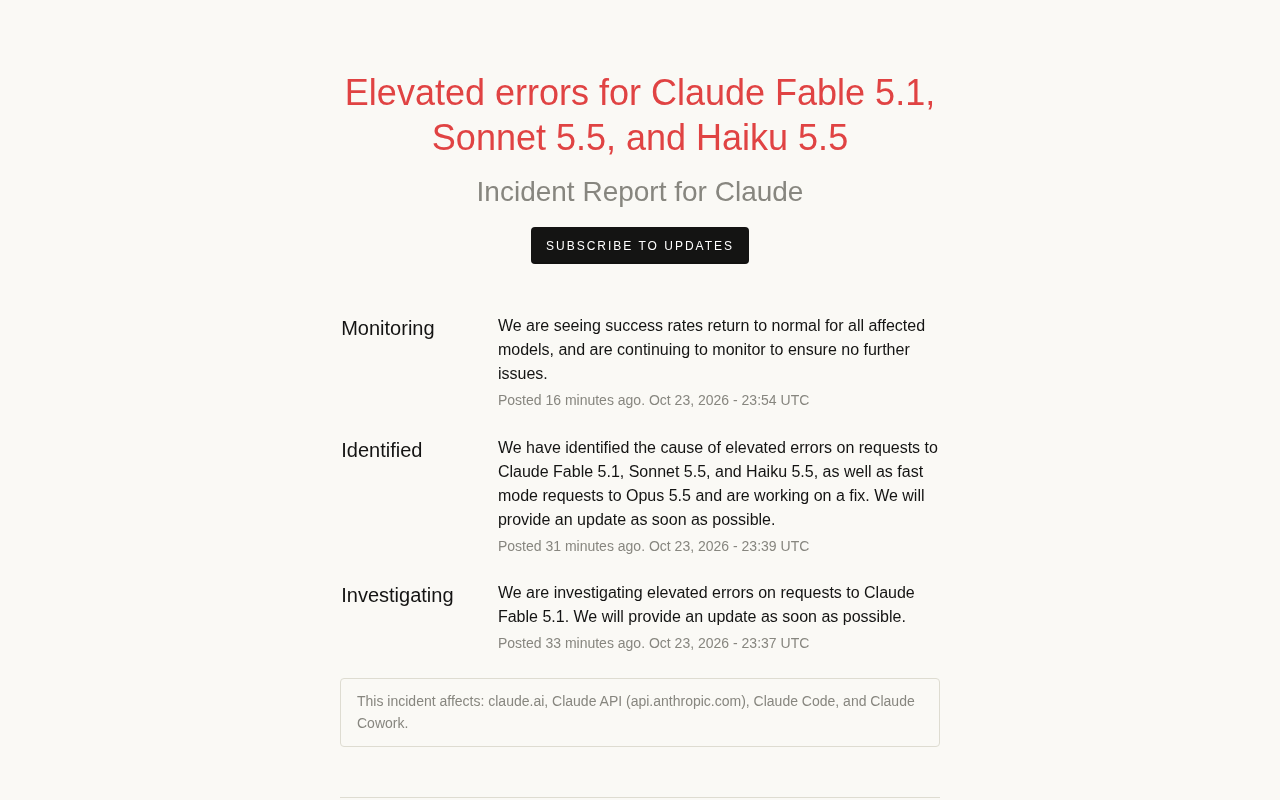
Multiple Claude Models Hit by Errors: A Postmortem of Fable 5.1, Sonnet 5.5, and Haiku 5.5
Claude Fable 5.1, Sonnet 5.5, Haiku 5.5, and Opus 5.5 fast mode saw elevated errors; Anthropic identified and resolved the issue in 17 minutes. This postmortem covers the timeline, the technical reasons for the multi-model cascading failure, and practical lessons for retry and degradation strategies.