Mozilla Launches Tabstack: Real-Time Web Access for AI Models, Privacy-First
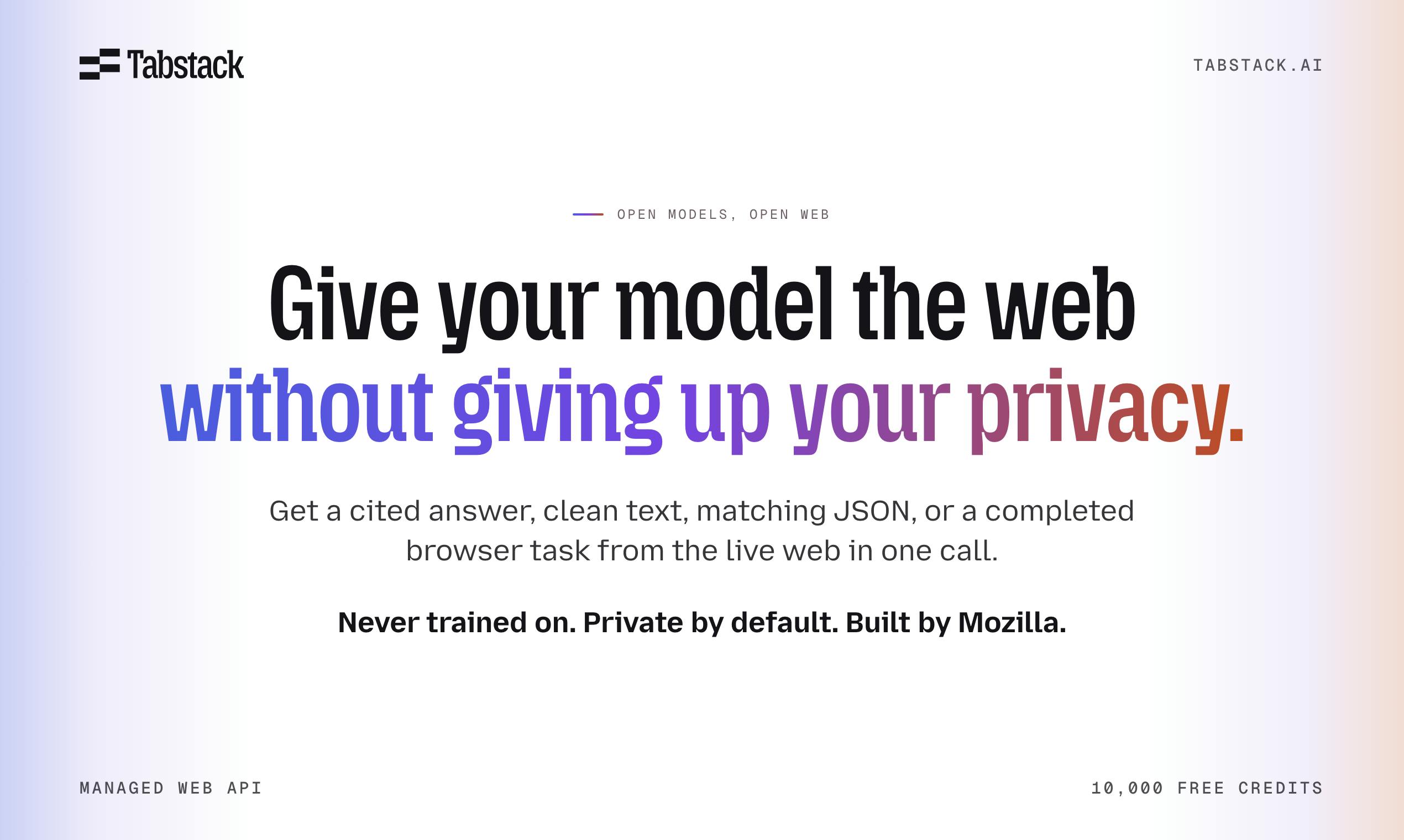
Mozilla launches Tabstack hosted API, completing web research and automation in a single call, emphasizing privacy and no training.
Mozilla has released Tabstack on Product Hunt, a hosted API for AI Agent developers that completes web research, content extraction, and browser task automation in a single call, outputting cited answers, clean text, structured JSON, or completed browser tasks. Its core selling point is privacy: data not used for training, private by default, backed by the Mozilla brand. The product offers 10,000 free credits to lower the evaluation barrier. Tabstack runs browsers and web loops outside the model, freeing developers from building their own web stack, but also introduces dependence on third-party service quality and stability. Whether to integrate depends on the Agent's reliance on real-time web data and acceptance of hosted services.
Mozilla has launched a new product called Tabstack on Product Hunt, positioned as "hand the web to your model without sacrificing privacy." It is essentially a hosted API that lets developers complete web research, content extraction, and browser task automation in a single call. For teams building AI Agents, Tabstack aims to solve the infrastructure layer problem of "the entire web stack beyond the model."
What Is Tabstack: Web Tasks in a Single Call
According to the Product Hunt page, Tabstack offers "a hosted API to research, extract, and automate tasks from the live web." Specific output formats include: answers with citations, clean text, matching JSON, or a completed browser task. In other words, developers don't need to build their own browser clusters, scraping pipelines, and web parsing logic—they simply call Tabstack's interface and let the model "get" web content.
This positioning hits a pain point for many AI applications. When building Agents, web scraping, anti-bot handling, page rendering, and content cleaning are often repetitive work with high maintenance costs. Tabstack takes this layer under its own operation—"we run the browsers and web loops outside your model, so you don't have to build your agent's web stack while building your agent."
On Product Hunt, the product received 114 votes, ranking 5th, with 4 comments.
AI Agent is a core concept in current AI applications, referring to AI systems that can autonomously perceive their environment, plan steps, and invoke tools (such as search, browsers, code execution) to complete complex tasks. Unlike traditional one-shot Q&A, Agents typically require multi-step reasoning and acquire external information at each step. Web access is one of the most common tools for Agents, but dynamic rendering of web content, anti-bot mechanisms, and noise cleaning make this step technically demanding. What Tabstack solves is precisely the infrastructure problem at the "web information retrieval" tool layer for Agents, allowing developers to focus on the Agent's decision logic rather than the web scraping pipeline.
Privacy-First: Data Not Used for Training
Tabstack's most notable differentiator is privacy. The official promise is "Never trained on. Private by default. Built by Mozilla."—meaning user data is not used for model training and is private by default. Given Mozilla's long-standing stance on privacy issues, this commitment carries a certain brand endorsement.
For enterprise AI applications, whether data is used by third parties for training is a sensitive factor in procurement decisions. Tabstack puts "never trained on" as a core promise on its homepage, clearly intending to attract developers with strict requirements on data flows.
"Data not used for training" is an important privacy commitment in AI services. Many cloud APIs reserve the right in their terms of service to use customer data to improve models, which for enterprise customers may mean the risk of sensitive information leakage. Tabstack explicitly states that user data will not be used for model training and is private by default, consistent with Mozilla's consistent privacy-first stance. However, the actual scope of this commitment (whether it covers logs, temporary caches, debugging data, etc.) and data retention periods typically require consulting the privacy policy or terms of service to confirm, and developers should carefully evaluate before integrating.
Pricing and Getting Started: Free Tier to Start
Tabstack offers a free starting quota: 10,000 credits. Developers can first use the free quota to validate call results before deciding whether to expand usage. This "try before you pay" model is relatively common in developer tools and helps lower the evaluation barrier.
The page also includes a link to the official website, where developers can further learn about API details and integration methods.
Credits are a common metering unit in API services, typically tied to call counts, computing resources, or data volume. Tabstack's 10,000 free credits allow developers to test various API features (such as web extraction, browser tasks, etc.) without paying, and to estimate production costs. Different API calls may consume different amounts of credits, and the specific conversion relationship should be referenced in the official pricing documentation. This model lowers the early evaluation barrier but also requires developers to reasonably estimate usage before formal integration.
What It Means for Developers
Tabstack's positioning is to turn "model access to the web" from self-built infrastructure into an on-demand service. For small teams, this means less manpower and operational investment to give Agents real-time internet capabilities; for large teams, they can outsource the non-core business of web scraping and focus on models and business logic.
However, such hosted APIs also introduce new dependency issues: the quality of web rendering and extraction, compatibility with target sites, and service stability all directly affect Agent performance. While privacy commitments are important, the actual implementation details (such as data retention policies and log handling) still need further verification by developers during use.
Overall, Tabstack, produced by Mozilla, has clear differentiation in privacy positioning and one-stop web capabilities. Whether it's worth integrating depends on how much your Agent relies on real-time web data and your acceptance of third-party hosted services.
One-line Summary
Mozilla launches Tabstack hosted API, completing web research and automation in a single call, emphasizing privacy and no training.
Paragraph Summary
Mozilla has released Tabstack on Product Hunt, a hosted API for AI Agent developers that completes web research, content extraction, and browser task automation in a single call, outputting answers with citations, clean text, structured JSON, or completed browser tasks. Its core selling point is privacy: data is not used for training, private by default, with Mozilla brand endorsement. The product offers 10,000 free credits to start, lowering the evaluation barrier. Tabstack runs browsers and web loops outside the model, freeing developers from building their own web stack, but also introduces dependence on third-party service quality and stability. Whether to integrate depends on the Agent's reliance on real-time web data and acceptance of hosted services.
Related articles

Gemini 4 Dual Models Exposed, Genie 4 World Model Launches, AI R&D Self-Accelerates
November 19 AI evening news roundup: DeepMind Gemini 4 Sodium rumors surface, Cursor launches Gemini 4 Neon scoring 63.7% on CursorBench 4.1; Genie 4 world model goes live with real-time editing and native audio; WorkBuddy integrates GPT-6.2 series; OpenAI discloses AI chip design efficiency gains and RSI research metrics.
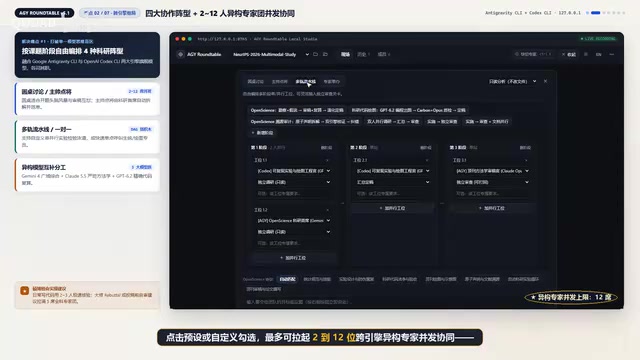
HY Roundtable: A Local Open-Source Multi-Agent Roundtable Where Multiple LLMs Blind-Review and Challenge Each Other's Papers
HY Roundtable is a local open-source multi-agent roundtable tool that brings Gemini 4, Claude Opus 5.5, and GPT 6.2 into a local seminar room to blind-review, cross-examine, and recompute code before submission, with built-in Open Science protocols for statistics and figures.
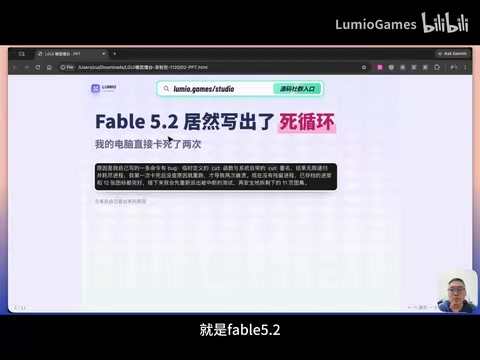
GPT 6.2, Fable 5.2, Gemini 4 Tested: Which Builds the Best Game UI from a Single Image?
Bilibili creator tests GPT 6.2, Fable 5.2, and Gemini 4 generating full game UI from one image: all work functionally, but fidelity and interaction quality differ sharply. Fable 5.2 looks best but caused infinite-loop crashes; GPT 6.2 is balanced but drifts from icons; Gemini 4 looks cheap. Includes LGUI Agent workflow and engine export details.