Multi-Agent Apps Hit 429 Rate Limits: A Multi-Provider Failover Deep Dive

How a multi-provider fallback chain and state decoupling keep free-tier LLM multi-agent apps from crashing on 429s.
A developer building a three-agent debate system with LangGraph discovered the real engineering challenge wasn't agent interaction logic — it was 429 rate limits from free-tier LLM APIs. Because multi-agent systems fire far more requests than single Q&A calls, Groq, Gemini, and OpenRouter free tiers get hit constantly, crashing debates mid-run. The solution: a multi-provider fallback chain that auto-switches on rate limits, combined with full decoupling of debate state from provider logic so the execution backend is swappable without breaking conversation context. The case illustrates a universal truth in agent development: reliability must come before features, and redundancy plus decoupling are essential survival strategies when depending on free tiers.
The Real Problem Isn't Agent Logic
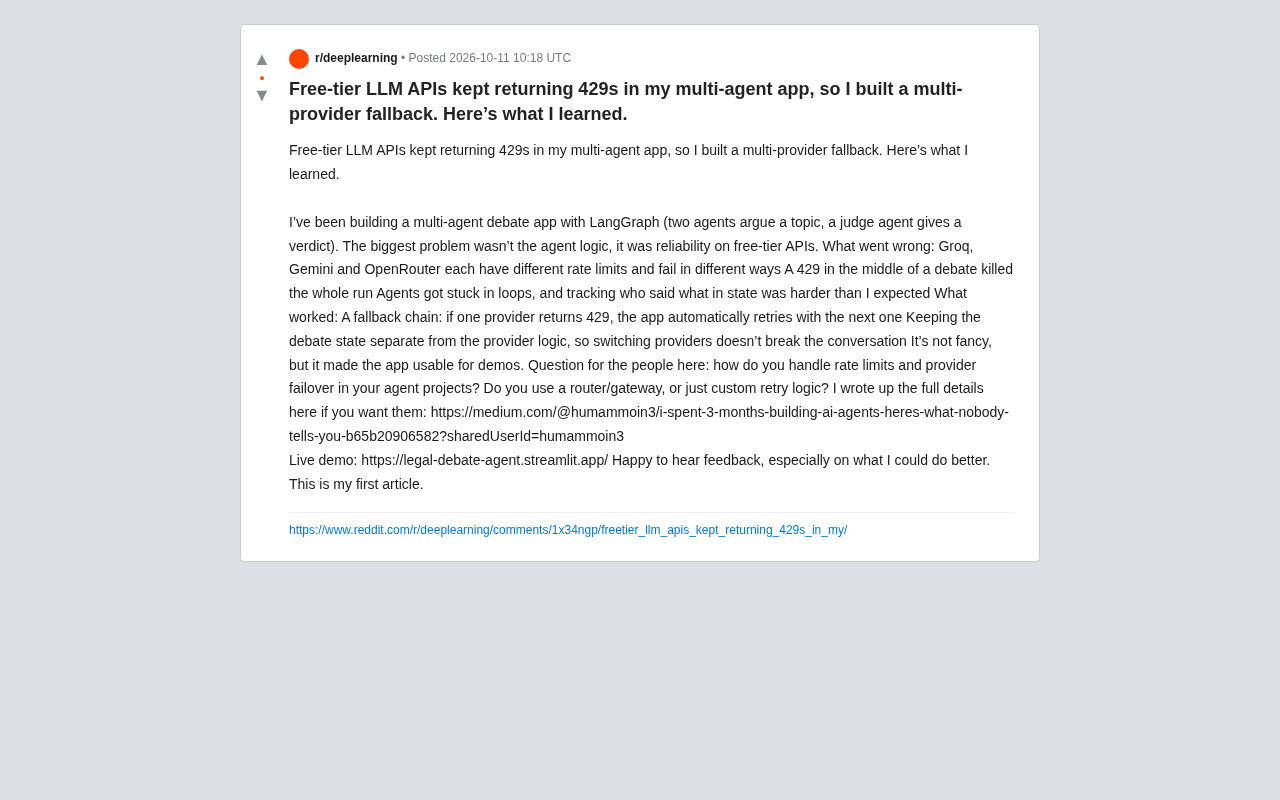
A developer shared on Reddit their experience building a multi-agent debate application with LangGraph: two agents argue opposing sides of a topic, while a third judge agent delivers the final verdict. It sounds like a fun architecture experiment — but the real obstacle wasn't the inter-agent interaction logic. It was the reliability of free-tier LLM APIs.
Specifically, Groq, Gemini, and OpenRouter each enforce different rate limits on their free tiers, and they fail in different ways when those limits are hit. The moment one provider returns a 429 Too Many Requests mid-debate, the entire pipeline crashes. For a multi-agent system that depends on sustained, sequential API calls, this kind of interruption is fatal.
How 429 Errors Derail an Entire Multi-Agent Flow
The key difference between a multi-agent application and a simple Q&A interaction is call density. A debate requires two agents to take turns repeatedly, plus intervention from the judge agent — meaning a high volume of LLM requests fired off in a short window. Free-tier API quotas are already tight, and this call pattern almost inevitably collides with rate limit ceilings.
The author highlighted several common pain points:
- Rate limit thresholds and error response formats vary across providers, making it hard to handle them with unified logic
- A 429 mid-debate means the entire session is wasted
- Agents are prone to getting stuck in loops, and tracking "who said what" in the state turns out to be trickier than expected
That last point deserves special attention — state management complexity is frequently underestimated. As conversation turns accumulate, clearly attributing each agent's contribution directly affects whether the judge agent can make a sound ruling.
Designing a Multi-Provider Failover Chain
The author's solution isn't complicated, but it nails the essentials: build a fallback chain. The core logic is simple — when a provider returns 429, the application automatically switches to the next provider and retries, rather than crashing out.
The value of this design is turning a "single point of dependency" into "multi-point redundancy." No single free-tier provider can guarantee availability, but the odds of all three being rate-limited simultaneously are much lower. Through round-robin graceful degradation, the application's overall availability improves significantly.
Decoupling State from Provider Logic Is the Key
The second lesson is even more valuable from an engineering standpoint: fully separate debate state from provider logic. The author emphasizes that this ensures switching providers doesn't corrupt an ongoing conversation.
In other words, regardless of whether the underlying backend is Groq or Gemini, the debate state machine above it should be completely unaware of that detail. The provider is just a swappable "execution backend," while conversation context, turn counts, and utterance history are all maintained independently. This separation of concerns is what keeps the system stable even as providers are switched frequently.
The author admits the solution is "nothing fancy," but it made the app demo-ready. For indie developers and prototype validation, this kind of pragmatic trade-off is exactly the right call.
Fallback chains typically take two basic forms: sequential degradation and random round-robin. Sequential degradation tries providers in a fixed priority order — for example, Groq first, then Gemini, then OpenRouter. Random round-robin selects randomly among available providers to avoid consistently overloading whichever sits at the top of the list. In a LangGraph context, this logic is usually encapsulated outside the node's call layer — the node is only responsible for constructing prompts and parsing responses, while retries and switching are handled by an external decorator or utility function. It's worth noting that 429 response formats differ significantly across providers: some return a Retry-After header specifying how long to wait, while others return only a generic error body. Building a robust fallback chain often requires modeling each provider's rate-limiting behavior individually, rather than assuming they all follow the same spec.
Community Discussion: Router Gateways vs. Custom Retry Logic?
At the end of the post, the author raises a highly representative question: how do others handle rate limiting and provider failover in their agent projects? Do they use a dedicated router/gateway, or roll their own retry logic?
This touches on a core architectural choice in modern LLM application engineering:
- Custom retry logic: Flexible, no extra dependencies, well-suited for small projects and rapid prototyping — but requires maintaining provider-specific handling for every quirk
- Router/Gateway approach: Tools like LiteLLM and OpenRouter abstract multiple providers into a unified interface, with built-in load balancing and failover, reducing the need to reinvent the wheel
For a project just getting started, the author's custom fallback chain is a reasonable choice — low cost, full control. But as the number of providers grows and call volume scales up, the maintainability advantages of a gateway solution become increasingly apparent.
LiteLLM is the most frequently cited open-source LLM unified gateway. It abstracts 100+ LLM interfaces into a single OpenAI-compatible API, with built-in retry, timeout, fallback, and load balancing logic. Developers only need to change the model parameter string (e.g., from "groq/llama3" to "gemini/gemini-pro") without modifying any calling code. For multi-provider scenarios, LiteLLM supports configuring fallback lists that automatically switch providers in order when a primary provider returns 429 or 5xx, and can set per-provider requests-per-minute (rpm) limits to proactively avoid hitting rate limits rather than reactively handling errors. Compared to custom retry logic, the gateway approach does introduce an extra dependency layer and potential debugging complexity — but once you're juggling more than two or three providers, the balance of maintenance cost typically tips toward the gateway.
Key Takeaways for Agent Developers
This case study is small in scale but densely packed with the typical challenges of shipping multi-agent applications in the real world. Here are a few transferable lessons:
Reliability before features. No matter how elegant the agent logic is, if the underlying API crashes on every rate limit, the application can't be delivered. Failure handling should be treated as a first-class citizen from the design stage.
Redundancy is the survival rule on free tiers. Depending on a single free provider is essentially handing your availability over to luck. Multi-provider degradation is a low-cost, high-impact way to improve stability.
Decoupling makes systems more resilient. Separating the volatile provider layer from the stable business state layer not only solves the immediate switching problem — it also leaves room to swap out models or migrate to paid tiers in the future.
The author has a live demo available at legal-debate-agent.streamlit.app, which is a useful lightweight reference for developers curious about multi-agent debate architectures. And the question they raised — "router or custom retry?" — remains an open conversation the broader agent development community is still actively working through.
Related articles

The Chaotic Aesthetics of Apple's HomeView Ad: A Marketing Code Only Parents Can Read
Apple's HomeView smart display ad ditches minimalist style for chaotic family mornings to win over parents. We analyze why it confuses most viewers but resonates instantly with families — and the trade-offs and risks of Apple's targeted marketing.

Cerebras CEO Pushes Back on AI Doomerism: Stop Spreading Panic
Cerebras CEO Andrew Feldman publicly pushes back on AI doomerism at TechCrunch Disrupt, arguing excessive risk focus drowns out AI's real opportunities.

Retooling in Minutes: Industrial Next Redefines Factory Robot Flexibility
Industrial Next aims to let factory robots retool in minutes instead of weeks, automating complex delicate tasks and advancing flexible manufacturing and small-batch production.