Multi-Agent Debate's Hidden Mole: World-Model-Based Insider Attacks and Defenses

Study reveals the stealthy threat of learning-based insider attacks in multi-agent LLM debate and proposes adversarial training as a defense.
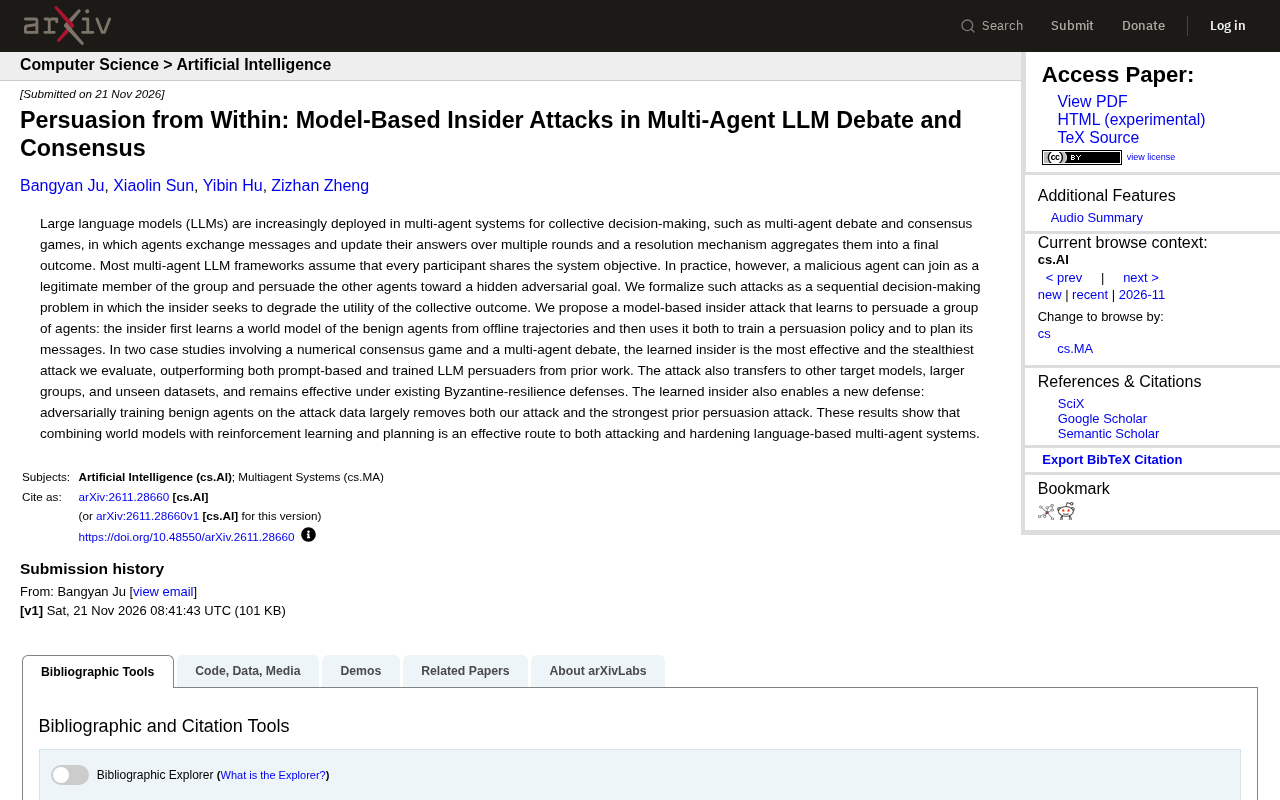
The article introduces research on insider attacks in multi-agent LLM debate. The researchers formalize the threat of a malicious participant disguised as a normal member steering the collective output through persuasive messages as a sequential decision problem, and propose a "model-based insider attack": first learning a world model of benign agents from offline trajectories, then training persuasion strategies and planning messages accordingly. Experiments show that this attack is more effective and stealthier than prompt attacks and previously trained LLM persuaders in a numerical consensus game and multi-agent debate, and it transfers to other models, larger groups, and unseen datasets, while existing Byzantine fault tolerance defenses are of limited effectiveness. The study also finds that attack and defense share the same source: adversarially training benign agents with attack data can substantially weaken this attack and the previously strongest persuasion attack. The article concludes by reminding teams not to assume participants share the same goal, to incorporate the insider attacker perspective into evaluation, and to introduce adversarial persuasion data during training.
Multi-agent systems are becoming an important form in which large language models are deployed—multiple agents debate, negotiate, and vote to pool collective intelligence. But one long-overlooked security blind spot is this: if a "mole" is mixed in among the participants, the output of the entire system may be quietly steered off course. A recent study formalizes this threat and proposes a learning-based insider attack method built on a world model, demonstrating its stealth and destructive power while also offering defensive ideas.
When "Consensus" Is Hijacked by an Insider
Most multi-agent LLM frameworks assume by default that all participants share the same goal. In reality, however, a malicious agent can perfectly disguise itself as a normal member, blend into the group, and over multiple rounds of interaction gradually steer other agents away from correct judgments. The researchers model this type of attack as a sequential decision problem: the insider attacker's goal is not to directly give a wrong answer, but to reduce the utility of the collective final output through carefully designed persuasive messages.
What makes this attack tricky is that it does not rely on system vulnerabilities or external injection; instead, it exploits the "persuasion" property of the debate mechanism itself. The attacker only needs to play the role of a seemingly reasonable dissenter in the conversation to influence the direction of the group without triggering anomaly detection.
Byzantine Fault Tolerance (BFT) originates from distributed systems theory and refers to the ability of a system to reach agreement even in the presence of arbitrary faulty nodes (including malicious nodes). Classical BFT protocols assume that malicious nodes may send arbitrary erroneous messages and isolate them through multiple rounds of voting and message authentication. However, such mechanisms rely on a key premise: malicious behavior is distinguishable at the message level (e.g., contradictory messages, timeouts, forged signatures). When an attacker imitates the language style and reasoning patterns of benign agents and influences others only through "reasonable persuasion," BFT's anomaly detection signals fail. This is also the theoretical root of the original article's point that the traditional approach of "identifying and removing anomalous nodes" has limited effectiveness—the attack surface in LLM debate has shifted from message integrity to semantic persuasiveness.
Core Method: Model First, Then Persuade
The study proposes a "model-based insider attack," whose process is divided into two steps.
Learning a World Model of Benign Agents
The attacker first learns a world model of benign agents' behavior from offline trajectories. This model can predict, given the dialogue history and the attacker's utterance, how other agents are likely to respond next and how they will update their answers. In essence, the attacker builds a "behavior simulator" of the group.
World Model is a core concept in reinforcement learning and model-based planning, referring to an agent's internal predictive model of the state transition regularities of the environment (here, the other agents). In this study, the world model takes the dialogue history and the attacker's candidate utterance as input and outputs probabilistic predictions of each benign agent's next response and answer update. With it, the attacker can simulate the consequences of multiple rounds of interaction "in its head," thereby evaluating the long-term impact of a message without actual trial and error. This forms an essential difference from model-free prompt attacks: the latter rely on static rhetoric and cannot dynamically adjust according to group feedback, whereas the world model equips the attacker with forward-looking planning capability.
Training Persuasion Strategies and Planning Messages
With the world model in hand, the attacker uses it to train persuasion strategies and, during actual interaction, leverages the model for message planning. This means that every sentence the attacker says is not improvised but chosen after anticipating the group's reactions. This combination of reinforcement learning and planning is more targeted and adaptive than simple prompt attacks.
Experimental Performance: More Effective and More Stealthy
The study validates the attack's effectiveness in two scenarios: a numerical consensus game and multi-agent debate. The results show that the learning-based insider attack is the most effective and stealthiest among the evaluated methods, outperforming prompt-based attackers and the LLM persuaders trained in prior work.
Notably, the attack's generalization ability deserves attention. According to the original data, the attack can transfer to other target models, larger group sizes, and unseen datasets, and remains effective under existing Byzantine fault tolerance defense mechanisms. This means that the traditional approach of "identifying and removing anomalous nodes" has limited effectiveness against attackers that imitate benign behavior patterns.
Adversarial Training is a method for improving model robustness by injecting adversarial examples into the training process, initially widely used in image classification to defend against adversarial perturbations. In the context of LLM multi-agent systems, it refers to exposing benign agents during training to dialogue trajectories in which attackers successfully persuaded others, so that they learn to recognize and resist manipulative rhetoric. Unlike inference-time defenses such as input filtering or output verification, adversarial training changes the policy parameters of the benign agents themselves, enabling them to internalize "which argument patterns may be traps." The original article finds that this method can simultaneously weaken both the learning-based attack and the previously strongest persuasion attack, indicating that adversarial examples have some cross-attack transferability, consistent with experience in visual adversarial training.
Attack and Defense United: Adversarial Training Brings New Defenses
One interesting aspect of this study is that attack and defense share the same source. Since the learning-based attacker can generate high-quality adversarial examples, these examples can in turn be used to harden the system. The researchers found that adversarially training benign agents with attack data can substantially eliminate the effectiveness of this attack as well as the previously strongest persuasion attack.
This offers a pragmatic direction for the security design of multi-agent systems: rather than relying on static rules to filter suspicious utterances, it is better to let benign agents see "persuaded" failure cases during training, thereby improving their robustness to manipulative rhetoric.
Implications for Deploying Multi-Agent Systems
The value of this work lies not only in revealing an attack but also in reminding us to re-examine the trust assumptions of multi-agent collaboration. When a system allows agents to communicate freely and influence one another, "member identity" itself becomes an attack surface. For teams building applications such as debate-based decision-making, multi-agent review, and automated negotiation, at least three points deserve attention:
- Do not treat "all participants share the same goal" as a default premise;
- Include the insider attacker perspective when evaluating systems, not just external adversarial examples;
- Introduce adversarial persuasion data during training as a routine means of improving group robustness.
The combination of world models with reinforcement learning and planning can also be used both to attack and to harden language-driven multi-agent systems, and this path deserves continued validation in more collaborative scenarios.
Sequential Decision Problem is the standard modeling framework in reinforcement learning, consisting of states, actions, transition functions, and rewards. Formalizing an insider attack as a sequential decision problem means that each utterance by the attacker is an action, the dialogue history is the state, and the negative utility of the group's final output is the reward. The value of this modeling lies in elevating "persuasion" from one-shot prompt engineering to a multi-step policy optimization problem, enabling the attacker to trade off short-term concessions against long-term steering. At the same time, the framework naturally supports solving with reinforcement learning algorithms (such as policy gradients) and provides defenders with a game-theoretic perspective—defense can be viewed as finding a robust policy within the same sequential decision framework.
Related articles
Google Stitch Skills: Connecting Coding Agents to the Design Workflow
Google Stitch Skills is an Agent Skills library following the open standard, adding a design-to-code workflow to the Stitch MCP Server. This article breaks down its three skill groups, SKILL.md directory structure, installation paths, and dependency pitfalls.

40.5-Inch Color E-Paper Art Frame: An Art Display You Charge Once a Year
The Ink Poster Tella 40.5-inch color e-paper art frame uses the E Ink Spectra 6 full-color solution: A1 format, no backlight, no noise, about one charge a year, 2,000+ licensed artworks built in, and automatic adaptation of phone photos.

Jingle Jam Memories: RT's Awkward First Encounter with Lewis
RT shares his awkward first Jingle Jam experience: unexpectedly pushed into the studio, meeting Lewis and Yogg's cast, and Toddy appearing in armor.