Multi-AI Agent Desktop Collaboration Experiment: Bangstick Lets AI Characters Divide and Cooperate

Developer showcases Bangstick: multiple AI agents divide and cooperate as desktop characters and directly operate applications.
A developer shared on Reddit his experiment with Bangstick, an AI-first desktop environment where multiple AI agents exist as desktop characters with distinct roles, communicating, dividing tasks, and interacting directly with applications. It supports backends like ChatGPT, Codex, Claude Code, and local LLM, with coordination mechanisms still being refined.
Multi-agent collaboration is moving from pure text conversations into the desktop environment. A developer shared on Reddit his experiment within Bangstick, a self-built AI-first desktop environment: multiple AI agents exist as desktop characters, each taking on different roles, able to communicate with one another, divide work and cooperate, and interact directly with desktop applications.
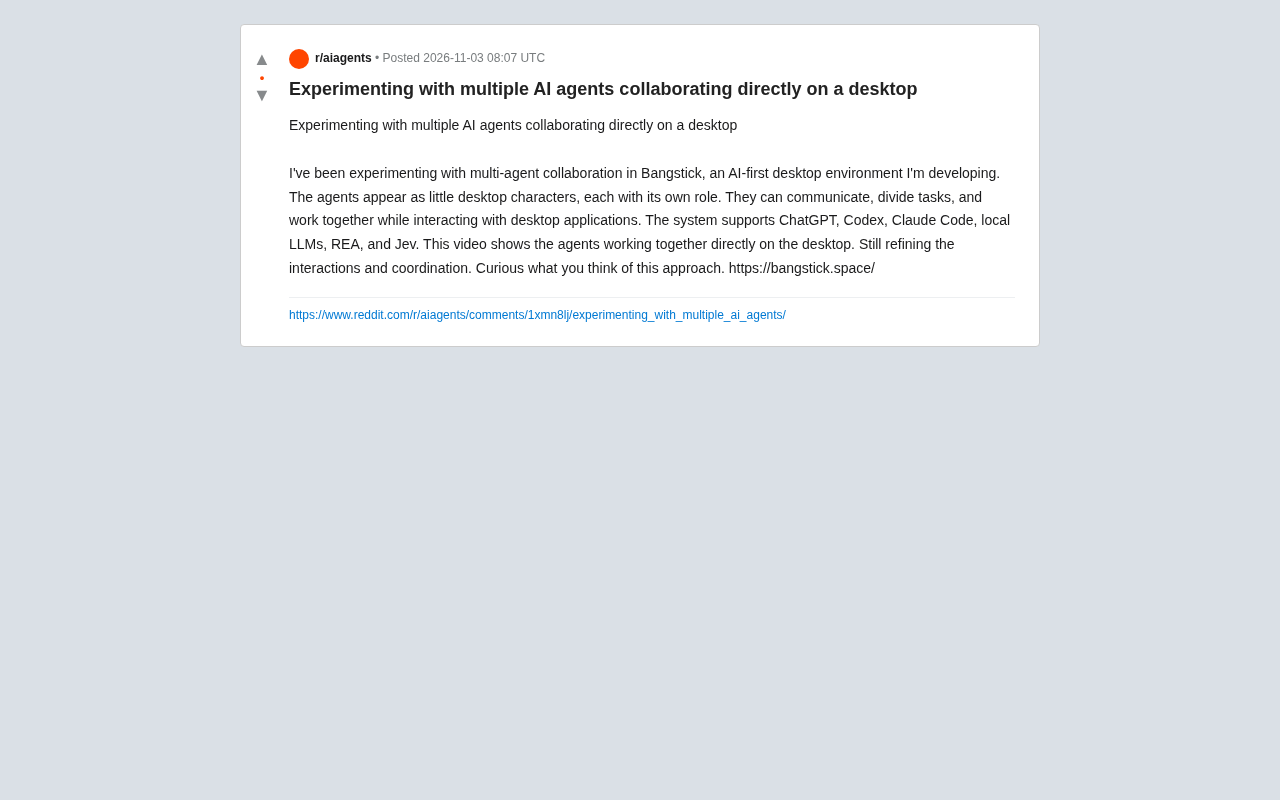
Bangstick: an AI-first desktop environment
Bangstick is an AI-first desktop environment under development, whose core design philosophy is to make AI agents first-class citizens of the desktop. Unlike the usual chat window, these agents are presented as small characters on the desktop, each with a clearly defined responsibility. This visual design lets users intuitively see each agent's status and task allocation.
The developer says the system currently supports multiple AI backends, including ChatGPT, Codex, Claude Code, local LLM, REA, and Jev. This means users can flexibly choose models based on task requirements—for example, using Claude Code for coding tasks, a local LLM for privacy-sensitive operations, or ChatGPT for general conversation.
How the agents collaborate
In the demo video, multiple agents work together directly on the desktop. They can communicate with each other, break complex tasks into subtasks and assign them to the appropriate roles, then each invoke desktop applications to complete the work. This collaboration model is fundamentally different from traditional single-agent conversation: agents are no longer isolated question-answering machines but collaborative units with environmental awareness and the ability to act.
The developer notes that the system is still being refined in terms of interaction and coordination mechanisms. The difficulty of multi-agent collaboration lies in task allocation, conflict resolution, and state synchronization—especially in an open-ended desktop environment, where agents need to understand screen content, operate windows, and share context with other agents.
Multi-Agent System is a classic concept in distributed artificial intelligence, referring to multiple agents with autonomous decision-making capabilities that complete tasks beyond the reach of a single agent through communication and coordination. In the LLM era, this paradigm has been reactivated: agents are driven by large models and possess natural language understanding, tool calling, and planning capabilities. Common collaboration architectures include centralized scheduling (one coordinator assigns tasks) and decentralized negotiation (equal communication among agents). Bangstick's approach is closer to the former—role-based division of labor plus direct execution in the desktop environment—sharing ideas with frameworks like AutoGen and CrewAI, but extending the scope from API calls to the graphical desktop.
The significance of multi-model support
Bangstick's support for multiple AI backends is a design worth noting. Different models have their own strengths and weaknesses in reasoning ability, code generation, and local deployment cost. Bringing multiple models into a single collaboration framework allows agents to dynamically choose a backend based on task type, and also gives users the possibility of avoiding vendor lock-in. The inclusion of a local LLM is especially suited to scenarios with data privacy requirements.
Model Routing refers to the mechanism of dispatching requests to different models, or different variants of the same model, based on task characteristics. Since models differ significantly in latency, cost, and capability, always using the largest model wastes resources, while always using a small model makes complex reasoning hard to handle. Routing strategies can be rule-based (e.g., coding tasks always go to Codex), classifier-prediction-based, or dynamically adjusted based on a cost budget. Bangstick's support for multiple backends essentially provides the infrastructure for routing; but who makes the routing decision—the user manually specifying, a coordinating agent deciding automatically, or heuristic rules—directly affects the system's reliability and overhead. This is a key design question that multi-model collaboration environments need to answer.
Challenges and prospects of this direction
Multi-agent desktop collaboration is still at an early experimental stage. From the demo, the role-based agents and direct desktop operation are highlights, but the maturity of the coordination mechanism, the reliability of task allocation, and the overhead of switching between multiple models still need verification. The developer is openly soliciting feedback, indicating the project is still iterating.
This attempt reflects a trend in AI applications: evolving from a single conversational interface toward agent systems with environmental interaction capabilities. If the coordination problem is solved, multi-agent desktop environments could become a new form of personal productivity tool.
Computer-Using Agent refers to an agent that interacts with graphical interfaces by visually recognizing screen content and simulating mouse and keyboard operations, as distinct from tool calling that relies on APIs. Its technical difficulties lie in locating interface elements, verifying operation results, and error recovery, because the desktop environment has an open state and application behavior is unpredictable. When multiple such agents coexist, the consistency of shared screen state must also be addressed—a window opened by one agent may interfere with another agent's perception. This is an engineering challenge of a different order of magnitude from a single agent operating the desktop, and it is also why current demos mostly stay on short-flow tasks.
One-line Summary
Developer showcases Bangstick: multiple AI agents divide and cooperate as desktop characters and directly operate applications.
Paragraph Summary
A developer shared on Reddit his experiment with Bangstick, a self-built AI-first desktop environment: multiple AI agents exist as small desktop characters, each with clearly defined responsibilities, able to communicate with one another, break down tasks, and interact directly with desktop applications. The system supports multiple backends including ChatGPT, Codex, Claude Code, local LLM, REA, and Jev, letting users flexibly choose models by task type, with the local LLM accommodating privacy-sensitive scenarios. The article notes that the real difficulty of multi-agent collaboration lies in task allocation, conflict resolution, and state synchronization—especially tricky in an open-ended desktop environment. The coordination mechanism is still being refined, and the developer is openly soliciting feedback. This attempt reflects the trend of AI applications evolving from a single conversational interface toward agent systems with environmental interaction capabilities.
Related articles

9 AI Subscription Plans Compared: The Real Cost Per 100M Tokens Revealed
Bilibili creator tests 9 AI subscription plans from Volcano, Alibaba, Tencent, Baidu, Zhipu, Xiaomi, MiniMax and more, converting them all to real cost per 100M tokens, breaking down fixed-quota vs. three-tier coefficient billing and how caching, time-of-day discounts, and window limits affect actual quota.
Vibe Coding for Beginners: Expressing Intent Instead of Handwriting Code
What is Vibe Coding? A 137-episode Bilibili course defines it: the core is expressing intent, not writing code. This article analyzes Vibe Coding's productivity logic, target audience, and entry expectations to help beginners decide if it's worth learning.

LangChain Beginner's Guide: An Agent Development Roadmap from LangGraph to Deep Agents
Clarify the encapsulation relationship among LangChain, LangGraph, and Deep Agents, and master the learning path and selection logic for agent development frameworks—suitable for beginners in large model development.