Multimodal Foundation Model Achieves New Breakthrough in Plasma State Reconstruction

A 5.5M-parameter U-Net achieves cross-modal sparse reconstruction of plasma magnetic reconnection via independent masking training.
This study addresses sparse, heterogeneous, and missing diagnostics in magnetic reconnection experiments with a multimodal foundation model. The model is a 5.5M-parameter residual 3D U-Net trained on 250 VPIC synthetic simulations, taking incomplete observations and outputting three magnetic field components and electron density. The core innovation is independently masking magnetic field and density modalities, enabling one set of weights to support sparse sensing, cross-modal completion, density super-resolution, and temporal completion. Results show that with density fully hidden, 0.1% magnetic field visibility reduces median density NRMSE from ~0.9 to 0.1; without magnetic field observations, ~1% density visibility approaches density reconstruction accuracy under full magnetic field observation. This confirms bidirectional cross-modal predictive coupling, though currently only a proof of concept on synthetic data.
In plasma physics experiments, diagnostics are often sparse, heterogeneous, and incomplete. How to reconstruct a complete physical state from limited observations has long been a core challenge. A recent study proposed a multimodal foundation model for magnetic reconnection processes, providing preliminary validation of the feasibility of cross-modal predictive coupling.
From Sparse Diagnostics to Complete Reconstruction: Problem and Approach
Magnetic reconnection is a key process in which magnetic field energy is rapidly released in plasmas. Laboratory devices such as FLARE (Facility for Laboratory Reconnection Experiments) aim to reproduce this phenomenon. However, experimental diagnostics can only provide scattered measurements of different physical quantities, and these are often missing. Traditional methods struggle to simultaneously handle multimodal missingness and super-resolution requirements.
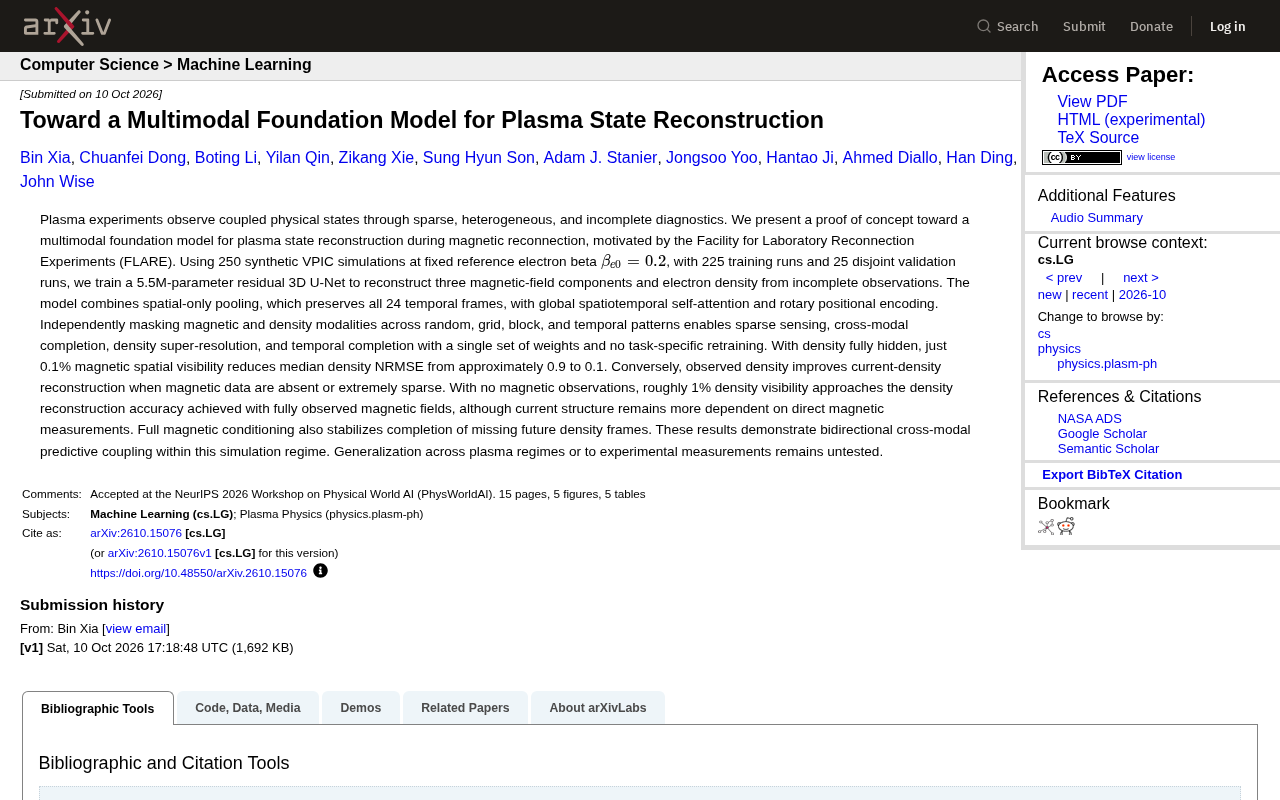
The study employed 250 synthetic VPIC simulations (with a fixed reference electron β_e0=0.2), of which 225 were used for training and 25 for independent validation. The model is a 5.5M-parameter residual 3D U-Net that takes incomplete observations as input and outputs three magnetic field components and electron density. Key design choices include: spatial-only pooling that preserves all 24 time frames, combined with global spatiotemporal self-attention and rotary position encoding.
Magnetic reconnection is a fundamental process in plasma physics: when magnetic field lines of opposite direction approach each other, they reconnect and change their topology, rapidly converting stored magnetic energy into plasma kinetic and thermal energy. This process is believed to be the energy release mechanism behind phenomena such as solar flares, Earth's magnetospheric substorms, and sawtooth oscillations in tokamaks. FLARE (Facility for Laboratory Reconnection Experiments) is a dedicated device built at the Princeton Plasma Physics Laboratory to reproduce magnetic reconnection under controlled laboratory conditions. Its diagnostic systems include magnetic probe arrays, Thomson scattering, and interferometers, but due to spatial layout and cost constraints, measurement points are often sparse and different diagnostics cover different physical quantities.
VPIC (Vector Particle-In-Cell) is a massively parallel particle simulation code developed at Los Alamos National Laboratory, widely used for kinetic simulations in plasma physics. It self-consistently evolves electromagnetic fields by tracking the motion of a large number of particles and solving Maxwell's equations, enabling simulation of processes such as magnetic reconnection. Electron β (β_e) is a parameter in plasma physics describing the ratio of electron thermal pressure to magnetic pressure. β_e0=0.2 means the electron thermal pressure is about 20% of the magnetic pressure, and this parameter determines the dynamical characteristics of the reconnection layer. Synthetic data refers to datasets generated by VPIC simulations rather than real experimental measurements, so complete "ground truth" fields can be obtained simultaneously, facilitating supervised training and quantitative evaluation.
Independent Masking Multimodal: One Set of Weights for Multiple Tasks
The key innovation of the study lies in independently masking the magnetic field and density modalities, with masking patterns covering random, grid, block, and temporal modes. This allows the same set of weights to support sparse sensing, cross-modal completion, density super-resolution, and temporal completion without task-specific retraining.
For example, when density is completely hidden, just 0.1% magnetic field spatial visibility can reduce the median density NRMSE from approximately 0.9 to 0.1. Conversely, when magnetic field data is missing or extremely sparse, observed density can improve current density reconstruction. Without magnetic field observations, approximately 1% density visibility can approach the density reconstruction accuracy achieved with fully observed magnetic fields — although current structures still depend more on direct magnetic field measurements. Additionally, complete magnetic field conditions can stabilize the completion of missing future density frames.
These results confirm the existence of bidirectional cross-modal predictive coupling between magnetic field and density within the scope of this simulation.
NRMSE (Normalized Root Mean Square Error) is a commonly used metric for evaluating the reconstruction accuracy of regression models, calculated as the root mean square error divided by the range or standard deviation of the target values. Smaller NRMSE values indicate more accurate reconstruction. The difference between 0.9 and 0.1 physically represents a transition from nearly unusable (error comparable to signal amplitude) to highly accurate reconstruction. In sparse sensing scenarios, visibility refers to the proportion of retained observation points to the total grid points; 0.1% magnetic field visibility means retaining only 1 observation point out of approximately 1000 grid points, demonstrating the model's ability to extract global information from extremely sparse inputs.
Limitations and Outlook
The current work is only a proof of concept. All results are based on synthetic simulation data, and generalization ability has not yet been tested across plasma regimes or on real experimental measurements. Future work needs to transfer the model to experimental data and explore performance under different plasma parameters.
This study provides a preliminary pathway for applying multimodal foundation models to plasma diagnostics, and its independent masking training strategy may inspire multimodal reconstruction tasks in other scientific domains.
Cross-modal predictive coupling refers to the ability of observations of one physical quantity (such as density) to help infer the state of another physical quantity (such as magnetic field). In magnetic reconnection, density and magnetic field do not evolve independently: the reconnection process produces density depletion and pile-up, and there exists an equilibrium relationship between electron pressure gradients and magnetic field curvature in the current sheet. Therefore, gradient information extracted from the density field can constrain the magnetic field structure, and vice versa. This study uses independent masking training to enable a single model to learn this bidirectional coupling without explicitly encoding physical equations. It should be noted that the strength of this coupling may vary with plasma parameters (such as β and guide field strength), and whether it remains stable under the complex noisy conditions of real experiments remains to be verified.
One-line Summary
A 5.5M-parameter U-Net achieves cross-modal sparse reconstruction of plasma magnetic reconnection through independent masking training.
Paragraph Summary
This study addresses the problem of sparse, heterogeneous, and missing diagnostics in magnetic reconnection experiments by proposing a multimodal foundation model. The model is a 5.5M-parameter residual 3D U-Net trained on 250 VPIC synthetic simulations, taking incomplete observations as input and outputting three magnetic field components and electron density. The core innovation is independently masking the magnetic field and density modalities, allowing one set of weights to support sparse sensing, cross-modal completion, density super-resolution, and temporal completion. Results show that when density is completely hidden, 0.1% magnetic field visibility can reduce the median density NRMSE from approximately 0.9 to 0.1; without magnetic field observations, approximately 1% density visibility can approach density reconstruction accuracy under fully observed magnetic fields. This confirms bidirectional cross-modal predictive coupling between magnetic field and density, though the current work is only a proof of concept on synthetic data.
Related articles

Free Unlimited Claude Code Solution: Agnes AI + CC Switch Setup Guide
No paid subscription needed — pair the free AI platform Agnes AI with the open-source tool CC Switch to provide a backend for Claude Code, enabling unlimited free calls to text, image, and video models. This guide covers the full setup, test results, and usage boundaries.

A Complete Zero-Cost Guide to Getting Started with Claude Code for Beginners in China
A beginner's guide to Claude Code for users in China: two installation methods (command line and IDE plugin), full configuration steps for replacing the official API with the free domestic LongCat model, and a hands-on demo of building a small tool with natural language, plus tips.

When the NSA Gets Involved: The AI Supply Chain Crisis Behind Open-Source CVEs and API Key Hijacking
Multiple open-source projects disclosed severe CVEs in one day, PHP flaws alarmed the FBI, and Railway and OpenCode were breached with API keys stolen. This article breaks down the vulnerability window, AI-accelerated exploitation, and the AI supply chain crisis behind the API key black market, with a developer defense checklist.