Munder Difflin: A Multi-Agent Framework for Running a Virtual Office with AI Clones

An open-source framework that simulates a virtual office run by collaborating AI agent clones.
Munder Difflin is an open-source multi-agent framework inspired by The Office that lets users run a virtual office staffed by AI clones. Built around an Agent Harness architecture, it handles role definition, message passing, and state management for multiple collaborating agents. While the concept is compelling, it faces real challenges including exponential token costs, hallucination accumulation across agent chains, and coordination reliability issues.
When AI Agents Walk Into the Office
Recently, an open-source project called Munder Difflin sparked discussion on Hacker News. The name is clearly a nod to Dunder Mifflin, the fictional paper company from the TV show The Office, and its core concept is equally playful: building an Agent Harness that lets users run a virtual office staffed by their own "clones."
This type of project reflects a noteworthy trend in the current AI Agent landscape—moving from standalone conversational assistants toward multi-agent orchestration. The concept of multi-agent collaboration can be traced back to research in Distributed Artificial Intelligence (DAI), with scholars exploring how multiple agents could accomplish complex tasks through communication and negotiation as early as the 1980s. However, limited by the AI capabilities of that era, this research remained largely academic. After the breakthrough in large language model capabilities in 2023, multi-agent systems finally reached a practical inflection point—Stanford University's "Generative Agents" paper demonstrated 25 AI Agents autonomously living social lives in a virtual town, directly sparking widespread industry interest in multi-agent systems. Projects like AutoGPT and BabyAGI followed in quick succession, and multi-agent orchestration rapidly evolved from an academic concept into engineering practice.
Unlike traditional single-model Q&A interactions, Munder Difflin attempts to simulate a scenario where multiple roles within an organization collaborate through division of labor.
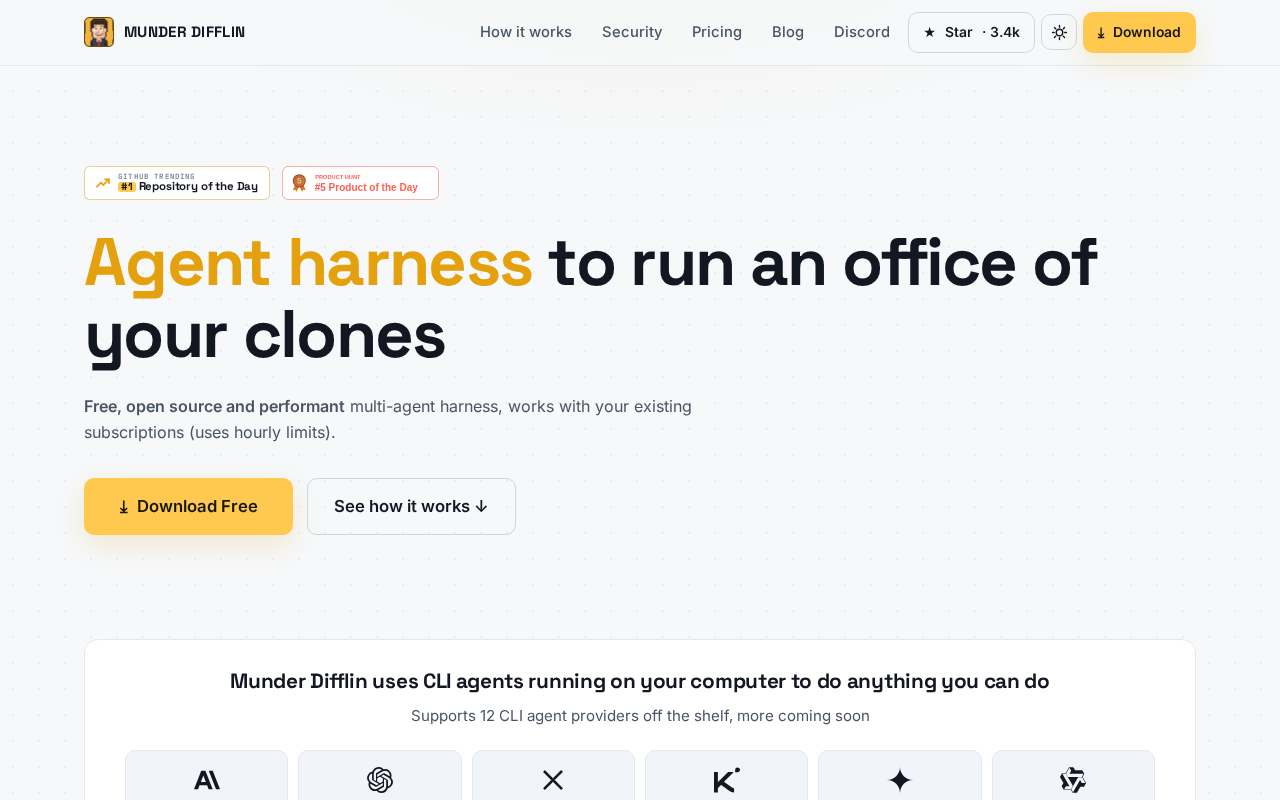
What Is an Agent Harness: A Runtime Framework for Multi-Agent Systems
An Agent Harness can be understood as a runtime framework designed to host, schedule, and manage multiple AI Agents. It typically handles several key responsibilities:
Role Definition and Division of Labor
In an "office," different Agents play different roles—there might be a "manager" responsible for decisions, "employees" handling execution, and a "reviewer" performing validation. Each role has its own system prompt, a set of callable tools, and behavioral boundaries.
The system prompt is a core mechanism in large language model interactions, setting the model's role, behavioral boundaries, and output style before a conversation begins. Unlike the prompts users type during conversation, system prompts carry higher priority—essentially establishing a set of "behavioral guidelines" for the AI. In multi-agent systems, system prompt design is particularly critical—it determines each Agent's "personality" and capability scope. For example, an Agent configured as a "strict reviewer" will tend to question and find errors, while a "creative planner" will generate ideas more divergently. The discipline of precisely designing these instructions to guide model behavior has evolved into a specialized field known as Prompt Engineering.
Message Passing and Coordination Mechanisms
The harness needs to pass messages between multiple Agents and coordinate task flow. One Agent's output often serves as another Agent's input, requiring the framework to have capabilities similar to a message queue or workflow engine, ensuring information flows efficiently within the "office" without falling into infinite loops.
State Management and Context Memory
Office operations are continuous, so the framework needs to maintain each Agent's memory and context state, allowing "employees" to remember previous conversations and decisions to form coherent collaboration.
The Imaginative Potential of an AI Clone Office
Munder Difflin's most intriguing premise is "running an office composed of your clones." Behind this lies a grander proposition: Can AI replicate the organizational forms of human collaboration?
Imagine this scenario: you simply provide a high-level goal, and a group of AI clones trained on your personal preferences and knowledge automatically divide the work—some handle research, others write content, others perform quality checks—and ultimately deliver results. This aligns with the philosophy of recently prominent multi-agent frameworks like AutoGPT, CrewAI, and AutoGen.
These three frameworks represent different design philosophies for multi-agent systems. AutoGPT (released March 2023) was the earliest project to ignite the multi-agent craze, adopting a single-Agent self-iteration model where one AI autonomously sets sub-goals and executes them step by step. CrewAI emphasizes a role-playing mechanism, allowing developers to define Agent "crew members" with specific expertise who collaborate through structured task delegation, with an API design closer to real-world software engineering needs. Microsoft's AutoGen uses a conversation-driven architecture where Agents coordinate work through multi-turn dialogue, supporting human-AI hybrid participation with strong flexibility in enterprise application scenarios. Each has its own focus, but all explore the same core question: how to scale large language model capabilities from individual points to system-level collaboration.
What sets Munder Difflin apart is its use of the "office" metaphor—a relatable, everyday analogy that lowers the cognitive barrier for ordinary users to understand multi-agent systems.
Real-World Challenges Facing Multi-Agent Frameworks
Despite the appealing concept, these projects face considerable challenges in practice—problems the entire industry has yet to fully solve:
Cost and Efficiency: Back-and-forth communication between multiple Agents means massive token consumption. Tokens are the basic unit of measurement for how large language models process text—roughly 1-1.5 tokens per English word, and about 1-2 tokens per Chinese character. Taking OpenAI's GPT-4o model as an example, pricing is approximately $2.5 per million input tokens and $10 per million output tokens. In multi-agent systems, cost issues scale exponentially: suppose a task involves 5 Agents, each averaging 3 interaction rounds consuming 2,000 tokens per round—a single task could consume over 30,000 tokens. Considering that each Agent also needs to carry a full context window, actual consumption may be even higher. This is why many multi-agent frameworks have begun supporting mixed-model strategies—having "manager" Agents use high-performance but expensive models while "executor" Agents use more economical smaller models. A single task going through multiple rounds of "office meetings" can cause API call costs to climb rapidly.
Hallucination and Error Accumulation: A single Agent's hallucinations or biases can be amplified and propagated through multi-agent chains, ultimately causing the entire collaborative output to deviate from expectations. AI hallucination refers to large language models generating content that seems plausible but is actually inaccurate or entirely fabricated. This phenomenon stems from how LLMs work—they are essentially performing probabilistic text prediction rather than truly "understanding" facts. In single-Agent scenarios, hallucinations can usually be caught and corrected through human review. But in multi-agent chains, the problem becomes more complex: erroneous information produced by one Agent may be treated as factual basis by downstream Agents, which then reason further on top of it, creating what's known as the "error snowball effect." Multiple studies have shown that error propagation rates in multi-agent systems can reach 3-5 times that of single-Agent setups. Current mitigation strategies include introducing dedicated "verification Agents," setting up fact-checking tool calls, and inserting human review checkpoints at critical nodes.
Coordination Reliability: How to prevent Agents from falling into meaningless circular discussions, and how to design effective termination conditions, remain engineering pain points.
Currently, the project has minimal traction on Hacker News (only 3 upvotes, no comments), placing it firmly in the experimental early-exploration stage. However, the direction it represents—evolving AI from a tool into a collaborative team—is undoubtedly a technological frontier worth continued observation.
Summary: The Future Outlook for Multi-Agent Collaboration
Munder Difflin may still be just a niche open-source experiment, but it humorously raises a serious question: when we can mass-generate "AI clones" and have them collaborate like real employees, how will the nature of work and organizations be redefined? For developers following the AI Agent ecosystem, frameworks like this are worth downloading and experiencing to glimpse the design philosophy and pitfalls of multi-agent systems.
Related articles

GPT-Next Leak, Gemini 4 Argon Imminent: AI News Roundup
GPT-Next leak suggests extreme efficiency; OpenAI's 28-day shipping pledge boosts speed 50%; Gemini 4 Argon nears release; Anthropic subscription value report sparks debate.

GPT-Next Leaked, Gemini 4 Argon Speeds Up, Fable 5.5 May Launch Today
OpenAI's GPT-Next model leaks, expected to be extremely low-cost and possibly part of the 28-day release plan; Gemini 4 Argon internal testing accelerates, NanoBanana 2.1 is live; Semi Analysis tests show Claude Max's equivalent API value is about 5 times that of ChatGPT Pro; Fable 5.5 may launch today.

Gemini 4 Argon Launches Globally: Key Highlights from the AI Daily Brief
Google opens Gemini 4 Argon globally across Pro and Ultra subscriptions and the API, and demonstrates robot control. This article rounds up open-source models, Agent infrastructure, cost transparency, and safety governance updates.