Muse, Dots, Instinct and Two More: A Roundup of Five AI Agent Shopping Tools — and How Online Stores Should Respond

Five AI shopping agents can now browse e-commerce sites and place orders on their own — forcing stores to rethink anti-bot strategy and checkout.
Between August and October 2026, five personal AI agents — Meta's Muse, OpenAI's Dots, Instinct, Grok Bot, and Tab — launched, and they no longer just chat: they browse e-commerce sites in cloud browsers like real people, read product info, add items to cart, and complete payment, mostly via Stripe's Link one-time virtual cards or Shopify's Shop Pay, asking for user confirmation before irreversible actions. This creates a new traffic channel for e-commerce but also new barriers: whether AI recommendation lists mention a brand, whether anti-bot defenses let agents through, and whether checkout is frictionless together determine if agents can place orders. Shopify chose to open agent checkout, while Amazon blocked Muse and Grok Bot for violating its terms. These agents currently operate only in the US and Canada and haven't reached Spain yet, but stores can get ahead by optimizing product information, checkout experience, and AI visibility.
Introduction: When AI Agents Shop for You
Imagine this scenario: you tell your AI assistant, "Buy me a pair of running shoes like the ones I have now, my size, under 100 euros," and it opens a browser, goes to the e-commerce site, fills out the forms, and completes payment with a one-time virtual card — all you have to do is say "OK" at the end. This isn't science fiction; it's something that already happened in the US in the fall of 2026.
According to Spanish tech outlet GenScore, five personal AI agents — Meta's Muse, OpenAI's Dots, startup Instinct, Musk's Grok Bot, and the emerging Tab — were launched or opened for testing between August and October 2026. What they share is clear: they no longer just chat, they act — opening a browser on a cloud computer, visiting websites like a real person, reading product information, and completing checkout.
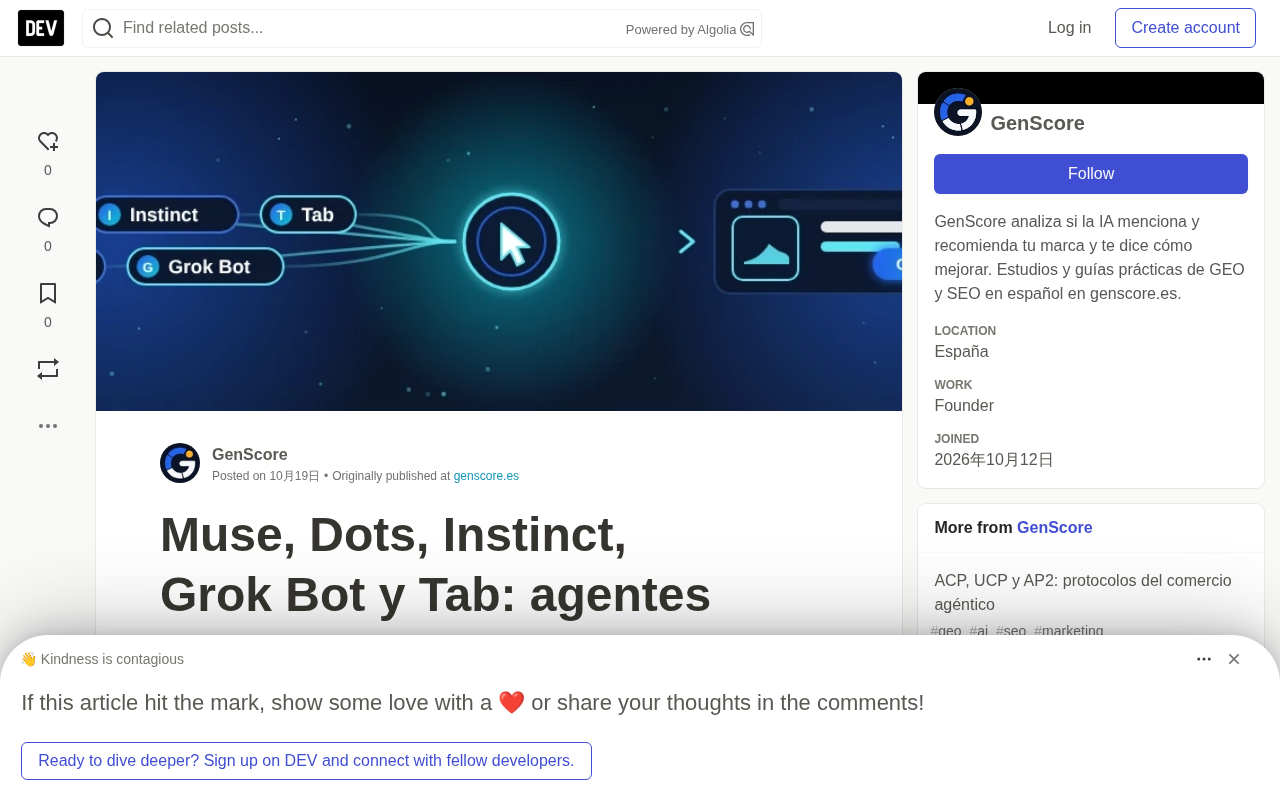
For e-commerce, this means a brand-new traffic channel — but also that your product pages, anti-bot defenses, and checkout flow will directly determine whether these "agent buyers" can complete an order.
What Is a Personal AI Agent?
Assistants like ChatGPT or Gemini answer the questions you ask. A personal AI agent, by contrast, receives a task and then executes it autonomously: booking a restaurant, canceling a subscription, buying shoes. To do this, it needs access to your email, calendar, and when necessary your payment methods — and it asks for your permission before any irreversible action.
The fall of 2026 is the moment these agents entered the public eye at scale. Within six weeks, Meta and OpenAI both entered the space, Instinct's valuation soared, and Grok Bot and Tab arrived one after another. Their promises are all the same: freeing you from handling chores yourself — including shopping.
A typical agent shopping flow looks like this:
- The user issues a task via chat or messaging.
- The agent queries the underlying AI to generate a short list of candidate stores. If your brand isn't in the AI's answer, you don't make the list.
- The agent opens a browser in the cloud and visits your website. ⛔ Anti-bot defenses or access blocks may stop it here.
- The agent reads the product page: sizes, final price, shipping information.
- The agent adds items to cart and fills in checkout details. ⛔ CAPTCHAs or mandatory registration may halt it here.
- The user confirms and completes payment, usually with a one-time virtual card.
The Agentic Commerce Protocol (ACP) is the infrastructure layer behind this wave. In September 2025, OpenAI and Stripe jointly proposed ACP to define a standard interface for "AI agents placing orders on behalf of users": merchants expose structured product, inventory, and payment-intent endpoints at checkout, and agents complete transactions through this dedicated channel rather than simulating human clicks. Since then, Google has led efforts on UCP (Universal Commerce Protocol), while Visa launched AP2 (Agent Payments Protocol) for agent identities, focused on the trust question of "who is paying and whether the user authorized it." The common thread across these protocols is letting agents identify themselves and negotiate with merchants rather than masquerading as browsers. But as of fall 2026, protocol adoption lags far behind agent product launches — which is precisely why the five agents covered here choose to drive browsers directly and take the "human path."
Side-by-Side Comparison of Five AI Shopping Agents
| Agent | Company | Interaction Method | Payment Method | Availability |
|---|---|---|---|---|
| Muse | Meta | App and web | One-time cards via Stripe's Link | US and Canada |
| Dots | OpenAI | Via ChatGPT and Codex | Undisclosed | Pro and Business Premium plans |
| Instinct | San Francisco startup | SMS, iMessage, WhatsApp, or email | Shopify's Shop Pay | Invite-only |
| Grok Bot | Musk's company | Grok chat | Link virtual cards | US |
| Tab | Startup Tab | iMessage or WhatsApp | Proprietary wallet | US |
Muse: Meta's Cloud Browser Agent
Meta launched Muse on September 8, 2026, positioned as "not just answering questions, but getting work done." It runs on a dedicated cloud computer, can open browsers, fill out forms, and negotiate on the user's behalf. For payment it uses Stripe's Link wallet, generating a different virtual card for each transaction without exposing the real card number. It requests user confirmation before purchasing.
Two weeks later, e-commerce platforms including Shopify, Walmart, Best Buy, Expedia, and Instacart came on board. But it also hit its first roadblock: Amazon blocked Muse's access to its site, citing unauthorized agent access as a violation of the platform's terms of service.
Dots: OpenAI's Background Task Agent
OpenAI introduced Dots at its developer conference on September 29, 2026. These are agents that work toward user goals in the background with low supervision requirements, and can be extended into "expert" agents with independent credentials and tools.
In WIRED's hands-on testing, Dots produced a solid candidate list — including prices and dimensions — for a sofa-buying task, but ultimately failed to complete the purchase. In another task to cancel a subscription, it was stopped by the store's CAPTCHA and returned the task to the user. This is exactly the kind of obstacle e-commerce sites intentionally put in place.
Instinct: The SMS Agent With No App
Instinct is an agent that went viral on social media in August 2026. It has no app; users interact with it via SMS, iMessage, WhatsApp, or email, as if contacting a human assistant. It can order food, organize email, search for flights, and shop. Shopify confirmed it can complete payments via Shop Pay using the user's saved payment and shipping information. According to Yahoo Finance, Instinct closed a funding round in September at a $10 billion valuation.
On September 29, Instinct began proactively recommending products: restaurant lists, travel plans, and shopping suggestions curated by "experts" such as chefs and designers. According to TechCrunch, many users reacted negatively upon realizing the agent was recommending products based on their emails and travel schedules. Instinct has not yet clarified whether it charges brands for placement.
Shop Pay and Link: Two Paths for Agent Payments. Stripe's Link is essentially a cross-merchant wallet account: once users save their card information, they can check out on any site that supports Link. Muse and Grok Bot use it to generate one-time virtual card numbers for each transaction, avoiding exposing real card details to the agent. Shopify's Shop Pay works on a similar principle but is tied to the Shopify ecosystem; Instinct uses it to reuse users' saved payment and shipping information. What both share is "credentials that don't land": the agent only receives a one-time payment token, and the user can still confirm the amount at the final step. This design reduces the risk of agent misuse while letting merchants identify the source of transactions at the payment stage. The takeaway for e-commerce: whether you integrate these wallets directly determines whether agents can successfully complete checkout on your site — not just whether they can "open the page."
Grok Bot: The Agent From Musk's Camp
Grok Bot is the agent version of Grok. Since August 28, 2026, US users who connect Stripe's Link wallet can have it place orders on e-commerce sites: each transaction generates a virtual card, and users confirm each one. On October 10, Musk revealed that he had asked Grok to buy LEGO, and Grok completed the purchase directly on LEGO's official website.
Five days later, multiple users reported that Amazon had blocked Grok Bot's orders. Musk's response: maybe they should build an Amazon competitor.
Tab: The Agent With Its Own Phone Number and Wallet
Tab debuted on October 7, 2026, with a reported valuation of $300 million according to TechCrunch. Users interact with it via iMessage or WhatsApp. According to its co-founder, Tab has its own phone number, its own computer, and its own wallet, and can pay bills, make bookings, and buy gifts or everyday items. Its safety rule is simple:
"Any irreversible action won't be executed without your confirmation."
— Tab, TechCrunch, October 2026
The Common Thread: They Enter Your Website Like Real People
The vision behind the Agentic Commerce Protocols (ACP, UCP, AP2) is for agents to communicate with stores through dedicated channels. But these agents don't wait for protocols to mature — they open browsers directly, load web pages, read product pages, add items to cart, fill in checkout details, and pay with cards generated by their wallets. In other words, if you understand how users shop on your website, you know how they will try.
Facing this trend, two e-commerce giants have chosen opposite paths:
Shopify: Opening the door. On September 28, 2026, it announced that agents with browsers can complete checkout — including using Shop Pay — provided they have buyer authorization. It uses the UCP protocol under the hood.
Amazon: Closing the door. On September 21, Amazon blocked Muse on the grounds that "unauthorized agent access violates the terms of service." In October, Grok Bot users reported the same block. Amazon's explanation:
"Third-party shopping agents should operate in an open manner and respect the decision of providers on whether to participate."
— Amazon, quoted by US media, September 2026
According to Amazon, Meta did not provide advance notice, the agent did not identify itself, and it appeared to have stored customer login credentials. This is the same problem Visa, Mastercard, and Cloudflare are trying to solve: letting stores identify who is entering before deciding whether to let them in.
Anti-bot defenses and agent identification are key to understanding the Amazon-Shopify split. Traditional anti-bot systems (Cloudflare, Akamai, DataDome, etc.) distinguish humans from crawlers based on browser fingerprints, behavioral characteristics, IP reputation, and JavaScript challenges — with CAPTCHAs as the most visible manifestation. The problem is that AI agent-driven cloud browsers are technically very similar to real human browsers, and while they have legitimate user authorization, they can also be abused for automated scraping. Vendors like Cloudflare are pushing "signed agent" mechanisms: agents carry verifiable identity credentials and user authorization declarations in their requests, and merchants decide whether to allow, rate-limit, or deny based on them. This means the future of e-commerce anti-bot strategy is no longer a simple "block or don't block" but tiered authorization based on agent identity — which also explains why Shopify requires agents to obtain buyer authorization while Amazon accuses Meta's agents of failing to identify themselves.
What Does This Mean for Spanish E-Commerce?
None of these five agents currently offer regular shopping services in Spain. But they don't need you to do anything to enter your website — they just need a browser. Once they open up to Europe, they'll enter your existing site exactly as it is. Things you can start preparing now include:
- ✅ Define your policy. Block, allow, or only allow agents that identify themselves — this is a business decision. Letting anti-bot defenses make the decision for you by default is the worst option.
- ✅ Make product pages guess-proof. Final price, stock for each size or variant, shipping time and cost, return policy — all must be on the page.
- ✅ Make checkout agent-friendly. Mandatory registration, CAPTCHAs, or pop-ups are exactly where they stop.
- ✅ Make AI aware of you. These agents start from a short list of stores, and that list comes from AI knowledge and retrieval results. If AI doesn't mention you, agents won't reach your site.
Quick action tip: On your phone, without logging in, complete a purchase on your own website from start to finish, and note every obstacle: pop-ups, CAPTCHAs, mandatory registration, information you can't find. Every obstacle could be where an agent stops in its tracks.
Conclusion: Agent Shopping Is Here — Are Stores Ready?
In the US, agents are already completing purchases on e-commerce sites with user authorization — and they aren't asking stores for permission. They're using browsers. When they come to Spain, their approach won't change. For online stores, this is both a new traffic opportunity and a test of your website infrastructure: Is your product information clear enough? Is your anti-bot strategy smart enough? Is your checkout flow smooth enough? The answers to these questions will determine whether you can receive orders in the age of the agent economy.
This article is based on reporting by GenScore, combined with announcements from Meta, OpenAI, Shopify, and Stripe, as well as public information from TechCrunch, WIRED, and Yahoo Finance.
Related articles

Build an AI Super Employee System at Zero Cost: A Full Breakdown of Automated Agent Workflows
A deep breakdown of the AI super employee system demoed on Bilibili: agent orchestration, digital human voiceovers, map and enterprise lead generation, 24/7 customer service, and legal modules. We analyze the business logic and compliance risks behind zero-cost signup to help entrepreneurs judge the real ROI of this AI digital employee system.

The Essential Difference Between Chatbots and AI Agents: Crossing from Conversation to Execution
What's the difference between a chatbot and an AI agent? Based on the MCP series on the Learn Tech channel, this article uses examples like booking flights and summarizing notes to explain: a chatbot only gives answers, while an agent actually completes tasks through a think-act-observe loop. It breaks down the four core components—model, tools, memory, and goal—as well as MCP's role as a bridge, and discusses agents' applicable boundaries and permission risks.

Free GitHub Repo: 342 Hours of AI Courses, from Math to MCP Servers
A free GitHub repo offers 342 hours of AI courses: 523 lessons across 20 phases, from math fundamentals to agent building and MCP servers. Nearly 100,000 learners have started.