Muse-Glimmer-30B Real-World Test: The Best Bang-for-Buck Model Scoring 76 Points Across 9 Dimensions on Just 24GB VRAM

Muse-Glimmer-30B delivers 90+ tool-calling scores on just 24GB VRAM with near-lossless 4-bit quantization.
Meta's open-source Muse-Glimmer-30B excels at tool calling and agent orchestration, scoring 76.04 across 9 benchmark dimensions (403 questions). It achieves 90+ in agent workflows and instruction following, runs on 24GB VRAM with near-lossless 4-bit quantization, and reaches 233 tokens/sec with D-Flash speculative decoding on RTX 5090. Its main weaknesses are verbose reasoning that can exhaust 128K context and slightly weaker coding versus top 27B competitors.
An Open-Source Model Born at the Wrong Time
Meta's recently open-sourced Muse-Glimmer-30B is a large language model focused on tool calling, agent orchestration, and CLI capabilities. It's a 30B-class model (actual architecture around 28B), supports 128K context, and shipped with local quantized versions from day one, making local deployment extremely accessible.
Based on hands-on testing by a Bilibili content creator, this model is "born at the wrong time," but its performance turned out to be surprisingly strong. To benchmark its upper limits, Corpus 3.6 27B was chosen as the comparison model — one of the best-performing quantized/candidate models in the 27B class, making it an accurate yardstick for measuring Muse-Glimmer's true capabilities.
If you don't have time for the details, just remember these four key takeaways: leading overall score, strong tool calling, exceptional value for money, and a surprising twist in safety performance.

Nine-Dimension Benchmark: A Subtle Lead at 5 Wins to 4 Losses
Overall Average of 76.04, Narrowly Beating the Competition
This test covered nine dimensions with a total of 403 questions, weighted and averaged. Muse-Glimmer-30B achieved an overall average of 76.04, edging out Corpus 3.6 27B's 75.57 by 0.47 points.
This 0.47-point gap may seem tiny, but considering it's a weighted average across 400+ questions, the margins in individual categories are actually quite significant. Muse-Glimmer passed 88% of the 403 questions, demonstrating solid format discipline.
Tool Calling Is the Absolute Strength
Muse-Glimmer's official marketing heavily emphasizes tool calling and Agent scenario performance. Real-world data confirms this:
- Agent Workflow: 90.87 points
- Instruction Following: 90.86 points
- Tool/CLI: 88.84 points
All three hover around 90 points, and all outperform Corpus 3.6 27B. In plain terms, as a "tool executor," its performance is outstanding.
Tool calling (Function Calling / Tool Use) refers to the model's ability to understand user intent and autonomously decide which external APIs or tools to invoke, correctly construct call parameters, and parse return results. Agent orchestration goes further, requiring the model to dynamically plan tool usage sequences, handle intermediate states, and manage exceptions across multi-step tasks. Muse-Glimmer's advantage here is closely tied to Meta's long-term investment in Agent infrastructure (such as Llama Stack and MCP protocol support).
Where It Wins and Where It Loses
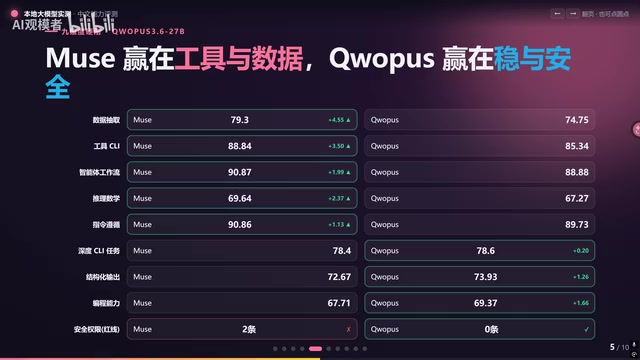
Across the nine dimensions, Muse-Glimmer won five, and the way it wins is telling:
- Data Extraction: Leading by ~4.55 points (the largest gap between the two models)
- Tool/CLI: Leading by 3.5 points
- Agent Workflow, Reasoning/Math, Instruction Following: All leading
Corpus 3.6 27B wins in these areas:
- Deep Tasks: Leading by only 0.2 points (benefiting from its inherited 256K long-context capability from Qwen 3.6)
- Structured Output: Slightly stronger
- Coding: Leading by 1.66 points
You might not notice that while the coding lead is only 1.66 points, since coding questions are numerous and heavily weighted in the test, this gap is actually quite significant. The conclusion is clear: Muse's strengths are more pronounced, Corpus is more consistent, and Corpus has the edge in coding.
Value for Money Is the Real Killer Feature
Extremely Low Hardware Requirements
Muse-Glimmer's most eye-catching trait is its minimal hardware demands. Though it's a 30B-class model, its actual hardware requirements are closer to a 25-26B model, noticeably lower than Gemma 4 31B at the same parameter tier.
This is due to differences in model architecture design. Gemma 4 31B uses wider hidden dimensions and more attention heads — while total parameter counts are similar, its VRAM usage during inference is higher. Muse-Glimmer's architecture prioritizes inference efficiency, likely employing techniques like Grouped Query Attention (GQA) to reduce the VRAM overhead of KV cache, making actual deployment requirements significantly lower than what the parameter count suggests.
Quantized versions come in multiple tiers, covering everything from entry-level to high-end GPU configurations:
| Quantization | VRAM Required | Precision Loss | Use Case |
|---|---|---|---|
| Full BF16 | 64G | None | Server deployment |
| Dynamic 17GB (K-Quant) | 32G | ~0.2% | High-end consumer GPUs |
| 4-bit quantization | 14-16G | ~1% | Recommended for mainstream GPUs |
| 2-bit quantization | ~10G | Higher | Entry-level experimentation |
K-Quant (K-means Quantization) is the most popular mixed-precision quantization scheme in the llama.cpp ecosystem. Unlike uniform quantization, K-Quant assigns different bit widths based on each layer's sensitivity to final output — critical layers retain 6-8 bit precision while less important layers are compressed further. This strategy reduces precision loss by 40-60% at the same average bit rate, which is why the 17GB dynamic quantization in the table loses only 0.2%.
In other words, full coverage from 10G at 2-bit all the way to 29G at 8-bit. A single RTX 4090 or even 5080 can drive it with ease.

4-Bit Quantization Is Virtually Lossless
For everyday local deployment users, 4-bit quantization is more than sufficient. Since the original precision loss is already minimal, performance after Q4 quantization is nearly indistinguishable from the original. The tester used Unsloth's Q4_K_XL quantized version, which performs roughly on par with the officially recommended version.
Unsloth is an open-source project focused on efficient LLM inference and fine-tuning. Its quantized versions typically add further optimizations on top of standard K-Quant, such as retaining higher precision for embedding and output layers, achieving better quantization quality with almost no additional VRAM overhead. The "XL" suffix in Q4_K_XL indicates an "Extra Large" proportion of layers retained at higher precision — the most aggressive precision-preserving 4-bit scheme available.
D-Flash Speculative Decoding: 3.1x Speed Boost
Running the model isn't enough — it needs to run fast. Muse-Glimmer comes with a built-in "secret weapon" — D-Flash speculative decoding, essentially an attached draft model that accelerates inference.
Speculative Decoding is one of the most important technical breakthroughs in LLM inference acceleration over the past two years. The core principle: in traditional autoregressive generation, each token requires a full model forward pass, wasting massive GPU time on waiting. Speculative decoding introduces a lightweight "draft model" that quickly guesses multiple future tokens at once, which the main model then verifies in parallel. Since verifying N tokens under the Transformer architecture costs nearly the same as generating 1 token, as long as the draft model's accuracy reaches 70-80%+, effective speedups of 2-4x are achievable. D-Flash is Meta's speculative decoding scheme designed specifically for the Muse series — the draft model shares most parameters with the main model, achieving fast prediction through only a few additional layers, adding virtually no VRAM overhead.
Official data shows inference speeds across different hardware:
- RTX 5090: From 74.9 tokens/sec surging to 233 tokens/sec, a 3.1x speedup
- Apple M5 Max laptop: ~50 tokens/sec
- Apple M4: ~37 tokens/sec
Without D-Flash enabled, the ~75 tokens/sec on the 5090 is comparable to 27B models. But once D-Flash kicks in, 200+ tokens/sec is more than enough for any use case. For reference, the average human reading speed for English is about 4-5 words/second, while 233 tokens/sec roughly equals 170-180 English words per second — far exceeding human reading speed.
Note that D-Flash may require the latest version of llama.cpp for support. Clients like LM Studio may have the toggle available but might not have it fully functional yet.
Official Benchmarks vs. Real-World Shortcomings
Official Comparison Data
In Meta's official comparisons, Muse-Glimmer-30B crushes Gemma 4 31B and Qwen 3.6 27B across multiple tests:
- MCP Atlas Agent Tasks: 75.5 points (competitors only scored in the 50s and 60s — a dominant lead)
- AIME 2026 Math Test: 94.7 points
- SWE-Bench Code Repair: 76 points (comparable to Qwen 3.6 27B, slightly better)
MCP Atlas is an agent capability evaluation benchmark built on Anthropic's Model Context Protocol. The MCP protocol defines standardized interaction interfaces between AI models and external tools, while the Atlas test evaluates a model's ability to execute complex Agent tasks including multi-step tool orchestration, error recovery, and dynamic decision-making within that protocol framework. A score of 75.5 means Muse-Glimmer can correctly complete the vast majority of complex multi-step agent tasks, aligning perfectly with its "tool-calling specialist" positioning.
SWE-Bench is a software engineering capability benchmark from Princeton University that extracts resolved issues from real GitHub open-source projects, requiring models to understand entire codebases and automatically generate correct fix patches. Unlike traditional function-level coding problems, it tests the model's comprehensive ability to understand large-scale engineering projects, locate defects, and generate standardized fixes.
Three Shortcomings to Note
Real-world testing also revealed some weaknesses:
1. Overly verbose thinking during output. Some questions produced excessive thinking text, failing to deliver answers within the available context. Of the 30 questions that failed out of 403, 19 were because the model "ran out of thinking space" — it was cut off mid-reasoning before reaching a conclusion. This is closely tied to its 128K context limit.
The root cause is that reasoning models share a single context window between "thinking tokens" and "output tokens." Modern reasoning models (like OpenAI's o1 series, DeepSeek-R1, etc.) unfold extensive internal reasoning before generating final answers — these reasoning chains can stretch to tens or even hundreds of thousands of tokens. For models with 256K context, there's ample room; but for Muse-Glimmer's 128K, complex problems requiring deep multi-step reasoning can exhaust the context capacity before reaching a conclusion. This isn't a failure of reasoning ability — it's a physical limitation of the "container" being too small.
2. Unexpected safety failures. The official claim is that safety performance clearly exceeds 27B models, but in testing Muse-Glimmer tripped two safety sub-category red lines, while Corpus 27B performed well. This contradicts official marketing and remains an open question.
3. Weaker math and coding in practice. While Corpus 27B itself is a top-tier post-trained model, Muse does fall slightly short in these two areas.

Conclusion: An Excellent Tool-Caller on 24GB VRAM
One-line summary: Muse-Glimmer-30B is an excellent tool-caller with slightly weaker thinking reliability, constrained by 128K context, and marginally weaker on deep tasks.
But its core advantage is irreplaceable: it runs on 24GB VRAM, and runs well. 4-bit quantization is virtually lossless, delivering exceptional value for money. While 128K context is shorter, consumer GPUs don't have much VRAM to spare for longer contexts anyway, so this limitation is largely inconsequential.
It's worth noting that context length and VRAM usage have a nearly linear relationship. For a 4-bit quantized 30B model, model weights alone occupy about 14-16GB of VRAM, with each additional 1K tokens of context (KV cache) consuming roughly tens of MB more. At full 128K context, KV cache may occupy 4-6GB of additional VRAM. Extending to 256K would require doubling just the KV cache alone, making a 24GB GPU completely unable to handle it. Therefore, the 128K context setting is precisely the right trade-off given consumer hardware constraints.
It's particularly suited for: efficiency-focused users who enjoy tinkering with local deployment but don't have top-tier hardware. If your daily workflow doesn't involve extremely long processes, Muse-Glimmer-30B is an excellent choice for general tasks, tool calling, and even light coding.
Related articles

The Cursor Agents Window Controversy: The Tug-of-War Between AI Coding Efficiency and Developer Control
Cursor's push for Agents Window sparks developer backlash. Does running multiple AI Agents in parallel truly boost coding efficiency? An in-depth look at the tension between efficiency and control.

Learning in the AI Era: 90% of Knowledge Only Needs Understanding, Not Memorization
In the AI era, 90% of learning material only needs understanding, not rote memorization. Learn how to distinguish core knowledge from information you can look up on demand.

Ox Alpha Suspected to Be Google Gemini: The Competitive Strategy Behind Anonymous Model Testing
AI community debates whether mysterious model Ox Alpha is a Google Gemini variant. Analysis of anonymous model testing strategies, industry practices, and implications for AI competition.