Muse Spark Open Released: The Strongest Open-Weight Model from the US

Meta releases the 816B-parameter Muse Spark Open open-weight model, focused on coding and Agent tasks.
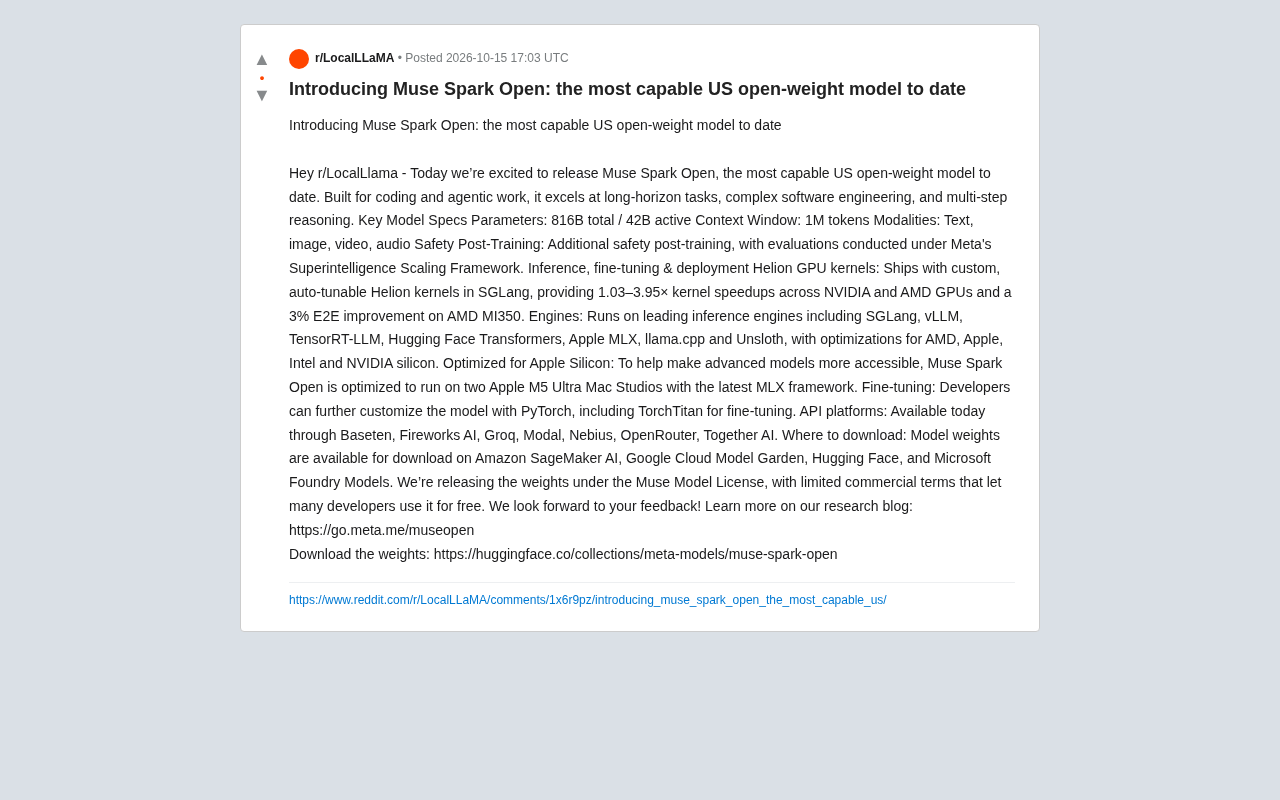
Meta released Muse Spark Open on r/LocalLlama, billing it as the strongest US open-weight model to date. It uses a MoE architecture with 816B total parameters and 42B activated parameters, supports a 1M token context and text, image, video, and audio inputs, and is optimized for coding, Agents, long-horizon tasks, and multi-step reasoning. It integrates Helion GPU kernels into SGLang, covers mainstream engines like vLLM, TensorRT-LLM, and MLX, and can run locally on two M5 Ultra Mac Studios. APIs are available at launch via Baseten, Fireworks AI, Groq, and OpenRouter, with weights downloadable from Hugging Face and more.
Meta released Muse Spark Open on the r/LocalLlama community, billing it as the strongest open-weight model from the US to date. The model focuses on coding and Agent tasks, with 816B total parameters, 42B activated parameters, and a 1 million token context window, excelling in long-horizon tasks, complex software engineering, and multi-step reasoning.
Model Architecture and Core Capabilities
Muse Spark Open uses a MoE architecture with 816B total parameters and 42B activated parameters. The 1 million token context window means it can handle extremely long codebases and documents. For multimodality, it supports text, image, video, and audio inputs.
The model is specifically optimized for coding and Agent scenarios, and the official description says it excels at "long-horizon tasks, complex software engineering, and multi-step reasoning." Safety post-training was evaluated under Meta's Superintelligence Scaling Framework.
In terms of parameter scale, 816B total parameters puts it in the top tier among open-weight models. The 42B activated parameter design balances inference cost and capability ceiling—only a subset of parameters needs to be activated at runtime, making deployment far less demanding than dense models.
MoE (Mixture of Experts) architecture is one of the most important architectural innovations in large models in recent years. Its core idea is to split the traditional single dense feed-forward network into multiple parallel "expert" subnetworks, then use a learnable gating routing mechanism so that each token activates only a few of those experts. This way, the model's total parameter count can be made extremely large to raise the capability ceiling, while the parameters actually involved in computation in a single forward pass (i.e., activated parameters) remain relatively small, greatly reducing compute overhead. Muse Spark Open's 816B total parameters correspond to 42B activated parameters, meaning each token invokes only about 5% of the parameters, preserving the knowledge capacity of a large model while keeping inference costs close to those of a medium-sized dense model. The tradeoff of MoE is that memory usage is still calculated based on total parameters, and routing load balancing plus expert parallel communication introduce additional engineering complexity.
Inference and Deployment: Multi-Hardware Adaptation
A lot of work went into deployment for this release. The model comes with Helion GPU kernels integrated into SGLang, achieving 1.03–3.95x kernel speedups on NVIDIA and AMD GPUs, with about a 3% end-to-end improvement on AMD MI350.
Supported inference engines cover the mainstream options: SGLang, vLLM, TensorRT-LLM, Hugging Face Transformers, Apple MLX, llama.cpp, and Unsloth, with optimizations for AMD, Apple, Intel, and NVIDIA chips.
The optimization for Apple Silicon deserves a separate mention—Muse Spark Open can run on two Mac Studios equipped with M5 Ultra chips, paired with the latest MLX framework. This means local running of high-end open-weight models is no longer limited to server-grade hardware.
Context window refers to the total number of tokens a model can "see" simultaneously in a single inference pass, including input and output. Traditional models are usually 8K to 128K, while a 1 million token window (roughly equivalent to hundreds of pages of documents or a medium-sized code repository) allows the model to process an entire project at once without chunking or relying on retrieval augmentation. The challenge of long context is not only that memory usage grows approximately quadratically with length, but also whether the model can maintain attention and reasoning consistency across spans of hundreds of thousands of tokens. The industry commonly uses benchmarks such as "needle-in-a-haystack" to verify the recall of key information in long windows, which is especially critical for the long-horizon tasks and multi-step reasoning emphasized by Muse Spark Open.
The Helion, SGLang, MLX, and llama.cpp mentioned in the article represent several key layers of the current open-source deployment ecosystem. Helion is a domain-specific language in the PyTorch ecosystem for writing high-performance GPU kernels, allowing developers to generate operators optimized for different hardware; SGLang is a high-throughput inference framework for large model serving, strong at handling long context and structured output; MLX is a machine learning framework built by Apple for its unified memory architecture chips, able to fully utilize the memory bandwidth of M-series chips; llama.cpp focuses on local inference under CPU/low-bit quantization. Integrating these engines and kernels means the same set of weights can run across NVIDIA, AMD, Apple Silicon, and even CPU environments, which is also one of the core advantages of open-weight models over closed APIs.
Fine-Tuning and API Ecosystem
Developers can fine-tune with PyTorch or use TorchTitan. On the API side, it is available on launch day through platforms including Baseten, Fireworks AI, Groq, Modal, Nebius, OpenRouter, and Together AI.
Weight download channels include Amazon SageMaker AI, Google Cloud Model Garden, Hugging Face, and Microsoft Foundry Models.
On licensing, the Muse Model License includes limited commercial terms and allows many developers to use it for free. The specific terms need to be checked in the official license text, but based on community feedback, this license is considerably more open than options that fully restrict commercial use.
Open weights and open licensing are two different concepts. Open weights mean the model parameters can be downloaded and run locally, but the scope of use is often constrained by the license. Many so-called "open" model licenses attach clauses such as monthly active user thresholds, prohibitions on training competitors, and limits on commercial scale; Meta's previous Llama series license was one such example. The Muse Model License mentioned in the article includes "limited commercial terms," which usually means small and medium-sized developers or entities below a certain revenue scale can use it commercially for free, while companies exceeding the threshold need to apply separately for authorization. Therefore, when evaluating an open-weight model, besides looking at parameters and benchmark scores, you must also check the commercial conditions, redistribution restrictions, and requirements for derivative models in the license text.
Community Response and Competitive Landscape
After the release on the r/LocalLlama community, discussion focused on several areas: the actual inference cost at the 816B parameter scale, the performance of the 1 million context window in real coding tasks, and the specific commercial restrictions of the Muse Model License.
In terms of positioning, Muse Spark Open directly targets the strongest current open-weight models. The 42B activated parameter design means inference efficiency is one of its core competitive strengths—under the MoE architecture, users do not need to pay for all 816B parameters.
Agent capability is a key emphasis of this release. Long-horizon tasks and multi-step reasoning usually require the model to maintain context consistency over longer time spans, and the 1 million token window plus Agent optimization is preparation in that direction.
Whether Muse Spark Open can become the benchmark for US open-weight models still depends on actual benchmark tests and community validation. But at least in terms of deployment coverage and hardware compatibility, Meta has given developers a fairly complete set of options this time.
More information can be found in the Meta research blog (https://go.meta.me/museopen) and the Hugging Face weights page (https://huggingface.co/collections/meta-models/muse-spark-open).
One-line Summary
Meta releases the 816B-parameter Muse Spark Open open-weight model, focused on coding and Agent tasks.
Paragraph Summary
Meta released Muse Spark Open on the r/LocalLlama community, billing it as the strongest US open-weight model to date. The model uses a MoE architecture with 816B total parameters and 42B activated parameters, supports a 1 million token context and text, image, video, and audio multimodal inputs, and is optimized for coding, Agents, long-horizon tasks, and multi-step reasoning. On deployment, it integrates Helion GPU kernels into SGLang, achieves 1.03–3.95x kernel speedups on NVIDIA and AMD GPUs, covers mainstream engines such as SGLang, vLLM, TensorRT-LLM, MLX, and llama.cpp, and can even run locally on two M5 Ultra Mac Studios. APIs are available on launch day through platforms including Baseten, Fireworks AI, Groq, and OpenRouter, and weights can be downloaded from channels such as Hugging Face. It uses a limited commercial license, and the community is focused on its inference cost, real-world long-context performance, and commercial restrictions.
Related articles

RAG Getting Started in Practice: From Principles to Building an Enterprise Knowledge Base
Bilibili RAG course highlights: from retrieval-augmented generation principles, document chunking and vectorization, to five accuracy factors and enterprise knowledge base boundaries, with fine-tuning vs RAG selection advice.

AI Model Selection Guide: DeepSeek vs. Qwen3 in Practice
How should AI developers choose models? Based on a Bilibili tutorial, this article breaks down the Function Calling differences between DeepSeek V3 and R1, Qwen3's programmatic thinking mode switching and agent capabilities, and outlines a multi-model learning path and practical selection logic.

Anchoring, Loss Aversion, and Nudges: 5 Psychological Tactics Retailers Use to Make You Spend
Behavioral economics reveals how retailers use anchoring, framing, loss aversion, and nudge theory to manipulate your spending decisions. This article breaks down 5 common psychological tactics and offers counterstrategies like slowing down decisions and setting your own anchors to see through the pricing design behind discounts.