Muse Wonder Priced Same as Opus 5.5: Loses 9 of Meta's Own 14 Benchmarks

Meta releases Muse Wonder, priced the same as Opus 5.5 but with 5 wins and 9 losses on its own benchmarks.
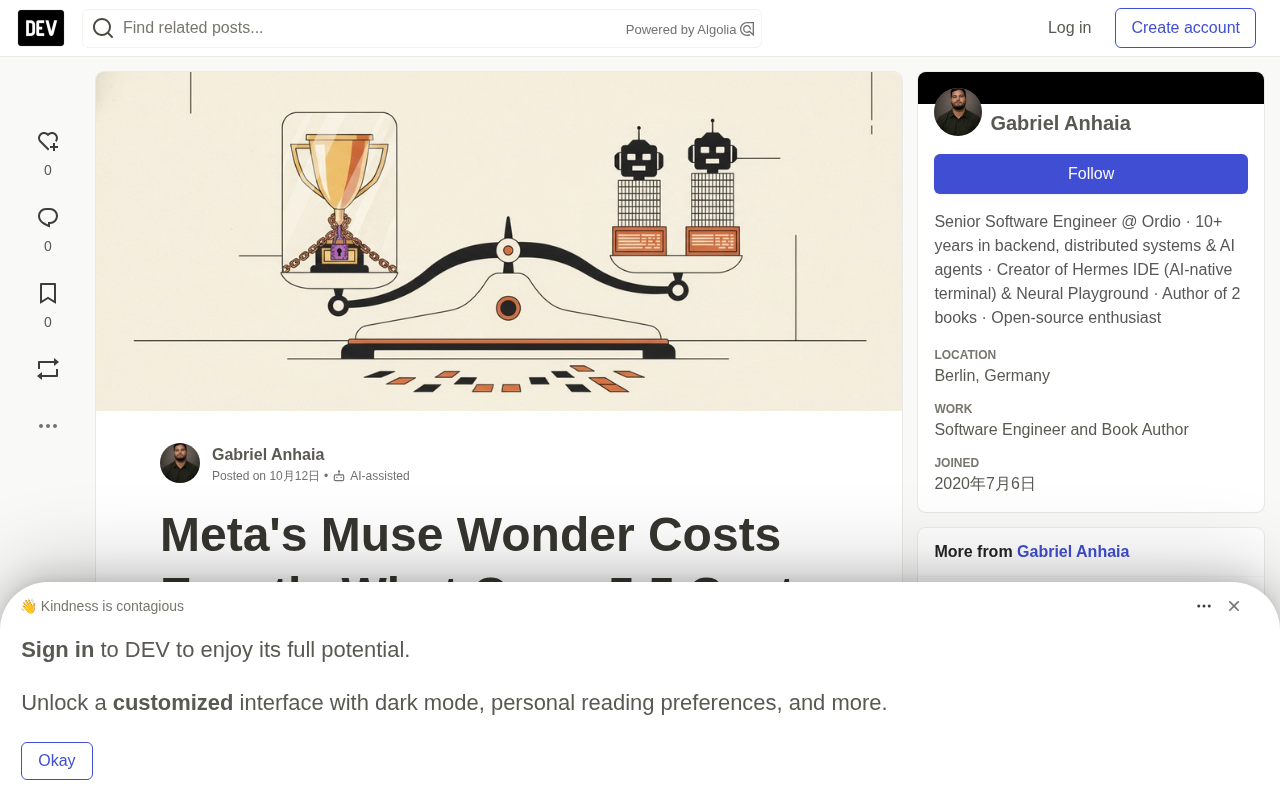
Meta Superintelligence Labs released two models, Muse Wonder and Muse Wonder Full, but only Muse Wonder is available via API, priced at $4/million input, $20/million output, and $0.20 cached input—identical to Claude Opus 5.5; Muse Wonder Full is limited to Muse Code subscribers at $50/month and up. In Meta's own 14 benchmarks, Muse Wonder goes 5-9 against Opus 5.5, with ProgramBench showing the largest gap at 20.5 points. Wonder's wins cluster in long-horizon coding (DeepSWE, SWE-Marathon), legal agents (Harvey LAB-AA), and memory (MemoryBench), with DeepSWE being the most credible as measured by third-party Datacurve. Model card footnotes also note that competitor runs are "best-effort," with prompts, tools, and harnesses not optimized for competitors. Independent firm Artificial Analysis gives Wonder an intelligence index of 52 vs. Opus 5.5's 58, while noting Wonder's 19.27-second first-token latency is about 3.5x the 5.52-second median, and its output token consumption is higher.
Meta Superintelligence Labs released two models, Muse Wonder and Muse Wonder Full, but only one is available via API. More notably: the version you can actually call is priced exactly the same as Claude Opus 5.5, yet loses 9 out of Meta's own 14 benchmarks.
Two Models, Only One Served via API
According to Meta's newsroom and TechCrunch, Meta released Muse Wonder and Muse Wonder Full, calling them "the most capable models," achieving "state-of-the-art performance on personal and professional agentic tasks."
But only one version comes with an API key:
- Muse Wonder is available on Meta Model API as
muse-wonder-1.0, and on OpenRouter asmeta/muse-wonder. Priced at $4/million input tokens, $20/million output tokens. Cached input reported at $0.20/million. The model card lists a 1M token context, with support for text, image, video, and audio input, and text output. - Muse Wonder Full is limited to Muse Code subscribers. Not available via API. The $50/month Power Usage plan includes it, and the $200 Maximum Usage tier sits above that.
Opus 5.5 is priced identically: $4 input/$20 output, $0.20 cached reads. GPT-6 Astra and Claude Fable 5.1 are both $10 input/$50 output.
So the fair matchup is Wonder vs. Opus 5.5—input, output, and cache prices are all identical.
A note on token pricing and cached input: LLM APIs typically bill by the smallest unit of processed text—the token—split into two tiers: input (the prompt and context you send the model) and output (what the model generates), with output usually more expensive. In this article, $4/million input tokens means $4 per million input tokens processed. Cached input refers to prompt caching: when multiple requests share the same prefix (such as a fixed system prompt or long document), the provider can reuse already-computed intermediate state, billing at a rate far below standard input—$0.20/million being roughly 1/20 of the standard input price. Because agent loops repeatedly send the same context and tool definitions, cache hit rates directly determine the actual bill, which is why providers break out cache pricing for comparison.
Meta's Scorecard: A Line-by-Line Analysis
The numbers below come from Meta's model card, all at maximum reasoning effort settings. The last column shows how Muse Wonder (the API version) fares against Opus 5.5:
| Benchmark | Wonder Full | Wonder (API) | Opus 5.5 | Wonder vs Opus |
|---|---|---|---|---|
| Personal Superintelligence Index | 59.1 | 54.3 | 55.2 | Loss |
| Harvey LAB-AA (Legal) | 13.1 | 10.0 | 4.2 | Win |
| Vals Finance Agent V2 | 59.1 | 56.6 | 58.6 | Loss |
| HealthBench Pro | 62.3 | 60.5 | 65.6 | Loss |
| AutomationBench-AA | 45.4 | 39.1 | 41.2 | Loss |
| GDP.pdf | 33.2 | 30.8 | 30.6 | Win |
| JobBench | 75.3 | 70.5 | 75.4 | Loss |
| OSWorld V2.1 | 78.4 | 72.6 | 81.8 | Loss |
| MemoryBench | 85.5 | 85.6 | 81.5 | Win |
| Terminal-Bench 4.0 | 57.1 | 52.0 | 59.6 | Loss |
| DeepSWE 1.1 | 79.0 | 78.8 | 74.2 | Win |
| SWE-Marathon | 57.5 | 53.1 | 46.3 | Win |
| ProgramBench | 59.0 | 50.0 | 70.5 | Loss |
| AA Intelligence Index | 56 | 52 | 58 | Loss |
Tallying the last column: 5 wins, 9 losses.
The gaps vary. ProgramBench is the largest: 50.0 vs. 70.5, a 20.5-point lead for Opus. OSWorld V2.1 loses by 9.2 points, Terminal-Bench by 7.6, HealthBench Pro by 5.1. Some are close: the Personal Superintelligence Index differs by only 0.9 points, Vals Finance by 2.0, AutomationBench by 2.1.
A note on 'maximum reasoning effort' and benchmarks: "Reasoning effort" refers to how much internal thinking a model does before answering—the longer it thinks, the higher the accuracy, but the greater the latency and token consumption. Vendor tables often label this as "maximum effort" mode, meaning the score was produced with the slowest, most expensive configuration, which day-to-day calls often won't reach. As for benchmarks, there are several common categories: SWE-Bench-style tests examine bug fixes in real software repositories; Terminal-Bench tests multi-step task execution in command-line environments; OSWorld measures ability to complete operations in a graphical OS; HealthBench evaluates medical Q&A. Vendor-built benchmarks (such as Meta's "Personal Superintelligence Index" or MemoryBench) have weaker comparability than third-party benchmarks (such as Datacurve or Artificial Analysis) because their data is not public and they often use the vendor's own LLM as judge—so distinguish sources when reading.
Where Wonder Wins
Among the five victories, GDP.pdf leads by just 0.2 points, 30.8 vs. 30.6—essentially a tie on a vendor table. The other four deserve attention:
Long-horizon coding tasks. On DeepSWE 1.1, Wonder scores 78.8 vs. Opus's 74.2. The model card footnote notes that the DeepSWE results for Wonder, Wonder Full, and Opus 5.5 all come from third-party Datacurve. This is the cleanest win on the table: the same external source measured both models.
SWE-Marathon is Wonder's biggest margin over Opus, 53.1 vs. 46.3, sourced from Abundant AI. But the footnote adds: Astra and Fable were run using Codex and Claude Code, and "this row is not a controlled general harness comparison." It's a strong signal, but with an asterisk.
Legal agent tasks. On Harvey LAB-AA, Wonder scores 10.0 vs. Opus's 4.2, more than double. But look at absolute numbers—the highest score in the whole row is Wonder Full's 13.1, and all models score low. If you're building legal tools, this is worth testing.
Memory capability. On MemoryBench, Wonder scores 85.6 vs. 81.5. This is a Meta internal benchmark using LLM judging. Meta built it, Meta ran it, the model scored it. It aligns with Meta's Active Memory feature, but should be treated as vendor data.
Note where the coding wins land: all on long-horizon task rows. Terminal-Bench and ProgramBench, meanwhile, lose to Opus by 7.6 and 20.5 points respectively.
What the Footnotes Reveal
Four lines of footnotes in the model card change how the table reads:
-
How scores were selected: "Where comparable third-party or provider-reported results exist, we use them; otherwise we use the highest of internal validation runs, self-reported scores, or official leaderboard scores." When no external number exists, the table picks the highest of three.
-
Competitor runs are best-effort: "Internally generated competitor runs use general-purpose settings where practically feasible, but remain best-effort: prompts, tools, and runtimes may not be optimized for proprietary models."
-
Mixed harnesses: DeepSWE mixes Datacurve runs, OpenAI's Astra provider data, and Anthropic's Fable system card. SWE-Marathon compares models across different agent harnesses.
-
Headline model uses different settings: The table is labeled as maximum reasoning effort, but Wonder Full's 57.5 on SWE-Marathon is "reported at xhigh reasoning effort."
Additionally, both the Personal Superintelligence Index and MemoryBench are Meta internal benchmarks. The limitations section explicitly states: "Performance may vary with quantization, serving configuration, prompts, tools, and agent harness."
Independent Verification
Artificial Analysis gives Muse Wonder an intelligence index of 52, ranking 9th out of 219 models. Opus 5.5 scores 58, which AA calls "the highest we've measured, by several points." Astra scores 53, Wonder Full scores 56.
6 points below Opus, at the same price.
To be fair, AA notes Muse Spark 1.3 scored 48, just 6 weeks before Wonder's release. A 4-point index gain in six weeks is quite steep.
Operational data matters more when placed into an agent loop:
| Metric (Artificial Analysis) | Muse Wonder | Comparable Models |
|---|---|---|
| Time to first token | 19.27 seconds | Median 5.52 seconds |
| Output tokens for run index | 130M | Median 85M |
| Output speed | 83.0 tokens/sec | N/A |
| Cost per intelligence-index task | $4.52 | N/A |
Coding agents make multiple calls per task. AA measures first-token latency at 19.27 seconds, about 3.5x the 5.52-second median—a wait that repeats in an agent loop. 130M output tokens vs. the 85M median means more of the bill lands on the $20 side.
Early feedback is also mixed. In a Hacker News thread, one person found the image-to-HTML test "much worse than Opus 5.5," while another called it "still a full generation behind in real-world performance." Others were enthusiastic. Treat these as anecdotes. Handy AI reports Meta's Alexandr Wang saying API pricing would be "significantly lower" than competitors—true against Astra and Fable at $10/$50, but exactly on par with Opus 5.5.
A note on agent loops and operational metrics: An agent works by having the model repeatedly "think—call tools—observe results" in a loop until the task is done, so a single task may trigger dozens of API calls. In this mode, the time to first token (TTFT) of a single request gets multiplied—every call waits for the model to emit its first word, and a 19.27-second wait times the number of loop iterations becomes a significant bottleneck. Output token consumption is amplified similarly: AA counts 130M output tokens for Muse Wonder to complete a full run-index task, far above the 85M median for comparable models, which combined with the $20/million output price means higher per-task cost. Cost per intelligence-index task divides spending by the intelligence index score, measuring price-performance. Together these metrics show that models with similar benchmark scores can differ greatly in usability and overhead within a real agent pipeline.
Conclusion
Wonder is a genuine frontier-class model, ranking 9th out of 219 models on an independent index. But at the $4/$20 price point, Opus 5.5 is the better choice on most of Meta's own rows, and the version of Wonder that beats Opus requires the $50/month Muse Code plan. Wonder is worth testing in four scenarios:
- Long-horizon coding agent teams: DeepSWE and SWE-Marathon are its best rows, and the DeepSWE numbers come from a third party.
- Legal agent developers: Harvey LAB-AA shows a 10.0 vs. 4.2 gap.
- Finance agent developers currently using Astra: Wonder beats Astra on Vals Finance Agent V2, 56.6 vs. 53.5, at less than half the price. Opus 5.5 scores 58.6 at Wonder's price point—both are worth testing.
- Users needing 1M token context at $4/$20: one more same-price provider option.
A benchmark lead is a reason to run your own tests. In legal or financial work, professional review is still needed regardless of which model produces the output.
Related articles

Cursor AI Programming in Practice: Build a Student Management System from Scratch in 30 Minutes
A Bilibili creator demonstrates Cursor AI programming: generating a student management system in 30 minutes with natural language. Details on Agent mode, Claude selection, prompt techniques, and thresholds.

Top 20 AI Coding Tools Ranking: From Rock-Solid to Lackluster, a Scored Matrix
Bilibili creator releases top 20 AI coding tools ranking, tiered T0–T4 from rock-solid to lackluster, with Claude Code and Codex tied at T0. This article details the scoring dimensions (capability, reliability, robustness, durability, cost, domestic availability) and tool performances to help developers choose the right AI coding assistant.

Vibe Coding Systematic Tutorial: Master AI-Assisted Programming from Zero
A three-month Vibe Coding tutorial from a Bilibili creator covering Codex, ClaudeCode, and Cursor, from core logic to commercial project practice for beginners.