MusicGrabber v4.3.0 Released: A Powerful Self-Hosted Music Aggregation and Download Tool

MusicGrabber v4.3.0 is a self-hosted music fetching service that automates personal music library management from multiple sources.
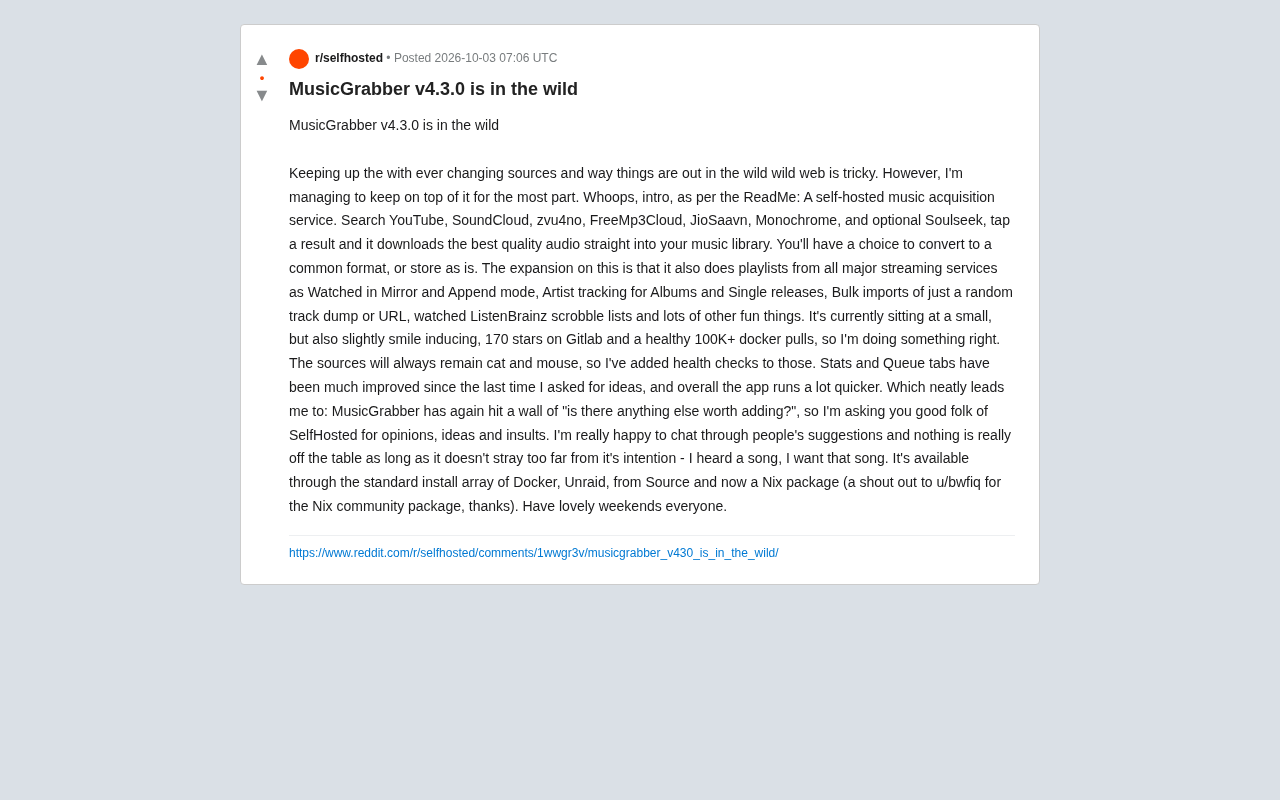
MusicGrabber is an open-source self-hosted music fetching tool. The latest v4.3.0 release supports retrieving audio from YouTube, SoundCloud, and other platforms into a local library. Its core value lies in full library automation: playlist mirror/append sync, artist release tracking, bulk import, and ListenBrainz scrobble integration. New in this version are source health checks, Stats and Queue UI performance improvements, and a community-contributed Nix package. With ~170 GitLab stars and over 100K Docker pulls, it's a solid choice for users who want full control over their music library — though copyright compliance should be considered.
A Self-Hosted Music Fetching Service
In an era of fragmented streaming subscriptions and siloed music libraries, keeping your favorite songs in one place is anything but simple. The open-source project MusicGrabber has just released v4.3.0 — a self-hosted music fetching service whose core philosophy is captured by its author in the simplest of terms: "I hear a song, I want that song."
According to the project README, MusicGrabber supports searching and retrieving audio from multiple sources including YouTube, SoundCloud, zvu4no, FreeMp3Cloud, JioSaavn, and Monochrome, with optional Soulseek integration. Users simply search for a keyword, click a result, and the tool automatically grabs the highest-quality audio file and saves it directly to their local music library. Two processing modes are available at download time: convert to a universal format, or preserve the original source format.
More Than Just Single-Track Downloads
A tool that only fetches individual tracks is nothing remarkable. MusicGrabber's real value lies in the complete suite of features it has built around music library automation.
It supports syncing playlists from major streaming services in two modes — Watched (mirror) and Append — where the former keeps your local library in sync with an online playlist, and the latter only adds new tracks incrementally. The tool also offers artist tracking to monitor new album and single releases from specific artists, bulk import for handling scattered track lists or batches of URLs all at once, and even integration with ListenBrainz scrobble history for automatic sync.
Taken together, these features elevate MusicGrabber from a simple "downloader" to a fully capable personal music library management hub with ongoing automation.
ListenBrainz is an open-source music listening history platform operated by the MetaBrainz Foundation, similar in concept to the once-popular Last.fm — when you listen to music, compatible clients submit play records (scrobbles) to a server, building a personal music history archive. Unlike Last.fm, ListenBrainz is fully open-source, requires no commercial account, and allows free data export. MusicGrabber's integration with the platform means any song you've listened to on a scrobble-compatible player can be automatically synced to your local library — creating a seamless "heard it, own it" loop.
The Cat-and-Mouse Game of Sources
The author candidly notes in the release notes that the availability of music sources is an ongoing cat-and-mouse game — online resource sites and scraping methods are constantly changing. To address this reality, v4.3.0 introduces health checks for each source, helping users quickly determine which sources are still operational.
This is a common pain point for self-hosted scraping tools: they are highly dependent on external sites, and any source going offline can break functionality. Health checks don't solve the underlying problem, but they at least make the situation transparent and reduce the time users spend troubleshooting.
Performance and UI Improvements
Compared to the previous version that was put out for community feedback, this release brings noticeable improvements to the Stats and Queue tabs, along with overall performance gains. For users who need to process large numbers of tracks in bulk, the queue management improvements are especially welcome.
From a community perspective, the project is modest in scale but healthy in adoption: it has accumulated around 170 stars on GitLab, and Docker pulls have surpassed 100,000. For a tool targeting the niche self-hosted audience, that level of adoption suggests it genuinely addresses real user needs.
Flexible Deployment Options
On the installation side, MusicGrabber covers the most common paths for self-hosted users: standard Docker deployment, Unraid Community Applications, building from source, and a newly added Nix package contributed by a community member. This variety of distribution methods lowers the barrier to entry for users with different technical backgrounds.
Nix is a package manager and system configuration framework built around the principle of reproducible builds, used primarily on NixOS and across macOS/Linux environments. Unlike traditional package managers, Nix fully declares and isolates all dependencies for each package, ensuring identical installation results on any machine — eliminating the classic "it works on my machine" problem. For NixOS users or those who manage their development environments with Nix, the community-contributed Nix package means MusicGrabber can be declaratively added with a single configuration entry and version-managed alongside the rest of the system.
What's Next
The author notes that MusicGrabber has once again hit a wall of "what else is worth adding?" and is openly inviting ideas and suggestions from the community. He emphasizes that almost any proposal is on the table, as long as it doesn't stray from the project's original purpose — getting the song you just heard.
This kind of open development attitude is precisely what keeps many great open-source self-hosted projects alive. For users who value ownership of their music library and don't want to rely entirely on subscription-based streaming, MusicGrabber is a compelling option worth watching. That said, users should be mindful of copyright and compliance requirements in their respective regions when using tools that scrape audio from third-party sources.
Related articles

Cursor AI Programming in Practice: Build a Student Management System from Scratch in 30 Minutes
A Bilibili creator demonstrates Cursor AI programming: generating a student management system in 30 minutes with natural language. Details on Agent mode, Claude selection, prompt techniques, and thresholds.

Top 20 AI Coding Tools Ranking: From Rock-Solid to Lackluster, a Scored Matrix
Bilibili creator releases top 20 AI coding tools ranking, tiered T0–T4 from rock-solid to lackluster, with Claude Code and Codex tied at T0. This article details the scoring dimensions (capability, reliability, robustness, durability, cost, domestic availability) and tool performances to help developers choose the right AI coding assistant.

Vibe Coding Systematic Tutorial: Master AI-Assisted Programming from Zero
A three-month Vibe Coding tutorial from a Bilibili creator covering Codex, ClaudeCode, and Cursor, from core logic to commercial project practice for beginners.