Musk Admits Grok Falls Short of Claude: A Confession Nobody Saw Coming (But Everyone Already Knew)

Musk admits Grok can't match Claude — and nobody on Reddit was surprised.
Elon Musk publicly admitted that Grok lags behind Anthropic's Claude, but the Reddit community's reaction was essentially "we already knew that." The discussion revealed a clear model capability hierarchy, with users distinguishing between top-tier models for hard problems and cheaper options for routine tasks. The more interesting debate was about capability vs. trustworthiness — enterprise developers often prefer stable, predictable models over more powerful ones for critical system changes. Data retention compliance can also be an outright dealbreaker. The thread reflects a mature consensus: leaderboard rankings are just the starting point; real selection decisions hinge on task context, cost, reliability, and compliance.
Elon Musk has made the rare public admission that his own Grok is less capable than Anthropic's Claude. The news spread quickly on Reddit — but the community's near-universal reaction was a collective "Well, duh." The discussion reflects both the current realities of the large language model landscape and the increasingly clear-eyed standards users apply when choosing between models.
An Admission That Surprised No One
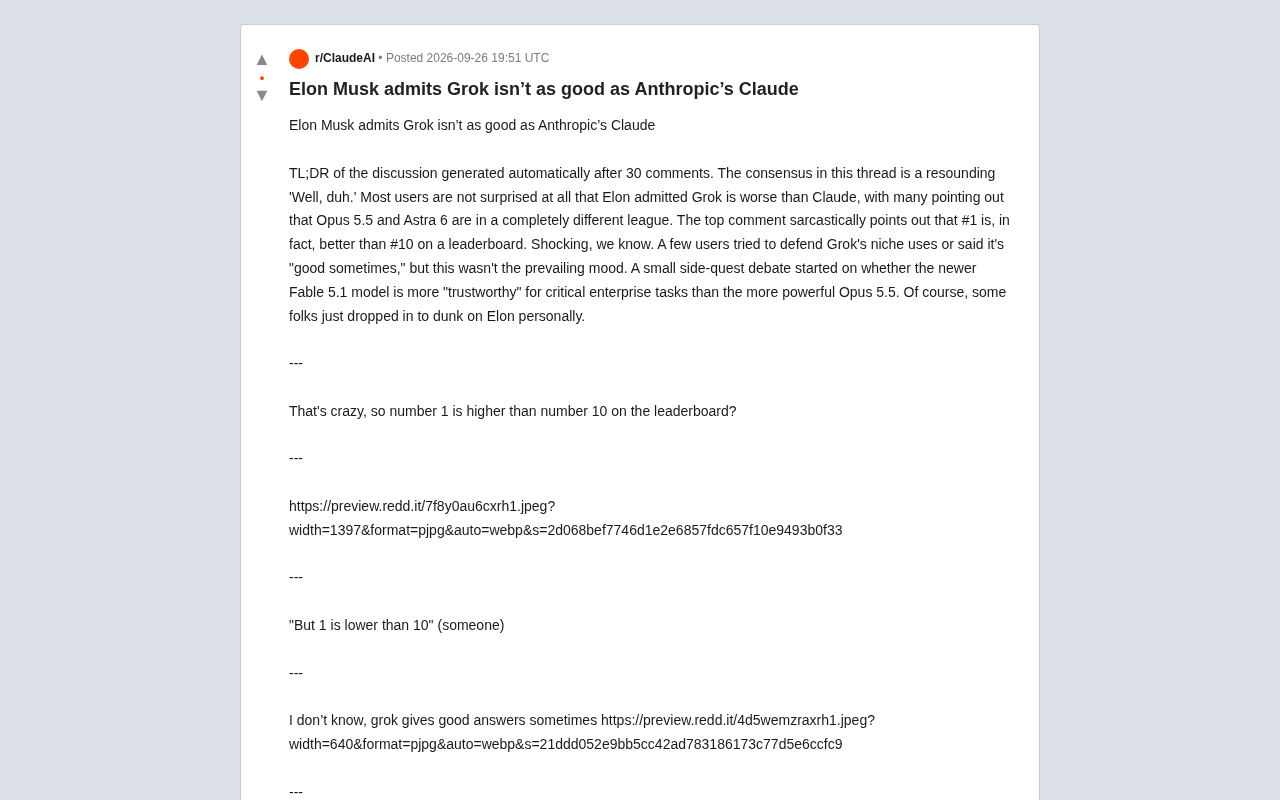
In the Reddit thread, more than 30 comments coalesced around a single, highly consistent verdict: Musk's concession was entirely unsurprising. One top comment captured the absurdity with dry humor — "Crazy, so the model ranked #1 is better than the one ranked #10?"
This lightly sarcastic response points to how clearly the community understands the current model hierarchy. When it comes to tackling hard problems, users generally recognize a distinct capability tier: top-tier models (Opus 5.5 and Astra 6 were mentioned in the thread) sit in the first tier, while Grok gets lumped in with "everything else." As one user put it bluntly: "This isn't much of an admission because of course it's worse."
That said, the verdict wasn't a total write-off of Grok. One user noted that it "sometimes gives decent answers," and that for basic tasks, reaching for a cheaper model is completely reasonable. This reflects a mature mindset: model selection should be driven by task complexity and cost considerations, not a blind pursuit of the single "best" option.
Powerful ≠ Trustworthy: A Different Logic for Enterprise Use Cases
The most valuable tension in the discussion emerged around the distinction between model capability and trustworthiness. A side debate comparing Fable 5.1 with Opus 5.5 surfaced a critical dimension that public leaderboards tend to overlook.
One enterprise developer admitted that while Opus 5.5 can "vibecode an impressive website or app from scratch" — genuinely impressive stuff — in real enterprise environments, when he needs to make a few careful changes to a critical system without expanding the regression testing blast radius, Fable 5.1 is "the more trustworthy partner."
Others echoed the sentiment: "I trust Fable more than any other model right now." The core insight here is that in mission-critical contexts, predictability and stability can matter more than raw capability. A model that produces dazzling output isn't necessarily the one you'd trust to touch the core code of a production system.
That said, trustworthiness isn't the only enterprise threshold. Another user added a dose of cold water: "I can't even use Fable in my enterprise environment because of data retention policy issues." This is a reminder that enterprise model selection is the result of multiple overlapping constraints — capability, trustworthiness, compliance, data security — and no single dimension of leadership is enough to clinch adoption.
"Vibecoding" (sometimes written as vibe coding) is a term popularized in early 2025 by OpenAI co-founder Andrej Karpathy. It refers to a development paradigm where AI-assisted tools let you generate code rapidly through highly natural language input — almost entirely by feel. Developers simply describe their intent and let the model fill in the implementation details, dramatically lowering the barrier to building prototypes from scratch. This approach is remarkably efficient for demos and proof-of-concept work, but because the output is hard to predict and code style can be inconsistent, it introduces additional risk in production environments where you need precise control over the scope of changes — which is exactly the context the enterprise developer in this discussion had in mind when praising Fable 5.1's reliability.
The Real Competition Beyond the Leaderboard
Musk's admission reflects a broader truth: competition among large AI models has entered a more fragmented phase. Public leaderboards offer a rough capability ranking, but real-world usage decisions are far more complex than "who's number one."
From this discussion, we can distill several layers of model selection logic:
- Basic tasks: Cost comes first — cheap and good enough works fine, and models like Grok have a legitimate place here;
- Hard problems: Top-tier capability is non-negotiable, and first-tier models are irreplaceable;
- Critical system changes: Trustworthiness and stability take priority — powerful doesn't mean reliable;
- Enterprise compliance: Hard constraints like data retention and privacy policy can be an instant disqualifier.
As for Musk himself, some users took the opportunity to take shots at him — there's always someone who'll "take a dig at him while they're at it." But setting aside the personal controversies, the admission itself is a healthy signal: in an AI industry awash in marketing hype, publicly acknowledging a gap is, oddly enough, a rare and refreshing thing.
"Data Retention Policy" is a core compliance metric enterprises evaluate when assessing AI services. It refers to how a service provider stores, uses, and deletes user inputs — including prompts and conversation logs — along with how long that data is retained. Many industries (finance, healthcare, law) are subject to regulations like GDPR, HIPAA, and SOC 2, which require vendors to commit to not using data for model training, to support on-demand deletion, and to provide audit logs. If an AI service can't meet an enterprise's industry-specific data residency or privacy compliance requirements, it gets eliminated in the evaluation phase regardless of how high it scores on capability benchmarks. This is precisely why the competitive landscape in the "enterprise AI" market often looks quite different from the consumer market.
Closing Thoughts
What looks like an unremarkable Reddit thread actually captures the current state of rational, mature thinking about AI models. Leaderboard rankings are just a starting point. What truly determines a model's value is its performance in specific contexts — a multi-dimensional negotiation between capability, trustworthiness, cost, and compliance. For developers and enterprises alike, the better question isn't "which model is the strongest?" It's "what does my task actually need?"
Related articles

One Person Producing 90 Episodes of AI Anime Shorts: The Complete Production Workflow in 10 Hours for 10 Yuan
No screenwriting experience needed for AI anime shorts: 10 hours and 10 yuan in costs, 4,200 yuan earnings per work on Hongguo. This article breaks down the complete six-step workflow from AI-generated scripts and storyboard scripts to the finished film, with a universal questioning formula and beginner pitfall guide.
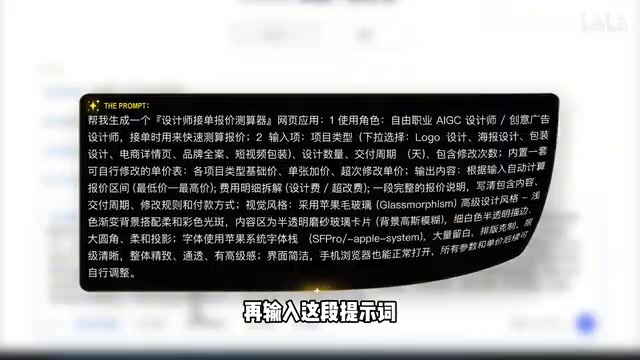
Build a Quote Calculator with Doubao Agent: Stop Guessing Your Freelance Rates
A Bilibili creator uses Doubao Agent to build a no-code quote calculator that auto-generates itemized quotes with rush and copyright buyout rates, one-click copy, and mobile quoting.

WorkBuddy Hands-On Tutorial: 10 Agent Projects from Beginner to Resume-Worthy
WorkBuddy tutorial: a Chinese-language AI work assistant with simpler setup than Codex or Claude Code. 10 hands-on Agent projects for beginners, resume-ready.