Musk and Palmer Luckey Lead 'Project Meridian': America's Controversial Future Weapons Program
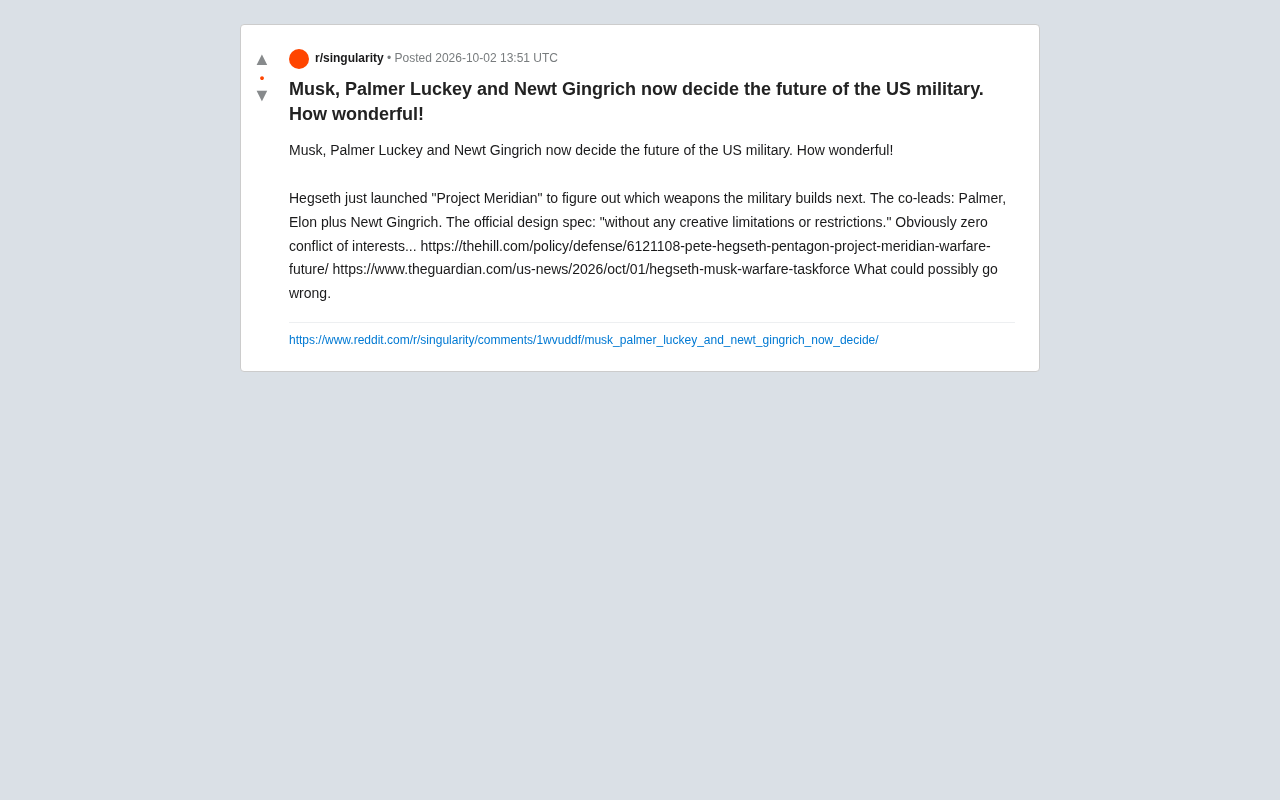
Project Meridian puts Musk and Anduril's founder in charge of US next-gen weapons, raising serious conflict-of-interest alarms.
Defense Secretary Hegseth has launched Project Meridian, tasking Elon Musk, Anduril founder Palmer Luckey, and former House Speaker Newt Gingrich with shaping next-generation US military weapons development—explicitly "without any creative limitations." Critics point out that at least two of the three leaders have direct commercial stakes in defense: Anduril builds autonomous weapons systems, and SpaceX is a core military supplier. This effectively lets potential vendors define procurement needs. The project also highlights a deeper trend of AI and autonomous systems becoming central to future warfare, raising ethical concerns about the erosion of human-in-the-loop principles and algorithmic accountability.
Musk and Palmer Luckey Lead 'Project Meridian': America's Controversial Future Weapons Program
US Defense Secretary Pete Hegseth has recently launched a new initiative called Project Meridian, designed to shape the development direction of the next generation of American military weapons systems. What has truly ignited public outcry, however, is the lineup of the project's three co-leaders — Tesla and SpaceX founder Elon Musk, Anduril founder Palmer Luckey, and former House Speaker Newt Gingrich.
A Weapons Development Project With "No Creative Limitations"
According to reports from The Hill and The Guardian, Project Meridian's official design mandate is explicitly described as operating "without any creative limitations or restrictions." This kind of language is highly unusual in defense procurement — such projects are typically subject to rigorous budget scrutiny, technical specifications, and ethical frameworks.
On the surface, involving innovators from the tech and defense industries in designing the future of warfare seems consistent with the Pentagon's recent trend of "learning from Silicon Valley." The US military has long struggled with lengthy procurement cycles and slow technology iteration, and the legacy defense contractor ecosystem — companies like Lockheed Martin and Raytheon — has faced persistent criticism. Bringing in outside perspectives could, in theory, help break entrenched institutional inertia.
The problem, however, is that the three co-leaders themselves carry obvious conflicts of interest.
The Unavoidable Conflict-of-Interest Problem
This is exactly where communities like Reddit have focused their sharpest criticism. At least two of the three co-leaders have direct commercial ties to the defense industry:
- Palmer Luckey is the founder of Anduril Industries, a defense tech company focused on autonomous weapons systems, drones, and AI-driven military technology — making it a direct competitor for US military procurement contracts.
- Elon Musk's SpaceX is already a core supplier for US military and government space launches, and its Starlink system plays a role in multiple military applications.
In other words, having these individuals decide "what weapons the US military should build next" is roughly equivalent to letting potential suppliers define the procurement requirements. Community reactions were sharply sardonic — "Obviously zero conflict of interests" and "What could possibly go wrong."
This arrangement touches one of the most sensitive fault lines in government procurement: when decision-makers and beneficiaries are largely the same people, the public interest is difficult to protect. Even if the three individuals have no malicious intent, the institutional design itself lacks basic checks and balances.
US federal law includes mechanisms such as Revolving Door Rules and Recusal Requirements designed for exactly these situations. These rules typically require government advisors or officials to recuse themselves from decisions involving their own commercial interests, and restrict lobbying activities for a set number of years afterward. However, when decision-makers participate as informal advisors or project leads rather than in official government roles, these constraints often fall into legal gray areas. There is currently no publicly available information indicating whether Project Meridian's three co-leaders have signed conflict-of-interest disclosure agreements or are formally bound by the Federal Advisory Committee Act (FACA). This institutional gap is precisely what critics mean when they say the project "lacks basic checks and balances."
AI and Autonomous Weapons Are Becoming the Central Battleground
Setting aside the conflicts of interest, Project Meridian reflects a deeper trend: AI and autonomous systems are becoming the core of future warfare.
Palmer Luckey's Anduril is fundamentally an AI defense company. Its flagship Lattice platform relies on machine learning for target identification and battlefield situational awareness. Musk, meanwhile, has multiple AI ventures including xAI and Tesla's autonomous driving program. Placing these two figures at the center of US weapons development decision-making strongly suggests that the next generation of armaments will be deeply tied to AI-driven autonomous combat systems.
The implications extend far beyond commercial competition. The ethical boundaries of autonomous weapons, the accountability of algorithmic decision-making, and whether the human-in-the-loop principle will be eroded by a mandate of "no creative limitations" — all of these are directions that warrant serious concern. When weapons development is freed from constraints, technological optimism risks overriding necessary safety and ethical considerations.
The Human-in-the-Loop Principle is a central point of contention in international discussions about autonomous weapons. It requires that before a weapons system makes a "lethal decision" — such as firing or striking a target — a human operator must intervene and confirm the action, preventing irreversible consequences from algorithmic errors or system failures. The opposite approach is Human-out-of-the-Loop full autonomy, where a machine independently completes the entire sequence from target identification to attack without any human intervention.
Anduril's Lattice platform is currently positioned as a middle-ground Human-on-the-Loop solution — the system autonomously handles most sensing and decision-making, while humans retain veto authority only at the level of high-level commands. Critics point out that as battlefield tempo accelerates and decision windows compress to seconds, this nominal "human oversight" may become little more than a formality. The phrase "without any creative limitations" is precisely what makes scholars who study autonomous weapons ethics uneasy — it implies that even this baseline principle could be placed on the negotiating table.
The Dilemma Between Technical Efficiency and Institutional Checks
Supporters might argue that bureaucratic inefficiency is the US military's real enemy, and that empowering people who truly understand technology and dare to innovate is the only way to maintain superiority. This logic has some merit — the past few decades are filled with examples of major military procurement projects running massively over budget and behind schedule.
But efficiency cannot come at the cost of accountability. Military procurement involves enormous public funds and national security, and transparency, competitive bidding, and conflict-of-interest recusal are basic requirements of modern governance. Subordinating these principles to the pursuit of "innovation speed" may yield short-term results while planting systemic risks in the long run.
Based on currently available information, Project Meridian looks more like an experiment in embedding private tech power into national military decision-making. Its trajectory matters not only for the future of the US military arsenal, but also for where the boundary between tech elites and state power should ultimately be drawn.
Conclusion
The widespread mockery this story has generated on social platforms reflects genuine public anxiety about the excessive concentration of power and capital. When the authority to determine a nation's military future is placed in the hands of a few people who are simultaneously referees and players, even the most inspiring "vision of innovation" is bound to raise serious doubts. Whether this experiment ultimately enhances US military technological capabilities or devolves into a vehicle for funneling benefits to insiders remains to be seen.
Related articles

Cursor AI Programming in Practice: Build a Student Management System from Scratch in 30 Minutes
A Bilibili creator demonstrates Cursor AI programming: generating a student management system in 30 minutes with natural language. Details on Agent mode, Claude selection, prompt techniques, and thresholds.

Top 20 AI Coding Tools Ranking: From Rock-Solid to Lackluster, a Scored Matrix
Bilibili creator releases top 20 AI coding tools ranking, tiered T0–T4 from rock-solid to lackluster, with Claude Code and Codex tied at T0. This article details the scoring dimensions (capability, reliability, robustness, durability, cost, domestic availability) and tool performances to help developers choose the right AI coding assistant.

Vibe Coding Systematic Tutorial: Master AI-Assisted Programming from Zero
A three-month Vibe Coding tutorial from a Bilibili creator covering Codex, ClaudeCode, and Cursor, from core logic to commercial project practice for beginners.