Musk Pledges Not to Cut Off Anthropic: The Trust Game in AI Cloud Infrastructure
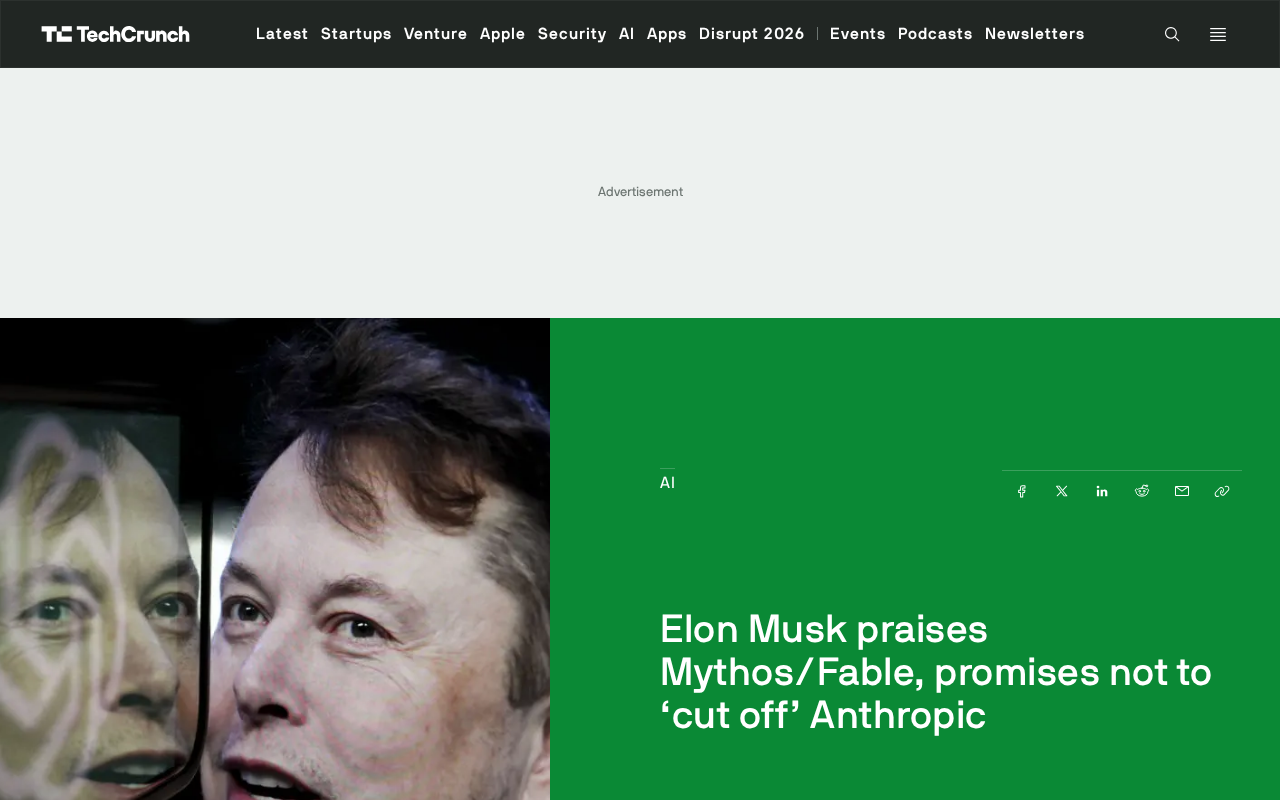
Musk pledges not to cut off Anthropic's infrastructure access, exposing AI's deepest trust dilemma.
Elon Musk's public promise not to cut off competitor Anthropic from xAI-related infrastructure has spotlighted a structural tension in the AI industry: when a compute provider is also a direct competitor, commercial trust becomes a quantifiable risk. With roughly $40 billion in commercial interests at stake, the episode reveals how power asymmetry, coopetition dynamics, and the lack of enforceable SLAs are reshaping how AI companies think about infrastructure dependency and strategic resilience.
A Trust Game in AI Cloud Services
Elon Musk, founder of Tesla and xAI, recently praised the Mythos/Fable project and made a notable public pledge: he would not "cut off" competitor Anthropic's access to the related infrastructure.
Background on Mythos/Fable: Mythos/Fable is an AI-driven interactive storytelling and gaming project that uses large language models to build dynamic story generation and role-playing experiences. It represents a typical application of AIGC (AI Generated Content) technology in a vertical domain — combining LLMs' contextual understanding with structured narrative frameworks to create "infinitely branching" interactive story experiences, a space that has attracted significant venture capital in recent years. Musk's public praise of the project quickly drew industry attention. Notably, the project's infrastructure has ties to xAI — the AI research company Musk founded in 2023, which develops the Grok series of large models and is actively building its own compute cluster, "Colossus." The Colossus project plans to deploy over 100,000 H100 GPUs, with the goal of becoming one of the world's largest AI training clusters. From a technical standpoint, the H100 GPU uses NVIDIA's Hopper architecture, with a peak compute performance of 3,958 TFLOPS (FP16 precision), optimized for large-scale Transformer model training — making it the most sought-after computing asset in the current AI arms race. This compute ambition is precisely what gives xAI the capability to serve simultaneously as an AI infrastructure provider, drawing close attention from competitors like Anthropic.
This statement involves roughly $40 billion in commercial interests and brings a sharper-than-ever question to the forefront of the AI industry: Can competitors truly build trust around cloud computing — a critical shared resource?
Musk's message was straightforward: Anthropic can feel safe hosting its models on the relevant platform. But the crux of the issue isn't the promise itself — it's whether you'd really hand over your lifeline to a company that simultaneously acts as your competitor and your infrastructure provider.
The Compute Dependency Behind $40 Billion
The revenue scale involved in this situation is approximately $40 billion — a figure that vividly illustrates the central role of cloud infrastructure in modern AI company operations. For large model companies like Anthropic, both model training and inference deployment are heavily dependent on large-scale GPU clusters and a stable supply of compute.
Background on Anthropic: Anthropic was founded in 2021 by Dario Amodei, former VP of Research at OpenAI, along with his sister Daniela Amodei and others. Headquartered in San Francisco, the company focuses on AI safety as its core research direction and has developed the Claude series of large models, introducing alignment techniques such as "Constitutional AI." Constitutional AI is an alignment technique that constrains model behavior through a predefined set of principles (the "constitution"), with the core idea of having models internalize norms through self-critique and revision rather than relying purely on human-annotated feedback — an approach considered more scalable than traditional RLHF (Reinforcement Learning from Human Feedback). Anthropic has received billions in investment from tech giants including Google and Amazon, with Amazon committing up to $4 billion and designating AWS as Anthropic's primary cloud infrastructure partner. Commercially, Anthropic competes directly with OpenAI, Google DeepMind, and xAI, with its Claude models holding significant share in the enterprise AI assistant market.
In the current AI arms race, compute is a lifeline. Any AI company that faces a compute "cutoff" at a critical moment would suffer devastating consequences to its business. This is precisely why Musk felt the need to make a public statement about "not cutting off" access — the concern is real, and it directly affects potential customers' willingness to sign on.
The Delicate Territory Between Competition and Cooperation
Anthropic, the developer of the Claude series, is a direct competitor to both OpenAI and xAI. Against this backdrop, Anthropic considering the use of infrastructure tied to xAI is itself a thought-provoking commercial choice.
This model of "coopetition" is not unfamiliar in the tech industry. The concept of "coopetition" was systematically introduced by Yale economists Barry Nalebuff and Adam Brandenburger in their 1996 book of the same name, describing the complex relationship where companies both compete and cooperate across different market dimensions. Before Apple developed its own chips, it long relied on Samsung and TSMC for manufacturing — while Samsung was a fierce rival in the smartphone market; Samsung manufactured Apple's A-series chips while its Galaxy lineup competed directly with the iPhone; Microsoft and Sony compete fiercely in the gaming console market while cooperating in cloud services and media content. Amazon AWS similarly provides cloud services to countless companies that compete directly with its retail business.
However, coopetition in the AI era has a structural characteristic rarely seen in traditional industries: the extreme sensitivity of data and model weights. In semiconductor foundry scenarios, when Samsung manufactures chips for Apple, what they share is manufacturing process, not product design specifications. But in AI infrastructure scenarios, if Anthropic were to deploy Claude models on an xAI-related compute platform, it would mean competitors potentially have technical access to core model weights — a risk dimension that far exceeds the boundaries of traditional coopetition frameworks. In the AI era, coopetition becomes even more complex due to the high concentration of compute resources — the number of companies capable of providing large-scale compute is extremely limited, forcing competitors to seek cooperation at certain junctures, giving rise to a new commercial game marked by power asymmetry and high trust costs. The core logic is whether commercial interests can outweigh competitive concerns, and how that balance tips.
Why Trust Has Become the Central Issue
Musk is known for his mercurial style and aggressive decision-making. From his sweeping overhaul of Twitter (now X) after its acquisition to his forceful interventions across multiple domains, the market has long maintained a cautious view of his "promise credibility."
So when Musk says he "won't cut off Anthropic," what Anthropic and its potential partners need to evaluate goes far beyond the current commercial terms — it extends to the many variables that could emerge in the future:
- Whether contractual protections are sufficient: There is a fundamental gap between a verbal statement and a legally binding Service Level Agreement (SLA). A Service Level Agreement (SLA) is a legally binding contract between a cloud service provider and a customer that clearly defines core terms including service availability, performance metrics, incident response times, and breach compensation mechanisms. In the cloud computing industry, SLAs typically promise service availability ranging from 99.9% to 99.999% (the "nines" standard), corresponding to maximum annual downtime ranging from 8.76 hours to approximately 5.26 minutes. It's worth noting that mature cloud service SLAs also include constraint mechanisms for "service termination" clauses — typically requiring providers to give customers months or even years of transition time before terminating service and to assist with data migration. If xAI and Anthropic sign a standard commercial cloud service agreement, the presence of such protective clauses would significantly reduce the risk of a "cutoff"; conversely, if the cooperation remains at the level of verbal commitments, the legal protection is essentially nonexistent. Public verbal promises carry virtually no legal enforceability — and this is one of the core reasons the industry remains cautious about Musk's statements.
- Risk when competition intensifies: If competition between xAI and Anthropic heats up further, can commercial rationality still suppress the impulse to "cut off" access?
- Security boundaries for data and models: Does hosting core models on infrastructure accessible to a competitor carry hidden risks of technical leakage or reverse engineering? At a technical level, model weights are essentially readable numerical matrices; if they run on hardware controlled by another party, they are theoretically susceptible to being copied or analyzed — though the practical barriers in both legal and engineering terms are substantial. Nevertheless, this concern has never truly dissipated in the fiercely competitive AI industry.
Deeper Implications for the AI Infrastructure Landscape
This episode reflects a deep structural contradiction in the AI industry: the high concentration of compute resources is creating new forms of dependency and power imbalance.
As the cost of large model training continues to rise, the number of players capable of providing compute at scale is shrinking, dramatically narrowing AI companies' options in infrastructure selection. When a supplier is simultaneously a competitor, "trust" transforms from a soft concept into a hard commercial risk that must be quantified and managed. From a macro industry perspective, this situation bears a strong resemblance to the "railroad monopoly" dilemma of the late 19th and early 20th centuries: when critical infrastructure is controlled by a handful of interested parties, competitive market order requires external forces — whether regulatory intervention or technological alternatives — to maintain it. The current high concentration of the AI compute market has already begun to draw the attention of the U.S. Federal Trade Commission (FTC) and EU competition regulators, and the direction of future regulation may profoundly reshape this landscape.
Multi-Cloud Strategy: The Fundamental Path to Breaking Dependency
For companies like Anthropic, avoiding lock-in to a single vendor and building a diversified compute supply may be the fundamental solution to the trust dilemma. A Multi-Cloud Strategy refers to enterprises simultaneously using computing resources from multiple cloud service providers to avoid over-dependence on any single vendor. In the AI domain, the value of this strategy is particularly prominent: the compute demands of large model training and inference are enormous and continuous — if a core provider experiences service disruption, price hikes, or a competitive "cutoff," the consequences for the enterprise can be catastrophic.
However, implementing a multi-cloud strategy in AI scenarios is far more difficult than in traditional enterprise IT. Large model training is highly dependent on high-speed intra-cluster interconnects (such as NVLink or InfiniBand); cross-cloud migration means needing to re-optimize the communication topology for distributed training. Deploying inference services across clouds faces challenges of latency inconsistency and increased load balancing complexity. Additionally, different cloud platforms vary in their underlying optimization for mainstream deep learning frameworks (PyTorch, JAX, etc.), which can affect model performance. These technical frictions make the actual cost of implementing a multi-cloud strategy far higher than it appears on paper. Currently, mainstream AI companies broadly adopt a "multi-cloud" approach: OpenAI relies on Microsoft Azure while maintaining its own infrastructure; Google DeepMind uses internal TPU clusters; Anthropic is deeply integrated with AWS while maintaining deployment capability on Google Cloud. This distributed approach improves resilience but also introduces higher system integration complexity and operational costs, testing AI companies' comprehensive architectural management capabilities. Distributing deployments to hedge concentration risk is the prevailing industry consensus.
Viewed from a broader perspective, Musk's pledge — whether ultimately honored or not — clearly reveals a new normal as the AI industry enters deeper waters: competition in technical capabilities is extending into a contest for control over underlying resources. Whoever controls compute holds greater leverage at the negotiating table.
Conclusion
Musk's praise of Mythos/Fable and his pledge not to "cut off" Anthropic may look on the surface like a public gesture of commercial goodwill, but in substance it is a microcosm of the trust game playing out across the AI industry. Under the dual pressures of enormous commercial stakes and fierce competition, whether Anthropic will ultimately choose to trust Musk remains an open question.
For the industry as a whole, this episode is more like a mirror: as the AI race heats up, beyond technical strength, the establishment of commercial trust, the contest for control over infrastructure, and systemic risk management are quietly becoming the invisible battlegrounds that determine corporate fate. Those companies that can find the balance between "dependence" and "autonomy," and build quantifiable trust mechanisms within coopetitive relationships, may well occupy a more advantageous position in the next phase of the AI industry landscape.
Related articles
What Is Vibe Coding? The AI Programming Skill Every Developer Needs
What is Vibe Coding? Learn how AI programming is reshaping dev teams, why traditional programmers face displacement, and why Cursor & Claude Code matter.
Making Rocks Think: A Philosophical Exploration of Generative AI and Information Compression
From a viral Reddit post to deep AI theory: why compression equals understanding, the Library of Babel thought experiment, semantic compression, and the Hutter Prize.
Irregular Warns: Four AI Lab Security Breaches Traced to the Same Root Cause
Irregular reveals four AI lab security breaches share a single root cause, exposing systemic risks from technology stack homogeneity across the AI industry.