Musk's "Human-Machine Merger" Comments Spark Controversy: Is Becoming a Cyborg Humanity's Only Way Out?

Musk says humans must merge with machines to avoid AI extinction; Reddit uses the Borg metaphor to question the logic.
Musk has reignited controversy with the extreme claim that humans will be eliminated by AI unless they merge with machines. Reddit users satirize the logic with the Borg assimilation metaphor from Star Trek, questioning whether "voluntary fusion" is truly voluntary when refusal means elimination. The article examines the gap between current brain-computer interface technology and the sci-fi vision of consciousness fusion, and how conservative silence reveals tensions within the tech right over bodily autonomy and deregulation.
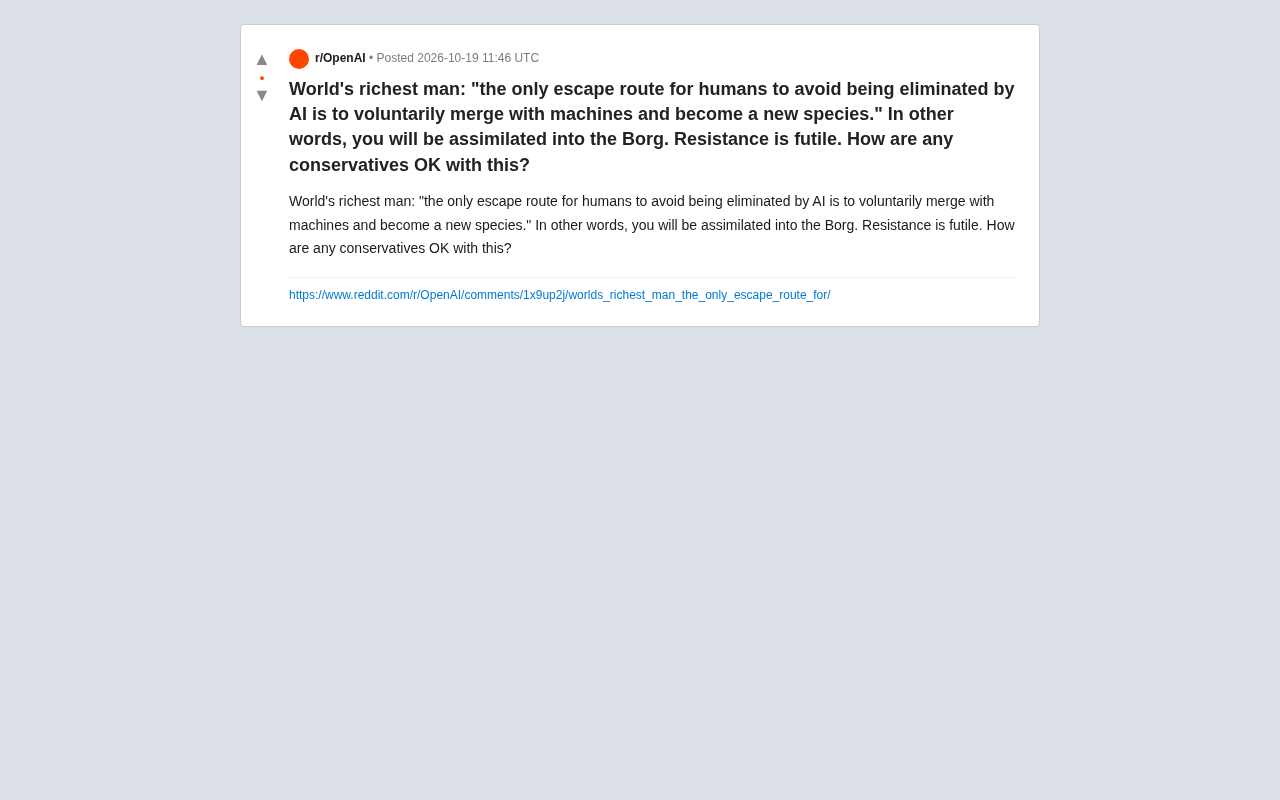
Musk has once again made a startling claim: if humanity wants to avoid being wiped out by AI, the only way out is to voluntarily merge with machines and evolve into a new species. These remarks have ignited fierce discussion on Reddit—some compared it to the Borg assimilation in Star Trek, asking, "How can conservatives accept this?"
The Core Claim: Merge or Be Eliminated
Musk's logic is straightforward: AI is developing far faster than the pace of human biological evolution, and if humans insist on maintaining a purely biological form, they will inevitably be at a disadvantage in the intelligence race. The "escape route" he offers is—voluntarily combining with machines to become a new human-machine hybrid species.
This is not the first time this view has appeared. For years, Musk has advanced brain-computer interface technology through Neuralink, and its underlying narrative has always revolved around "humans need to keep up with AI." But this time the formulation is more extreme: not "enhancing capabilities," but the only option to "avoid being eliminated."
The Reddit post's title uses a precise sci-fi reference—the Borg. In Star Trek, this species "elevates" other civilizations through assimilation, and their classic line is exactly "Resistance is futile." The poster is clearly being sarcastic: the "voluntary fusion" Musk describes is, in the eyes of critics, essentially no different from forced assimilation.
Neuralink is a neurotechnology company founded by Musk in 2016, with the core goal of developing implantable brain-computer interfaces (BCIs). Its device implants flexible electrode threads into the cerebral cortex to record neuronal electrical signals, and is currently mainly aimed at paralyzed patients, helping them control external devices through thought. In 2024, Neuralink completed its first human implant, and the subject was able to play video games and operate a computer cursor with his mind. However, from restoring movement or communication functions to achieving "the fusion of human consciousness with AI," there remains a huge gap involving a fundamental understanding of the brain's encoding mechanisms, long-term biocompatibility, information security, and neuroethics. Musk's narrative compresses this long and uncertain scientific research process into an urgent option of "survival necessity," blurring the essential difference between early medical applications and the ultimate sci-fi vision.
The Focus of Controversy: Voluntary or Destiny?
The sharpness of the post lies in raising a political spectrum question: conservative groups have always emphasized individual freedom, bodily autonomy, and traditional human values—so why would they tolerate or even support this narrative that "humanity must transform itself"?
According to various views in the Reddit discussion, there are several layers of tension here. On the one hand, Musk himself has become a tech standard-bearer for part of the conservative camp, and his remarks are easily given a "pragmatic" interpretation; on the other hand, the wording "voluntary fusion" itself plants the seeds of controversy—if this really is the only way out, how much real choice does "voluntary" leave?
Critics' analogy is not baseless. When a technology is described as a "survival necessity," the cost of individual refusal is elimination, and "voluntary" under this structure is closer to coercion. The reason the Borg metaphor hits the mark is precisely that it reveals the internal contradiction of this logic.
The Borg are a classic villain species in the Star Trek franchise, first appearing in The Next Generation. They assimilate other intelligent life forms through nanoprobes, connecting the assimilated to a "hive mind," erasing individuality, and declaring that "resistance is futile." Borg assimilation is often depicted as forced and irreversible, stripping away free will in the name of "elevation." This image has become synonymous in sci-fi culture with technological totalitarianism and the demise of the individual. By comparing Musk's "voluntary fusion" to Borg assimilation, the poster intends to reveal that when a transformation is defined as the sole prerequisite for survival, the apparent "voluntariness" may conceal structural coercion—the fate of those who refuse is elimination, which is no different from the Borg's "assimilate or perish" logic.
The Distance Between Technological Reality and Narrative
What deserves calm consideration is that Musk's statement mixes technical judgment with value claims. The current capability boundaries of brain-computer interfaces are very clear: devices such as Neuralink are still at the stage of helping specific patients restore functions, and there is an order-of-magnitude gap between them and the sci-fi vision of "the fusion of human consciousness with AI."
Using "AI may destroy humanity" as a premise and then deriving the conclusion "we must merge"—this chain of reasoning itself skips a large number of intermediate variables—AI governance, safety research, and regulatory frameworks are all more realistic paths for discussion. Directing survival anxiety straight toward bodily modification looks more like a narrative strategy than a rigorous technical roadmap.
According to the original Reddit post and comments, many users' core dissatisfaction is not with brain-computer interface technology itself, but with this "no way back" framing. Technology can be discussed, but when it is packaged as humanity's only survival option, questioning becomes a reasonable response.
AI governance and safety research is another mainstream path for addressing the potential risks of artificial intelligence, forming a contrast with Musk-style "bodily modification" narratives. This field covers technical alignment (ensuring AI goals are consistent with human values), interpretability, robustness, and international regulatory frameworks (such as the EU AI Act). Researchers generally believe that the key to reducing AI risk lies in design, auditing, and institutional constraints, rather than requiring humans to change their biological form. Directing survival anxiety straight toward brain-computer interface fusion skips real issues such as how to govern AI developers, how to establish global safety standards, and how to distribute the benefits of technology. In other words, Musk's inference simplifies a complex systemic problem into an individual-level "evolutionary choice," avoiding the institutional building that truly requires collective action.
Conservative Silence and Division
Returning to the original question of the post: why has there been no large-scale backlash from conservatives? From the discussion, it can be seen that this is not simply "acceptance," but rather the complexity of political coalitions at work. Supporting deregulation of the tech industry and opposing excessive AI regulation, on the one hand, and being wary of bodily modification and defending human ontology, on the other, create friction within the same camp.
Some choose to downplay the extremism of Musk's remarks, viewing them as "exaggerated expressions that promote technological progress"; others do feel uneasy but are unwilling to politically break with the tech right. This silence does not equal agreement; it is more an unresolved internal tension.
Musk's "merge or die" rhetoric essentially compresses an open question of technology governance into a binary survival choice. The reason the Borg metaphor resonates on Reddit is precisely that it reminds people: when "resistance is futile" becomes the default premise, what truly needs to be examined is not whether humanity should transform itself, but who is setting this premise.
The tech right is a loose coalition that has emerged in recent American politics, combining traditional conservatism's advocacy for deregulation, tax cuts, and industrial innovation with support for tech giants (especially Musk's companies). This group is opposed to progressives on issues such as AI regulation, cryptocurrency, and space commercialization. However, the tech right has not reached consensus on issues such as bodily autonomy, bioethics, and human ontology. Some religious conservatives and bioethics conservatives strongly question human modification, while tech optimists tend to view Musk's extreme remarks as "rhetorical exaggeration." This friction in positions makes it difficult for the group to form a unified response to the "human-machine fusion" narrative; the silence reflects a conflict of value priorities within the coalition, rather than genuine agreement with Musk's views.
One-line Summary
Musk says humans must merge with machines to avoid being wiped out by AI; Reddit questions his logic with a Borg metaphor.
Paragraph Summary
Musk has once again proposed the extreme view that "humans will be eliminated by AI unless they merge," and Reddit users have mocked his logic with a metaphor of Borg assimilation from Star Trek. The article analyzes the core of the controversy: when "voluntary fusion" is described as the only way out, the cost of refusal casts doubt on voluntariness, bringing it closer to structural coercion. At the same time, there is a huge gap between the current state of brain-computer interface technology and the vision of "consciousness fusion," and the argument is more of a narrative strategy than a technical roadmap. Conservative silence exposes the tension within the tech right coalition between bodily autonomy and deregulation. The article ultimately points out that what truly needs to be examined is not whether humanity should transform itself, but who is setting the default premise that "resistance is futile."
Related articles

AI Digital Twin in Action: Using DOT to Automatically Track Bugs and User Feedback
DOTS engineers demonstrate how AI digital twin DOT collects cross-platform user feedback, categorizes issue themes, opens threads to investigate bug root causes, and submits PRs—showcasing a complete AI agent workflow for defect triage with auditable design.

Why Transistors Are No Longer Flat: The Evolution from Planar to Gate-All-Around
Transistor evolution from planar to FinFET to gate-all-around: why gates went from three-sided to four-sided wrapping to suppress short-channel effects and leakage current, extending Moore's Law.

Swarm Intelligence = a Single RL Agent? A Proof of Multi-Armed Bandit Equivalence
A paper proves that collective decision-making through local imitation in swarms is mathematically equivalent to single-agent reinforcement learning: N blind imitators act as N parallel environment samples, with an effective learning rate of 1/N. This article explains the derivation and implications of the Maynard-Cross Learning algorithm.